
Workforce diversity in construction means having crews and offices that reflect a range of race and ethnicity, gender, age, disability status, veteran background, language, and cognitive or experiential perspective. It is not a compliance checkbox. According to the U.S. Bureau of Labor Statistics, construction remains one of the least demographically representative industries in the country, and that gap has direct consequences for labor supply, safety outcomes, and project performance. McKinsey & Company’s research consistently links diverse leadership teams to stronger financial results. Debecorp’s CHERP and SiteComm platforms were built with this operational reality in mind, giving crews tools that work for everyone on the jobsite.
A few facts that frame the urgency:
- Hispanic workers now make up roughly 32% of the U.S. construction workforce, up from about 23.6% in 2010.
- Women remain a small fraction of onsite craft roles, well below their share of the national workforce.
- The industry faces a persistent skilled-labor shortage that no single demographic group can fill alone.
Stat to know: By 2023, a substantial number of Hispanic construction workers were employed in the U.S., representing a notable share of the industry, significantly higher than their share in the overall U.S. economy.
Table of Contents
- What types of diversity actually matter on a construction jobsite?
- Where does the U.S. construction workforce actually stand today?
- Why does workforce diversity give construction firms a competitive edge?
- What barriers keep construction workforces from becoming more diverse?
- How do you actually recruit, retain, and advance diverse talent in construction?
- How do you measure whether your DEI efforts are actually working?
- How can field operations technology support inclusion on the jobsite?
- What trends will shape DEI in U.S. construction over the next few years?
- Key Takeaways
- The part of this conversation that usually gets skipped
- How Debecorp helps make inclusion practical on the jobsite
- Further reading and authoritative sources
What types of diversity actually matter on a construction jobsite?
Construction firms often default to tracking race and gender, which is a start. The fuller picture includes eight dimensions that show up differently depending on whether someone is swinging a hammer or managing a project schedule.
Race and ethnicity is the most tracked dimension and the one with the most available benchmark data. Gender matters across all roles but presents differently: women are underrepresented in craft trades at a much steeper rate than in project management or estimating. Age is increasingly urgent given the industry’s aging craft workforce. Disability status affects accommodation needs, PPE selection, and task assignment. Veteran status brings structured discipline and transferable skills that construction firms routinely undervalue. Language shapes safety communication, daily briefings, and reporting. Education and skill background determines what on-ramps (apprenticeships, pre-apprenticeships) someone needs. Cognitive and experiential diversity is the least-tracked but arguably the most operationally valuable: a foreperson who came up through drywall sees a coordination problem differently than one who came up through electrical.
Consider a single role: a foreperson managing a mixed crew on a commercial build. She benefits from racial and linguistic diversity among her crew because it broadens the problem-solving approaches available when a schedule conflict hits. She benefits from age diversity because a 55-year-old journeyman and a 24-year-old apprentice bring different risk instincts. She benefits from cognitive diversity because someone who trained in a different trade will spot a sequencing issue she has seen so many times she stopped noticing it.
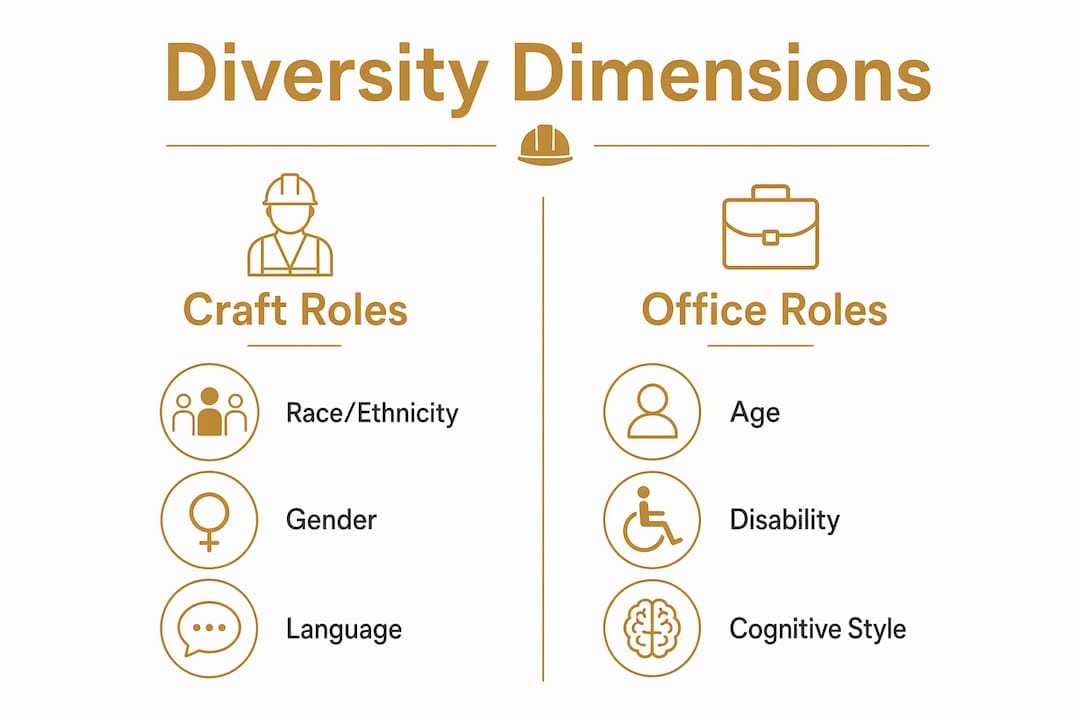
Pro Tip: Track diversity dimensions separately for craft roles and office/management roles. Aggregating them masks where your real gaps are and makes it harder to design targeted interventions.
Where does the U.S. construction workforce actually stand today?
The demographic picture of U.S. construction has shifted meaningfully over the past decade, though representation gaps remain wide in several categories.
| Group | Share of Construction Workforce | Notes |
|---|---|---|
| Non-Hispanic White | — | Majority share; declining gradually |
| Hispanic | ~32% | Up from ~23.6% in 2010; fastest-growing segment |
| Black or African American | ~6% | Underrepresented relative to national share |
| Asian | ~2% | Underrepresented; higher in engineering/PM roles |
- Women are present in construction roles, primarily in office positions, but constitute a smaller portion of the craft workforce.
Sources: NAHB analysis of ACS/BLS data; BLS Current Population Survey.
The Hispanic share of construction is nearly double that group’s share of the broader U.S. economy, reflecting decades of workforce entry through craft trades and apprenticeship pipelines. That concentration in craft roles, however, has not translated into proportional representation at the foreman, superintendent, or executive level.
Stat to know: Women hold roughly 11% of all construction jobs but are concentrated in administrative and project management roles. Their share of onsite craft positions is significantly lower, according to U.S. Department of Labor analysis.
The craft-versus-office split matters for strategy. Firms that measure diversity only at the company level can look reasonably balanced while their jobsites remain almost entirely homogeneous. Separating the numbers by role type gives a more honest baseline.
Why does workforce diversity give construction firms a competitive edge?
The business case for diversity in construction is not theoretical. It runs through five concrete operational areas.
- Recruitment and retention. A labor shortage that has persisted for years means firms cannot afford to recruit from a narrow slice of the available workforce. Inclusive cultures also reduce turnover: the AGC’s research found that 65% of workers who feel excluded would leave their employer, a turnover cost no contractor can absorb indefinitely.
- Innovation and problem-solving. Research from Wharton shows that diverse groups prepare more thoroughly and generate higher-quality decisions on complex tasks, even when the process initially feels less comfortable. Construction is full of complex, non-repeating problems.
- Safety outcomes. Workers who feel excluded are more likely to have accidents, according to AGC reporting. Inclusive cultures where workers can speak up, report hazards, and get properly fitting PPE produce measurably safer jobsites.
- Market access. Public-sector clients and large general contractors increasingly require workforce diversity metrics from subcontractors. Firms that can document their numbers win more bids.
- Financial performance. McKinsey’s analysis across industries shows that companies with more diverse management teams are more likely to outperform financial peers. The link is strongest on complex, innovation-dependent work — exactly the kind of work that defines large construction projects.
The diversity-performance connection is not automatic. It is strongest when firms pair representation with inclusion: structured communication, equitable task assignment, and leadership that actively models the culture.
What barriers keep construction workforces from becoming more diverse?
The obstacles are real and specific to how construction operates. Knowing them is the first step to getting around them.
- Unconscious bias in hiring. Referral-based recruiting is the norm in construction, which means existing networks reproduce themselves. If your current crew is 90% one demographic, your referral pipeline will be too.
- Apprenticeship and credential bottlenecks. Entry into many trades still runs through union halls and joint apprenticeship committees that have historically served narrow networks. Academic research points to the need to integrate DEI into training curricula and employer-academic partnerships to widen the pipeline.
- Workplace culture and “fit” expectations. Informal hazing, exclusionary humor, and unwritten norms about how a “real” tradesperson behaves push out workers who do not match the historical profile.
- Pay transparency gaps. When pay decisions are informal and undocumented, bias compounds over time. Workers from underrepresented groups often cannot tell whether they are being paid fairly.
- Lack of mentorship and sponsorship. Getting hired is one hurdle. Getting promoted to foreman or superintendent requires someone in leadership actively advocating for you. That sponsorship is rare for workers outside the dominant group.
- PPE fit issues. Standard-issue hard hats, harnesses, and gloves are sized for the average male body. Workers who do not fit that profile face real safety risks and daily discomfort that accelerates attrition. A 2024 federal rule updated OSHA’s PPE standards in construction to address fit requirements more explicitly.
- Language and communication barriers. Safety briefings, daily logs, and incident reports in English only exclude a significant share of the craft workforce.
The craft-versus-office distinction matters here too. Office staff face career-pathing and sponsorship barriers. Craft workers face physical, linguistic, and cultural barriers that are more immediate and harder to address without operational changes.
Pro Tip: PPE fit is one of the fastest, cheapest inclusion fixes available. Audit your current PPE inventory for size range and add a simple request process. Workers who feel physically safe and comfortable stay longer.
How do you actually recruit, retain, and advance diverse talent in construction?
Strategy without sequence is just a list. Here is a prioritized order that reflects where most firms get the most traction fastest.
- Diversify your recruiting pipelines first. Partner with community colleges, HBCUs, pre-apprenticeship programs, and community organizations that serve underrepresented groups. Post jobs in Spanish and other languages spoken by your local workforce. Referral bonuses are fine, but they cannot be your only pipeline.
- Build paid on-ramps. Pre-apprenticeship and registered apprenticeship programs are the most proven entry point for workers who lack credentials but have aptitude. Fund them or partner with programs that do.
- Standardize your interview and selection process. Structured interviews with consistent questions and a defined scoring rubric reduce the influence of personal affinity. Add a second reviewer to hiring decisions.
- Launch mentorship and sponsorship programs. Mentorship gives new hires guidance. Sponsorship gives them visibility with decision-makers. Both are needed. Pairing a new hire with a senior tradesperson from a similar background, where possible, accelerates retention.
- Publish pay and promotion criteria. Workers who can see the path to foreman or project manager are more likely to stay and pursue it. Opacity breeds suspicion and attrition.
- Adjust scheduling where operationally possible. Rigid 6 AM starts and mandatory Saturday work exclude caregivers disproportionately. Some flexibility, even on a project-by-project basis, widens the pool of workers who can stay.
- Fix PPE and safety reporting. Procure PPE in a full size range. Create a reporting channel for safety concerns that does not require workers to confront their direct supervisor.
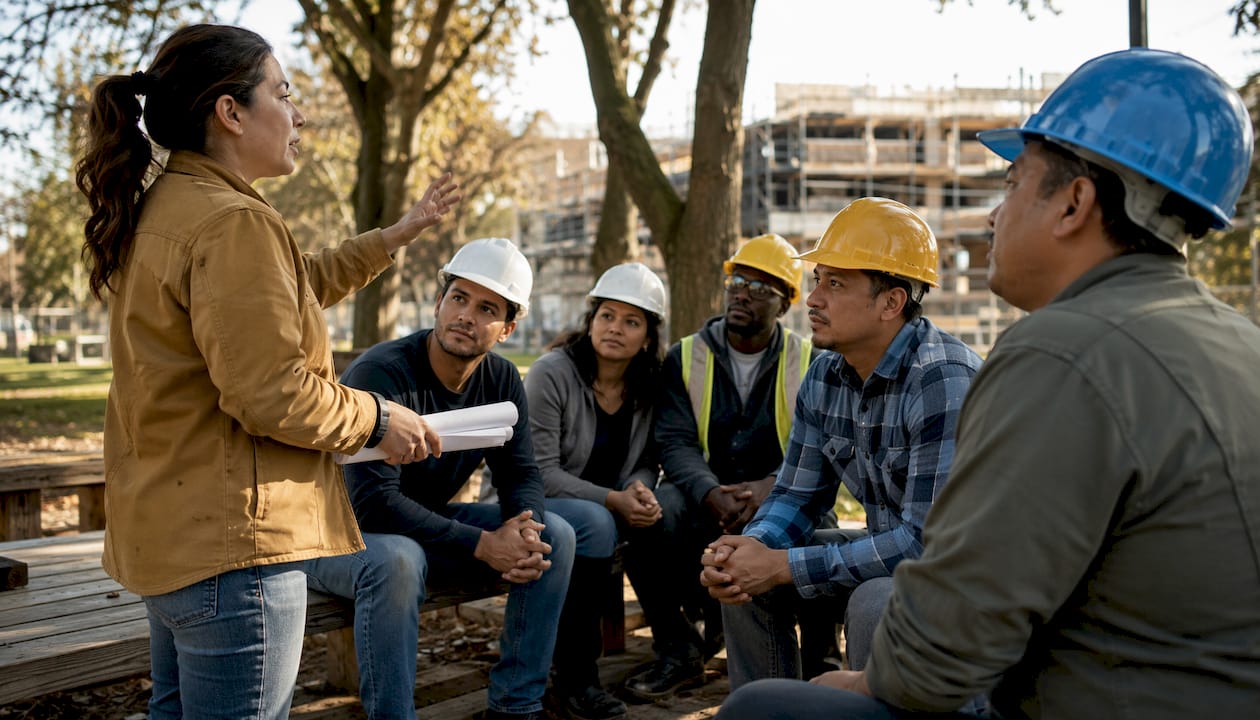
For craft crews specifically, bilingual supervisors and multilingual safety briefings are not optional extras. They are operational necessities on any diverse jobsite. For office staff, the priority shifts to career-pathing, travel support, and visible representation in leadership.
Pro Tip: Recruitment without retention is a revolving door. The firms that see lasting demographic change pair every new hiring initiative with a mentorship assignment and a 90-day check-in. The check-in alone catches problems before they become resignations.
Supplier diversity is worth a separate note. Actively sourcing from woman-owned construction companies and minority-owned subcontractors extends your firm’s diversity impact beyond your own payroll and positions you better for public-sector bids that require it.
How do you measure whether your DEI efforts are actually working?
Measurement is where most construction firms stall. They collect some data, produce an annual report, and call it done. What actually works is a tiered system: monthly operational data, quarterly leadership reviews, and annual benchmarking against ACS/BLS figures.
| KPI | Data Source | Reporting Cadence |
|---|---|---|
| Representation by role and trade | HRIS, CHERP attendance logs | Monthly |
| Applicant pipeline demographics | ATS / recruiting records | Per hiring cycle |
| Retention and turnover by group | Payroll, exit interviews | Quarterly |
| Promotion rates by demographic | HRIS, performance reviews | Quarterly |
| Pay equity indicators | Payroll analysis | Annually |
| Safety reporting rates | Incident logs, SiteComm reports | Monthly |
| Apprenticeship conversion and completion | Training records | Per cohort |
A CDC/ASCE-linked study identified ten indicators as highly influential for assessing DEI in construction, including ethnic and racial diversity at the company level, gender diversity, leadership diversity, pay transparency, and merit-based recruitment and promotion. Those ten map closely to the KPIs above.
The data sources matter as much as the metrics. Mobile attendance tracking on jobsites captures representation data at the crew level, where aggregate company numbers often miss the real picture. Payroll systems give you pay equity data. Exit interviews, when structured consistently, give you retention intelligence you cannot get any other way.
Benchmark your internal numbers against ACS data for your metro area and BLS industry figures annually. That comparison tells you whether you are improving relative to the industry or just moving with the tide.
How can field operations technology support inclusion on the jobsite?
Technology does not fix culture. But the right platform removes friction that disproportionately affects workers from underrepresented groups, and that friction is often what drives attrition.
Debecorp’s CHERP and SiteComm platforms illustrate what this looks like in practice:
- Centralized, multilingual messaging via SiteComm means safety briefings and daily updates reach every worker in a format they can actually read. Reducing miscommunication on jobsites is not just an efficiency issue; it is a safety and inclusion issue when language barriers are involved.
- Time and attendance tracking through CHERP creates an objective record of hours worked, which supports pay equity audits and removes the informal “who the foreman likes” dynamic from scheduling decisions.
- Safety reporting through SiteComm gives workers a channel to flag hazards without confronting a supervisor directly. Workers who feel excluded are less likely to speak up verbally; a digital channel lowers that barrier.
- PPE tracking and request logging in CHERP creates a documented record of fit requests and fulfillment, which matters both for safety compliance and for demonstrating that the firm takes PPE fit seriously.
A few practical use cases: A bilingual crew on a hospital renovation receives daily safety updates in both English and Spanish through SiteComm, cutting the lag between briefing and comprehension. A new apprentice uses CHERP’s daily log to document her hours and tasks, giving her a record that supports her promotion case at the six-month review. A worker who notices a trench shoring issue submits a safety report through SiteComm rather than waiting to find the right moment to tell the superintendent.
Technology supports inclusion. It does not replace the leadership commitment, structured mentorship, and cultural work that make inclusion real. Engagement and jobsite safety are connected, and both require human decisions, not just software.
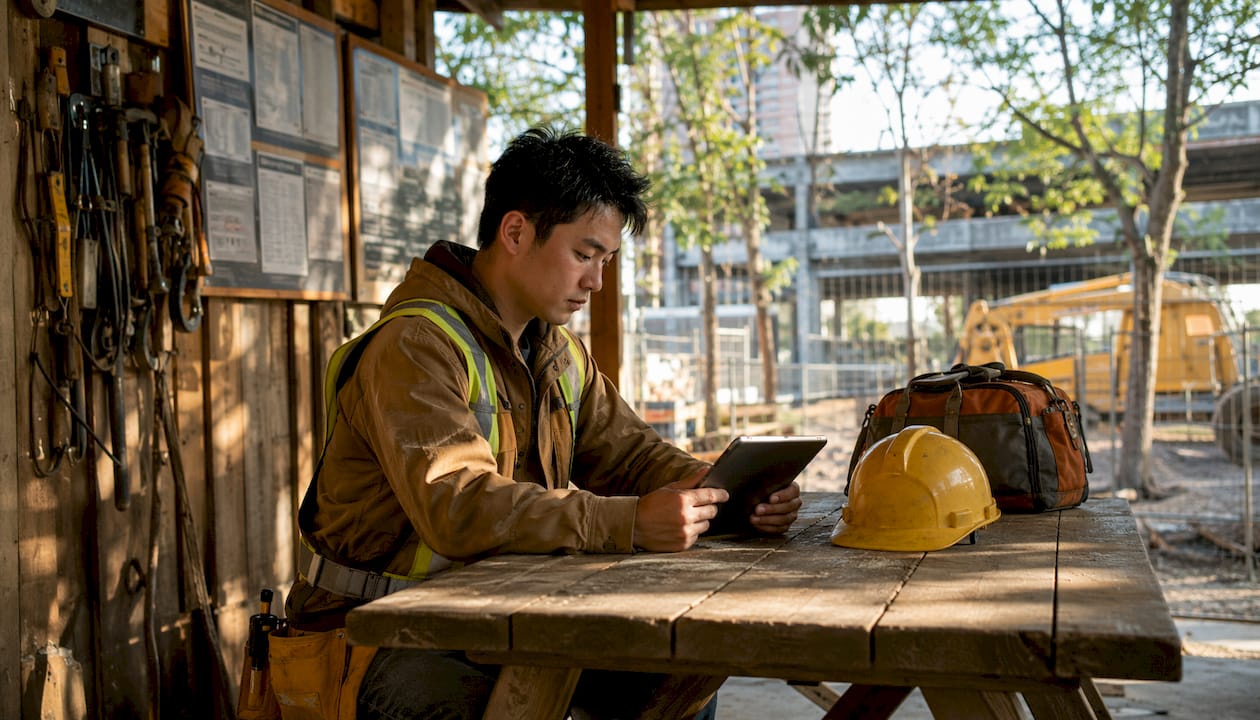
Pro Tip: Before deploying any field platform, audit which languages your crews actually speak and confirm the platform supports them. A tool that only works in English is not a neutral tool on a multilingual jobsite.
What trends will shape DEI in U.S. construction over the next few years?
Several forces are converging that will make workforce diversity less optional and more operationally urgent.
- Demographic shifts accelerate the labor math. The craft workforce is aging, and retirements are outpacing new entries in several trades. Firms that have not built pipelines into underrepresented communities will face the shortage most acutely.
- Client and procurement requirements are tightening. Public-sector owners and large private developers increasingly require workforce diversity data and diverse subcontractor participation as bid conditions. Subcontractor selection criteria now routinely include supplier diversity documentation. Firms without a vetted diverse subcontractor list will lose bids.
- Trade associations are raising the floor. The Associated General Contractors (AGC) has published a formal business case for diversity and inclusion, framing it as a measurable strategy tied to safety, retention, and profitability. The Construction Industry Council (CIC) and ASCE have called for flexible work pilots and cultural change as structural responses to demographic risk.
- EEOC guidance and state contractor requirements are evolving. Federal equal employment rules apply to all construction employers. Several states have added workforce diversity reporting requirements for public-contract recipients. Firms should monitor state-level contractor compliance requirements in their operating markets and consult legal counsel for their specific situation.
- Cognitive and experiential diversity will get more attention. As construction grows more technically complex, firms that recruit only from traditional craft pipelines will find themselves short of the problem-solving capacity that complex projects demand.
The operational implication of each trend is specific: aging workforce means pre-apprenticeship investment now; procurement requirements mean building a diverse subcontractor database before the next bid cycle; EEOC evolution means keeping your DEI documentation current and auditable.
This article provides general information, not legal advice. Confirm current EEOC guidelines and state contractor requirements with a qualified employment attorney for your specific situation.
Key Takeaways
Workforce diversity in construction is a measurable operational strategy that improves recruitment, safety, retention, and financial performance when paired with structured inclusion practices.
| Point | Details |
|---|---|
| Define diversity broadly | Track race, gender, age, disability, language, and cognitive diversity separately for craft and office roles. |
| U.S. baseline is uneven | Hispanic workers are 32% of the construction workforce; women hold roughly 11% of jobs, concentrated in office roles, and remain a small fraction of onsite craft positions. |
| Business case is concrete | AGC research links exclusion to higher accident rates and a 65% likelihood that excluded workers will leave. |
| Measure at crew level | Use HRIS, payroll, and field platform data monthly; benchmark annually against BLS and ACS figures. |
| Debecorp’s role | CHERP and SiteComm support inclusion through multilingual messaging, objective attendance tracking, and digital safety reporting. |
The part of this conversation that usually gets skipped
The standard DEI playbook for construction goes: write a policy, post it on the website, run a training, measure nothing, repeat. That cycle has been running for 20 years and the numbers have barely moved in most firms.
What actually changes the numbers is treating diversity like a production problem. You would not accept a 40% turnover rate in your equipment fleet without diagnosing the cause and fixing it systematically. The same logic applies to your workforce. When a new hire from an underrepresented group leaves in the first 90 days, that is a data point. When it happens three times in a row, that is a pattern. When you have no exit interview data, no mentorship assignment, and no 90-day check-in process, you have no way to know what is causing it.
The firms making real progress are not the ones with the best diversity statements. They are the ones that have connected their workforce planning process to their DEI data, built mentorship into their project onboarding sequence, and made PPE fit a procurement standard rather than an afterthought. Those are operational decisions, not HR programs.
The short-term cohesion dip that comes with diversifying a team is real. Research from Wharton confirms it. But it is temporary, and it is productive when leadership provides structure and clear expectations. Treating that early friction as evidence that diversity “doesn’t work” is the most expensive mistake a construction firm can make.
How Debecorp helps make inclusion practical on the jobsite
Most inclusion efforts stall not because firms lack commitment but because the day-to-day operational infrastructure does not support them. Attendance records are paper-based. Safety reports go through a single supervisor. Crew communications happen in one language. Those gaps are where good intentions break down.
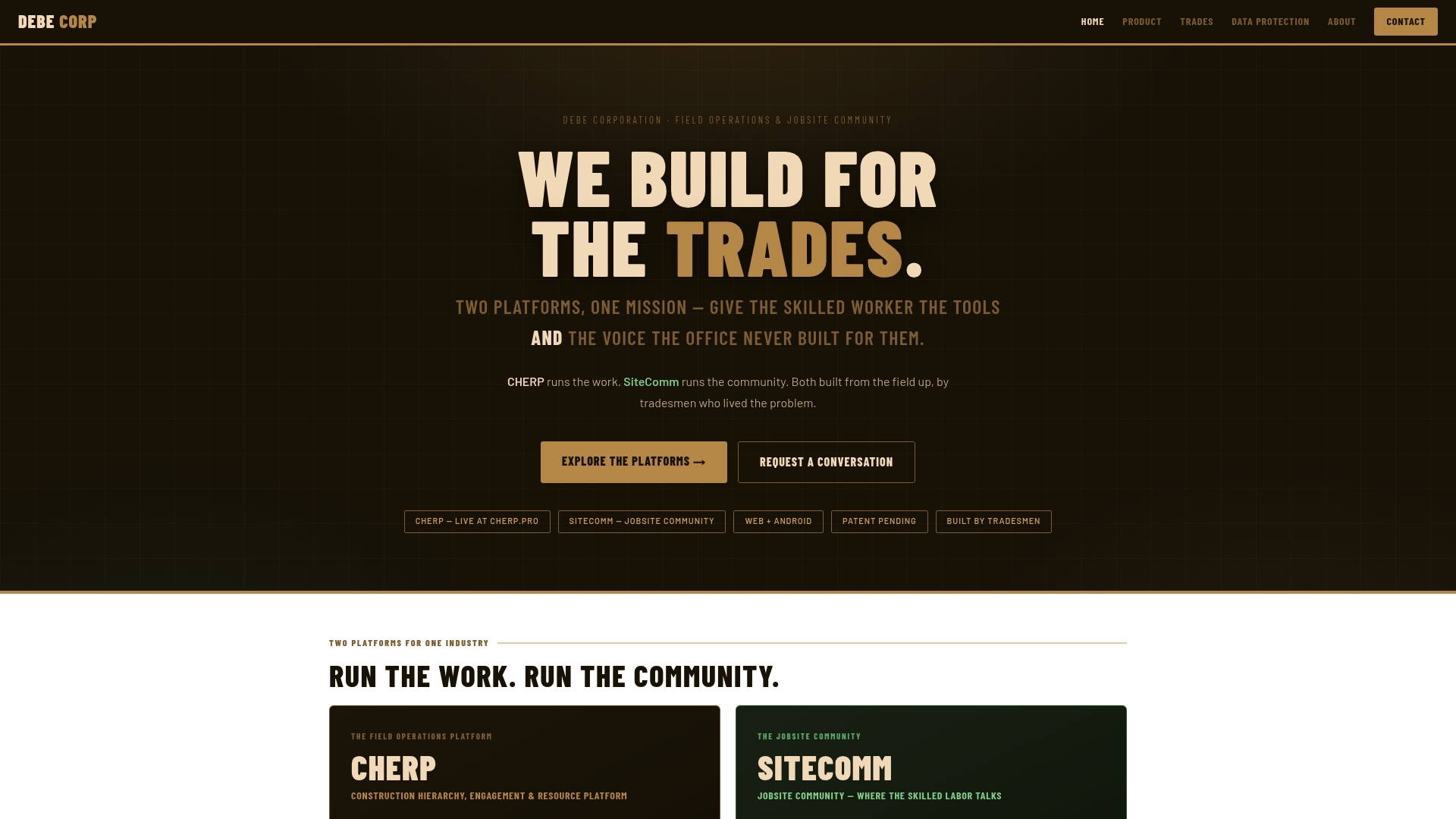
Debecorp built CHERP and SiteComm specifically for the trades, informed by the tradespeople who use them. CHERP centralizes time and attendance, daily logs, and safety compliance in one platform, giving HR and operations leaders the crew-level data they need to track representation and equity in real time. SiteComm handles field messaging, including multilingual notifications, so every worker on a diverse crew gets the same information at the same time. Together, they reduce the administrative friction that makes inclusion hard to sustain at scale.
If your firm is ready to connect its DEI goals to its field operations, explore CHERP and SiteComm or see how the platforms adapt across 14 different trades. The tools are built for the jobsite, not the boardroom.
Further reading and authoritative sources
- BLS Current Population Survey — Table 18: Annual employment data by industry, occupation, race, and gender. The primary benchmark for construction workforce demographics.
- NAHB — Diversity of the Construction Workforce (2025): ACS-based analysis of racial and ethnic shifts in construction from 2010 to 2023, including the Hispanic share trend.
- U.S. Department of Labor — Estimating Construction Workforce: Federal brief on gender representation in construction, including onsite craft roles.
- McKinsey & Company — Delivering Through Diversity (2018): Meta-analysis linking diverse leadership teams to financial outperformance across industries.
- AGC — The Business Case for Diversity and Inclusion (2025): Construction-specific report covering safety, retention, and profitability links to inclusion. Includes the 65% attrition finding for excluded workers.
- CDC/ASCE — Identifying Pertinent Indicators for DEI in Construction: Academic paper identifying ten highly influential DEI indicators for the construction workforce.
- Wharton/Phillips — How Diversity Makes Us Smarter (2014): Organizational science research on cognitive mechanisms behind diversity’s performance benefits.
- Apprenticeship.gov — ACA Interim Report: Federal data on registered apprenticeship programs, including participation by demographic group.
- Federal Register — PPE in Construction (2024): OSHA’s 2024 rule update addressing PPE fit requirements in construction.
- ASEE — Challenges and Opportunities for DEI in Construction: Academic paper on pipeline barriers and the role of academic-practitioner partnerships in building diverse talent.
- Debecorp — CHERP & SiteComm: Field operations platforms built for the trades, supporting attendance tracking, safety reporting, and multilingual crew communication.