
Workforce wellbeing in the trades is defined as the integrated approach to supporting the physical, mental, social, and emotional health of skilled workers through targeted organizational interventions. The McKinsey Health Institute estimates that improving employee health could unlock up to $11.7 trillion in annual economic value globally, with 77% of that driven by productivity gains and reduced presenteeism. For HR professionals and business leaders in skilled trades, this is not a peripheral concern. It is a core business priority that directly shapes retention, safety culture, and long-term workforce sustainability.
What is workforce wellbeing in the trades?
Workforce wellbeing in the trades covers every condition that affects whether a skilled worker can show up healthy, engaged, and productive. The industry term most commonly used in research and regulatory frameworks is occupational wellbeing, which encompasses physical health, psychological safety, social connection, and job design. Both terms describe the same goal: a work environment where people are not just free from harm but actively supported to thrive.
The job demands–resources (JD-R) framework is the most widely applied model for understanding wellbeing at work. It holds that wellbeing deteriorates when job demands, such as physical strain, role overload, and time pressure, consistently exceed the resources available, such as supervisor support, autonomy, and clear communication. In skilled trades, that imbalance is common and often severe.
Physical demands in trades are not abstract. Electricians, ironworkers, plumbers, and HVAC technicians routinely carry heavy loads, work in extreme temperatures, and sustain repetitive strain injuries. These conditions create chronic pain and fatigue that compound over a career. Mental health challenges layer on top of that physical burden, with trades workers facing elevated rates of anxiety, depression, and substance use compared to the general workforce.

Key dimensions and drivers of wellbeing for trade workers
Three dimensions shape workforce wellbeing in skilled trades: physical health, mental health, and social belonging. Each one interacts with the others, and weakness in one area accelerates decline in the rest.
Physical health in trades goes beyond injury prevention. Chronic fatigue, musculoskeletal pain, and poor sleep from shift work all reduce cognitive performance and emotional regulation. A worker managing chronic back pain is also more likely to make errors and less likely to speak up about safety concerns.
Mental health carries a stigma in trades culture that makes it the hardest dimension to address. Anxiety, depression, and substance use disorders are significantly more prevalent among construction and trades workers than in most other industries. That prevalence is not a character flaw. It reflects the structural pressures of the job: unpredictable income, physical pain, long hours away from family, and a culture that historically rewarded silence over disclosure.
Social belonging is a stronger predictor of wellbeing than compensation alone. Research from the World Economic Forum confirms that social factors and belonging drive retention and engagement more reliably than pay increases. Peer relationships, supervisor trust, and a sense of being valued on the crew are the social resources that buffer against job demands.
Key organizational drivers of wellbeing in trades include:
- Supervisor behavior: Foremen and site supervisors set the daily tone. Their willingness to check in, listen, and model healthy behavior determines whether wellbeing is real or performative.
- Job control: Workers with more autonomy over how they complete tasks report better mental health outcomes, even under high physical demand.
- Role clarity: Ambiguous responsibilities and conflicting instructions create psychosocial strain that compounds physical fatigue.
- Workload management: Chronic overload without recovery time is the single most consistent predictor of burnout in trades environments.
Pro Tip: Run a short anonymous pulse survey on your crew every quarter. Ask three questions: How manageable is your workload? Do you feel supported by your supervisor? Do you feel like you belong on this team? The answers will tell you more than any wellness program audit.
How does wellbeing affect business outcomes and the labor market?
The business case for workforce wellbeing in skilled trades is direct and measurable. The McKinsey Health Institute attributes 77% of the global economic value of improved employee health to productivity gains and reduced presenteeism. Presenteeism, where workers show up but perform below capacity due to pain, fatigue, or mental health struggles, costs trades businesses more than absenteeism does, because it is invisible and rarely tracked.
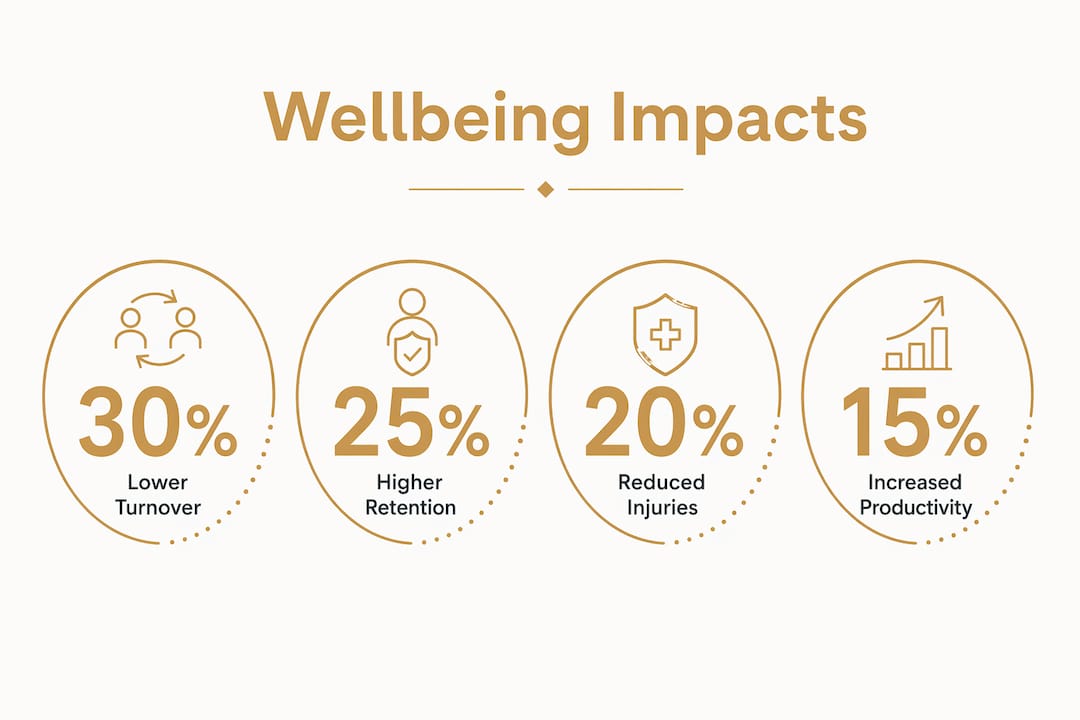
The labor market context makes this even more urgent. The construction and infrastructure sector faces a shortage of over 157,000 workers by june 2027. Organizations that neglect wellbeing accelerate that shortage by pushing experienced workers out of the industry. Those that invest in wellbeing retain institutional knowledge, reduce recruiting costs, and build a reputation that attracts new talent.
The table below shows how wellbeing investment connects to specific business outcomes in trades organizations.
| Business outcome | Impact of strong wellbeing programs |
|---|---|
| Worker retention | Reduced voluntary turnover; experienced crews stay longer |
| Productivity | Lower presenteeism; fewer errors and rework incidents |
| Safety performance | Psychologically safe workers report hazards earlier |
| Recruiting | Positive reputation attracts apprentices and journeymen |
| Client satisfaction | Engaged crews deliver higher quality and meet deadlines |
Wellbeing also affects labor productivity in ways that show up directly on the job cost report. A fatigued crew makes more mistakes. A crew with high psychological distress communicates poorly and misses coordination cues. Both outcomes cost money that most trades businesses never trace back to their root cause.
What are effective wellbeing strategies for trades organizations?
Effective workforce wellbeing programs in skilled trades share four characteristics: they are embedded in daily operations, they are led visibly from the top, they address structural causes rather than symptoms, and they use data to improve over time.
McKinsey’s analysis of 115 workplace interventions found that embedding wellbeing into daily workflows produces more sustained results than one-off initiatives. A wellness day or a poster campaign does not change the conditions that create distress. Adjusting scheduling practices, reducing role ambiguity, and training supervisors to have direct conversations do.
A practical framework for HR leaders and business leaders in trades looks like this:
- Conduct a psychosocial hazard assessment. Map the specific demands your crews face: physical load, scheduling pressure, supervisor conflict, and communication gaps. Use validated tools like the Work 10 Index or the PAW-CON survey to establish a baseline.
- Train supervisors first. Foremen and site leads are the primary wellbeing intervention. Train them to recognize distress, have supportive conversations, and model help-seeking behavior themselves. The AGC Oregon Columbia Chapter identifies positive leadership visibility as the single most important cultural lever.
- Redesign job demands where possible. Rotate physically demanding tasks, build recovery time into schedules, and clarify roles before a project starts. These structural changes reduce the baseline load that wellbeing programs have to compensate for.
- Create low-friction access to support. Employee Assistance Programs (EAPs) are underused in trades because workers distrust them or do not know they exist. Integrate access through the tools workers already use on site, whether that is a field app, a daily briefing, or a posted QR code in the break area.
- Measure, adjust, and repeat. Run quarterly pulse surveys, track absenteeism and incident rates, and review the data with your leadership team. Treat wellbeing like a safety metric, because it is one.
Pro Tip: Pair your wellbeing program launch with a visible action from senior leadership. A CEO or owner who publicly shares their own experience with stress or burnout does more to reduce stigma in one conversation than a year of posters.
What challenges are unique to promoting wellbeing in skilled trades?
Promoting wellbeing in trades faces obstacles that do not exist in office environments. Understanding them is the first step to designing programs that actually work.
- The “tough it out” culture: Trades culture historically rewards stoicism and punishes vulnerability. Workers who raise mental health concerns risk being seen as weak or unreliable. This stigma is the primary reason EAPs and mental health resources go unused even when they are available.
- Physical and logistical instability: Seasonal work, project-based employment, long commutes, and time away from home create chronic stress that generic wellness programs do not address. A mindfulness app does not help a pipefitter who has been away from his family for six weeks.
- Workforce demographics: Trades workforces skew male and older, two demographics that are statistically less likely to seek mental health support proactively. Programs must meet workers where they are, not where program designers assume they are.
- Geographic dispersion: Workers spread across multiple job sites cannot attend centralized wellness events. Any program that requires physical presence at a single location will exclude most of the workforce.
- Injury and chronic pain: Physical injury is both a wellbeing outcome and a wellbeing driver. Workers managing chronic pain from past injuries are at higher risk for depression and substance use. Wellbeing programs that ignore physical health miss the most common entry point for mental health decline in trades.
Psychosocial hazard management, as studied in large-scale construction projects, reduces role overload and conflict while increasing job control and supervisor support. That combination produces measurable improvements in mental health outcomes. The key is treating psychosocial risk the same way you treat physical safety risk: with assessment, controls, and ongoing monitoring.
Understanding why skilled workers leave is also part of overcoming these challenges. Turnover data often reveals the wellbeing failures that surveys miss.
How can HR leaders measure and sustain workforce wellbeing?
Measurement is what separates a wellbeing program from a wellbeing culture. Without data, organizations cannot tell whether their interventions are working or whether conditions are getting worse.
The PAW-CON survey and the Work 10 Index are two validated tools suited to trades environments. Both measure psychological distress, job demands, job resources, and social support in formats that workers can complete quickly. Baseline scores give HR leaders a starting point. Quarterly repeats show whether the needle is moving.
Key indicators to track alongside survey data include:
- Absenteeism rate by crew and project
- Incident and near-miss frequency
- Voluntary turnover rate
- EAP utilization rate
- Supervisor training completion
Successful wellbeing programs in construction use data and leadership commitment together to sustain progress. Data without leadership accountability produces reports that no one acts on. Leadership commitment without data produces activity without results. Both are required.
Sustaining wellbeing over time also requires integrating it into existing business systems. Wellbeing metrics belong in the same leadership review as safety metrics, project costs, and schedule performance. When wellbeing sits in a separate HR report that operations leaders never see, it stays a side program. When it appears on the same dashboard as the numbers that drive decisions, it becomes a business priority.
Debecorp’s platform CHERP supports this integration by embedding worker satisfaction tracking into the daily operational tools that trades teams already use, reducing the friction of data collection and keeping wellbeing visible at the field level.
Key Takeaways
Workforce wellbeing in skilled trades requires structural change, visible leadership, and continuous measurement to produce lasting improvements in retention, safety, and productivity.
| Point | Details |
|---|---|
| Define wellbeing clearly | Use the job demands–resources framework to assess physical, mental, and social health together. |
| Lead from the top | Supervisor and executive behavior shapes whether wellbeing is real or performative on any crew. |
| Embed, do not add on | Integrate wellbeing into daily workflows and operational reviews, not standalone events. |
| Measure with validated tools | Use surveys like PAW-CON or Work 10 Index quarterly to track progress and guide adjustments. |
| Address structural causes | Reduce role overload, clarify responsibilities, and redesign job demands before adding wellness perks. |
What I’ve learned about wellbeing in the trades after years of watching programs fail
Most wellbeing programs in trades fail for one reason: they treat a structural problem like a communication problem. Leadership decides workers need to know about the EAP, prints some flyers, and calls it a program. Nothing changes, because nothing structural changed.
The organizations I have seen succeed do something different. They start with the job itself. They ask what is making people miserable at work, and they actually fix it. Scheduling that creates chronic overload gets redesigned. Supervisors who undermine psychological safety get coached or replaced. Role conflicts that have existed for years get resolved. Those changes cost less than most people expect, and they produce results that no wellness app can replicate.
Leadership visibility is the one factor I would never compromise on. When a site manager tells his crew that he went through a rough patch and got help, the stigma in that room drops immediately. That conversation does more for mental health than any formal program. The evidence from trades organizations that have moved the needle confirms this consistently.
The other mistake I see constantly is treating measurement as a one-time event. You survey the crew at program launch, get a baseline, and then never look at the data again. Wellbeing is not a project with a completion date. It is an ongoing condition that requires ongoing attention. Build the measurement into your quarterly rhythm and treat the results the same way you treat a safety audit finding: with a corrective action and a follow-up date.
— SEAN
How Debecorp supports wellbeing and operations in the trades
Debecorp builds field operations software directly with tradespeople, which means the platforms reflect how work actually happens on a job site, not how it looks in a conference room.
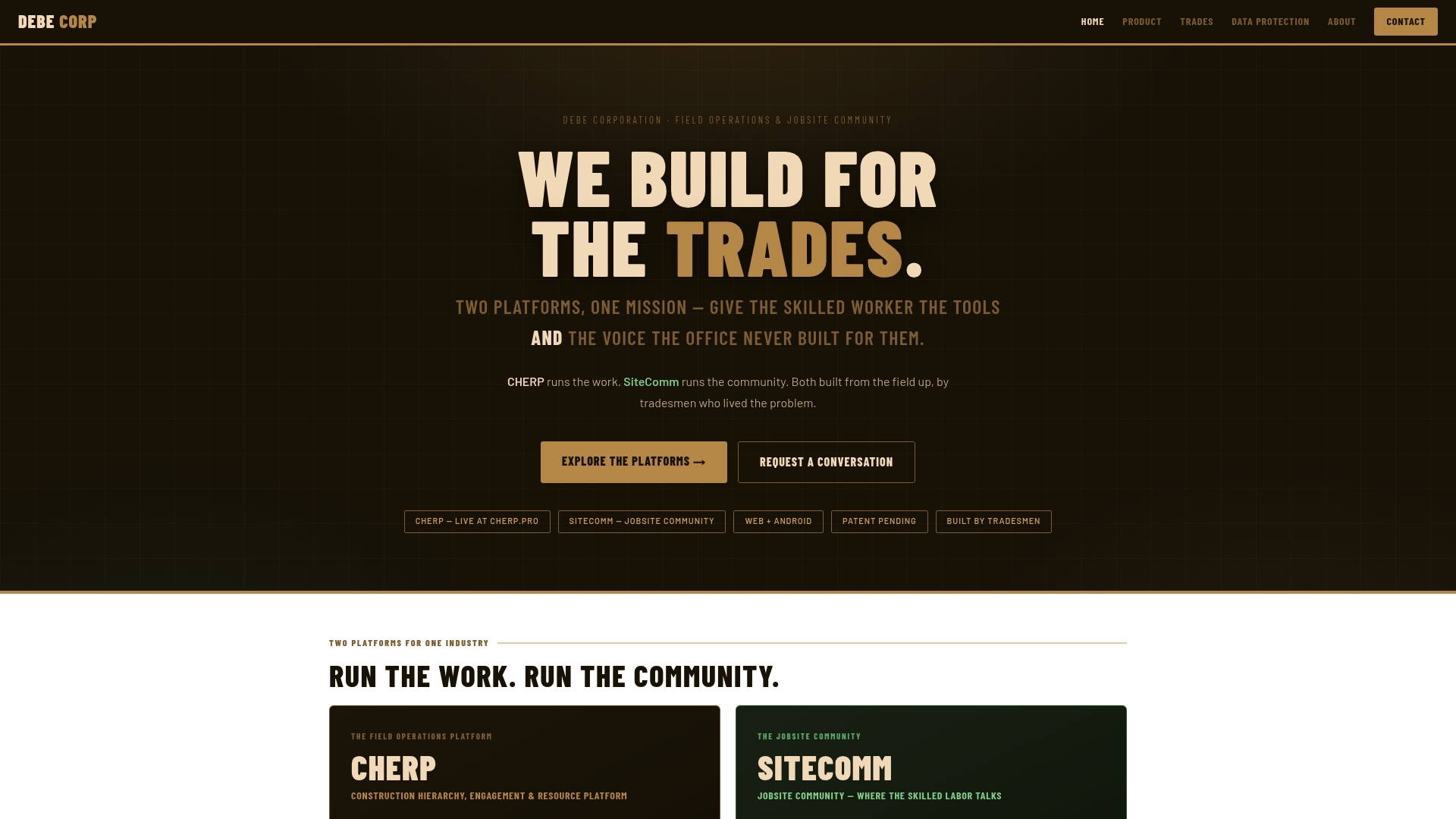
CHERP manages time and attendance, daily logs, and safety compliance in one place, giving HR leaders and site managers the real-time visibility they need to spot workload problems before they become wellbeing crises. SiteComm keeps crews connected across job sites, reducing the communication gaps that create role confusion and stress. Both platforms are built for the trades, covering 14 skilled trades with workflows tailored to each craft. If you want wellbeing to show up in your operations data, not just your HR reports, explore the CHERP and SiteComm platforms and see how Debecorp supports the full picture of workforce health.
FAQ
What is the workforce wellbeing definition for skilled trades?
Workforce wellbeing in skilled trades is the integrated management of physical, mental, and social health conditions that affect whether workers can perform safely and sustainably. It draws on the job demands–resources framework and includes psychosocial hazard management as a core component.
Why does mental health carry such stigma in trades?
Trades culture has historically rewarded stoicism, making workers reluctant to disclose mental health struggles for fear of being seen as unreliable. Reducing stigma requires visible leadership behavior, not just awareness campaigns.
How do wellbeing programs reduce worker turnover in trades?
Belonging and social connection predict retention more reliably than compensation alone. Programs that address structural job demands and build supervisor trust keep experienced workers from leaving the industry.
What tools measure workforce wellbeing in trades?
The PAW-CON survey and the Work 10 Index are validated instruments suited to trades environments. Both measure psychological distress, job demands, and social resources in formats workers can complete quickly on site.
How often should trades organizations assess workforce wellbeing?
Quarterly pulse surveys provide enough frequency to detect trends and adjust programs before problems compound. Pair survey data with absenteeism rates and incident frequency for a complete picture.