
Skilled trades workers leave their jobs primarily because of poor management, limited career growth, and burnout — not low pay. Median annual turnover in construction field work sits at 38.2%, and replacing a single skilled worker costs an average of $6,800. That figure does not include the productivity loss and crew disruption that follow every departure. Understanding why skilled workers leave trades jobs is the first step toward doing something about it, whether you are the worker walking out or the employer watching them go.
What are the main reasons skilled workers leave trades jobs?
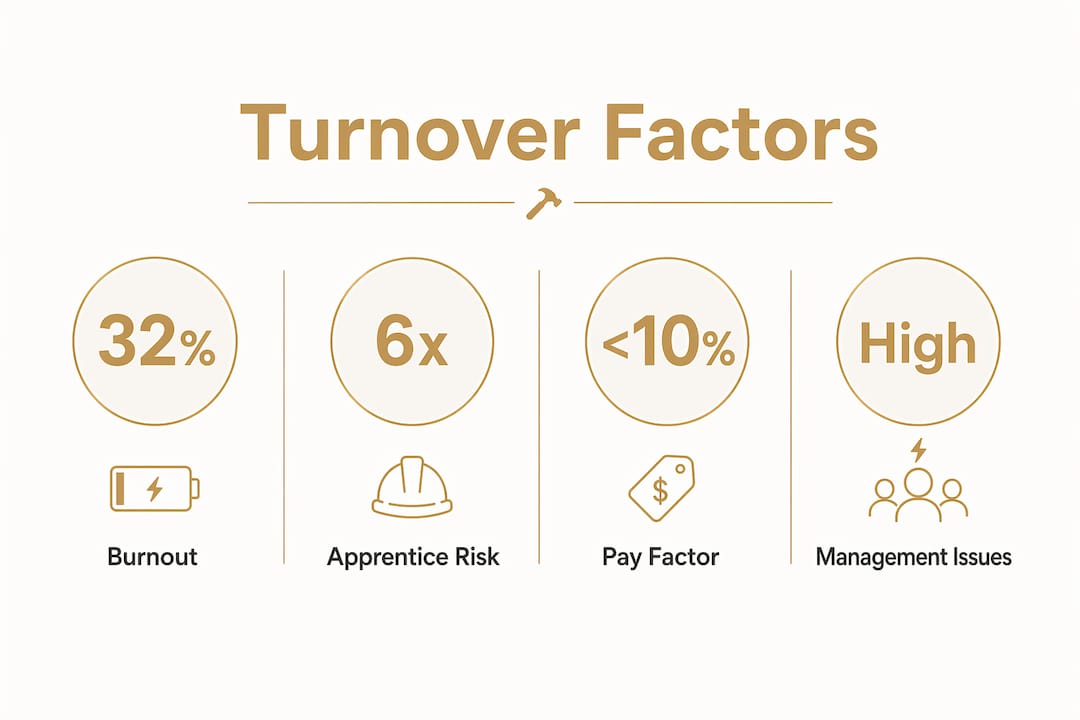
The most important finding in 2026 workforce data is this: fewer than 10% of tradespeople name pay as their primary reason for quitting. Pay matters, but it is rarely the breaking point. The real drivers are harder to see on a paycheck stub.
A full 76% of tradespeople have seriously considered leaving their trade entirely. That number signals a systemic problem, not a series of individual bad decisions. The top reasons trades workers quit cluster around four themes:
- Lack of career advancement. Workers who cannot see a clear path forward stop investing in the job. No certifications offered, no mentorship, no promotion track.
- Burnout. Physical and mental exhaustion from long hours, unpredictable schedules, and high-pressure deadlines accumulates faster than most employers recognize.
- Feeling undervalued. Workers who complete skilled, dangerous work and receive no acknowledgment eventually stop caring about the outcome.
- Poor management. Supervisors who micromanage, disrespect, or ignore workers are the single most cited factor in voluntary resignations across the trades.
Working conditions also play a decisive role. Safety culture, commute time, and shift hours all factor into a worker’s daily calculation of whether the job is worth it. A site with a strong safety culture and predictable hours retains workers even when the pay is not the highest in the market.
Pro Tip: If you are weighing a career change, write down the three things that frustrate you most about your current job. If none of them are about pay, a raise will not fix the problem.

How does apprentice status affect turnover in the trades?
Apprentices face a fundamentally different risk profile than journeymen or master tradespeople. Research on Ontario electricians found that apprentice status raises the odds of wanting to leave by more than six times, with an odds ratio of 6.59. That is not a marginal difference. It means the entry point into a trades career is also the most dangerous point for retention.
Burnout compounds the problem. The same study found that nearly 32% of workers surveyed reported burnout. Burnout at that scale is not a personal failure. It is a structural outcome of how the trades currently onboard and manage new workers.
Job satisfaction, by contrast, acts as a strong protective factor. The research shows that higher job satisfaction significantly lowers turnover intention, with an odds ratio of 0.58. Workers who feel good about their work stay. The challenge is that most trades environments do little to actively build that satisfaction.
| Factor | Effect on turnover intention |
|---|---|
| Apprentice status | Over 6x higher odds of wanting to leave |
| Burnout | Affects nearly 32% of workers surveyed |
| High job satisfaction | Statistically linked to lower turnover (OR = 0.58) |
| Poor management | Top cited reason across voluntary resignations |
Pro Tip: Apprentices: seek out a journeyman who actively teaches, not just one who delegates grunt work. That relationship is the single biggest predictor of whether you finish your apprenticeship.
The cultural problem inside apprenticeship programs deserves its own attention. A toxic “I suffered so you should too” mentality drives high dropout rates regardless of pay. Apprentices who encounter hazing, dismissal, or deliberate withholding of knowledge do not just leave the company. They leave the trade entirely. That is a pipeline problem the entire industry pays for.
How does workplace culture affect skilled trades retention?
The phrase “people don’t leave bad jobs, they leave bad bosses” is a cliché because it is consistently true. Management quality is one of the most critical drivers of retention in the trades, and it is also one of the most underfunded areas of employer investment.
Poor culture in a trades environment takes specific forms that differ from office settings. Verbal abuse on the jobsite is normalized in many crews. Recognition for skilled work is rare. Apprentices are hazed rather than mentored. Senior workers are expected to absorb endless pressure without complaint. These patterns do not just make the job unpleasant. They actively push experienced workers out the door.
“The most expensive thing a trades company can do is ignore its management culture. Every supervisor who disrespects a worker is writing a $6,800 check the company doesn’t know about yet.”
Companies with structured training, recognition, and manageable workloads report 31% higher retention than those relying on pay increases alone. That gap is large enough to be a competitive advantage. Employers who invest in management training for site supervisors see measurable improvements in both satisfaction scores and headcount stability.
The practical fixes are not complicated, but they require consistent effort:
- Train supervisors on basic communication and conflict resolution, not just technical skills.
- Build a formal recognition system. A monthly crew acknowledgment costs nothing and signals that management pays attention.
- Create a zero-tolerance policy for verbal abuse. Enforce it visibly, starting with senior workers.
- Give workers a voice. Regular check-ins where feedback is actually acted on build trust faster than any bonus program.
Skilled trades workers are not asking for a corporate wellness program. They are asking to be treated with the same respect they bring to their craft every day.
What operational problems push trades workers to quit?
Operational chaos is a quieter but equally powerful driver of skilled trades job turnover. Missing materials, last-minute schedule changes, and excessive administrative tasks cause more resignations than base pay dissatisfaction. Workers who show up ready to work and spend the first two hours waiting for materials or chasing down paperwork do not stay long.
The frustration is specific and cumulative. Here is how it typically builds:
- Materials are not on site. A crew arrives, the supplies are missing, and the foreman has no answer. Work stops. Workers stand around. The day feels wasted.
- Schedules change without notice. A client pushes a deadline, and workers find out the morning of. Personal plans, childcare, and second jobs all get disrupted.
- Administrative tasks pile up. Time sheets, safety forms, and daily logs done on paper at the end of a 10-hour shift feel like punishment for working hard.
- Communication breaks down. Workers get conflicting instructions from the office and the site supervisor. Nobody takes responsibility for the confusion.
- Tools and equipment are unreliable. Showing up to a job with broken or missing tools signals to workers that the company does not respect their time or their craft.
Fixing these operational issues builds respect and loyalty at a fraction of the cost of a wage increase. A worker who knows materials will be ready, schedules will be communicated clearly, and paperwork will take five minutes instead of forty feels valued. That feeling is a retention tool. Workers also consistently rank schedule flexibility and work-life balance just behind pay as top priorities. Solving operational chaos directly addresses both.
Key Takeaways
Skilled trades workers leave primarily because of poor management, burnout, and operational chaos, not low pay, and companies that address these factors retain workers at significantly higher rates.
| Point | Details |
|---|---|
| Pay is rarely the main reason | Fewer than 10% of tradespeople cite pay as their primary reason for quitting. |
| Apprentices are highest risk | Apprentice status raises turnover odds by over six times compared to other workers. |
| Job satisfaction protects retention | Higher satisfaction statistically lowers the likelihood a worker will leave. |
| Culture and management drive exits | Companies with structured recognition and training report 31% higher retention. |
| Operational chaos costs more than raises | Fixing scheduling, materials, and communication retains workers cheaper than wage hikes. |
What I’ve learned watching good tradespeople walk out the door
The hardest thing to watch in this industry is a genuinely skilled worker leave because nobody bothered to tell them they were doing a great job. I have seen electricians with 15 years of experience hand in their tools over a foreman who never once acknowledged their work. Not over money. Over being invisible.
The trades have a cultural blind spot around recognition. The assumption is that a paycheck is the only acknowledgment a worker needs. That assumption is wrong, and the turnover data proves it. Workers who feel seen and respected stay. Workers who feel like interchangeable labor leave, often for industries that treat them better even if the pay is similar.
My honest advice to any trades worker considering a change: separate the job from the employer before you make a decision. The trade itself may still be right for you. The company may not be. Look at whether there is a real career path in front of you, whether management respects your time, and whether the daily operations are organized enough to let you do your best work. If the answer to all three is no, the problem is the employer, not the trade.
For employers, the math is straightforward. Replacing one worker costs $6,800 on average, and that does not count the knowledge that walks out with them. Investing in management training, clear career paths, and basic operational discipline costs far less and pays back in retention, morale, and crew quality.
— SEAN
How Debecorp addresses the operational side of trades retention
The operational frustrations that push workers out the door are exactly what Debecorp built CHERP and SiteComm to solve. Both platforms were designed from the ground up with input from tradespeople who lived those daily frustrations firsthand.

CHERP handles time and attendance, daily logs, and safety compliance in one place, cutting the end-of-shift paperwork burden that wears workers down. SiteComm keeps crews and offices connected in real time, so schedule changes and material updates reach the right people before they become problems. If you want to see how these field management tools work across specific trades, the platform pages lay it out clearly. Debecorp also covers 14 skilled trades, so the tools are built for your craft, not adapted from a generic construction template.
FAQ
Why do skilled workers leave trades jobs if pay is not the issue?
The top reasons are lack of career advancement, burnout, feeling undervalued, and poor management. Fewer than 10% of tradespeople cite pay as their primary reason for leaving.
How much does it cost to replace a skilled trades worker?
Replacing a skilled trades worker costs an average of $6,800, not counting indirect costs like productivity loss and crew disruption.
Are apprentices more likely to quit than experienced workers?
Yes. Research shows apprentice status raises the odds of wanting to leave by over six times compared to non-apprentice workers, making early career support critical.
What is the fastest way to reduce skilled trades turnover?
Improving management behavior and fixing operational chaos, such as scheduling reliability and materials availability, delivers faster retention gains than pay increases alone.
Does job satisfaction actually lower turnover in the trades?
Yes. Research on electricians found that higher job satisfaction statistically lowers turnover intention, with an odds ratio of 0.58, making it one of the strongest protective factors measured.