
Career development in skilled trades is defined as the structured process of building technical skills, earning certifications, and advancing through recognized roles to increase earning power and job stability. The role of career development in skilled trades has never carried more weight than it does right now. Experienced tradespeople earn $80,000 to $100,000+ annually, an 18% wage premium over the national median. That gap grows wider the more deliberately you invest in your own advancement. Whether you are a first-year apprentice or a journeyman eyeing a foreman’s role, structured career planning separates those who plateau from those who lead.
What is the role of career development in skilled trades?
Career development in skilled trades gives workers a clear path from entry-level labor to high-earning, high-responsibility roles. Without it, tradespeople often stall at the journeyman level, not because they lack skill, but because they lack direction. The trades reward those who treat their career as a long-term project, not just a series of jobs.
The industry context makes this urgent. Approximately 649,300 job openings appear annually in skilled trades, driven by retirement attrition and rising construction and infrastructure demand. That number represents real opportunity for tradespeople who position themselves ahead of the curve. Employers are actively competing for talent, and the workers with documented skills and certifications get first pick of the best roles.

Career development also shapes identity and purpose on the job. Tradespeople who pursue advancement report higher satisfaction and stronger commitment to their craft. The work stops feeling like a grind and starts feeling like a profession with real stakes and real rewards.
What are the key career pathways in skilled trades?
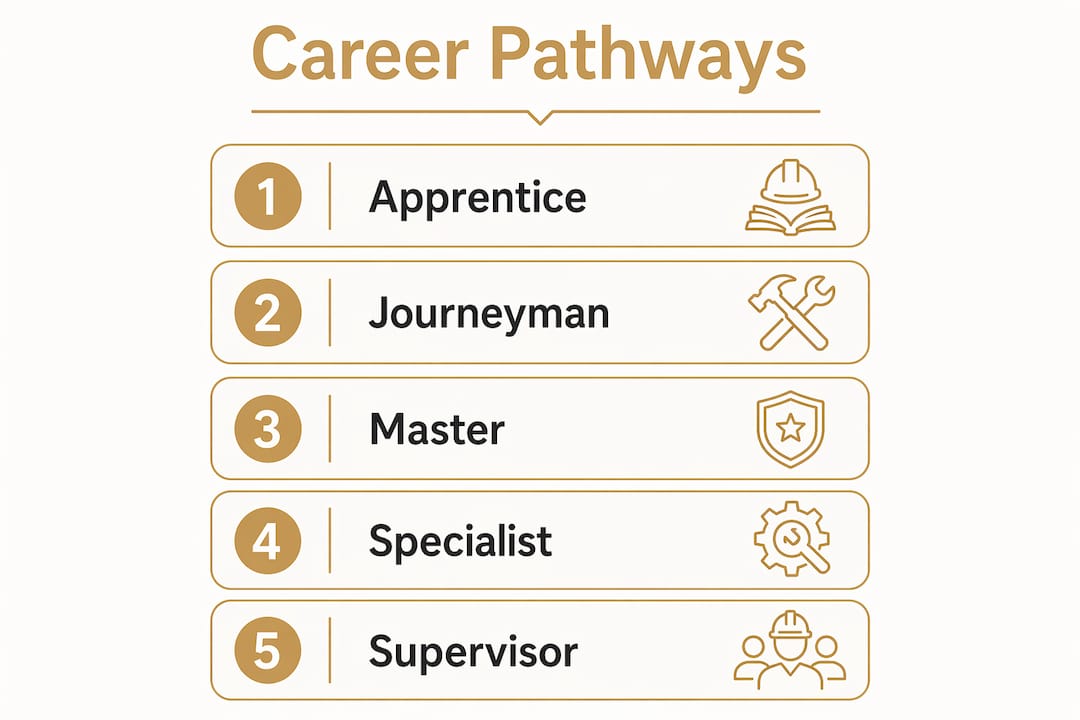
Trades career progression follows a structured sequence: Apprentice, Journeyman, Master Tradesperson, and then specialized or leadership roles. Each stage has defined skill requirements, licensing benchmarks, and typical timelines. Knowing where you stand in that sequence helps you plan your next move with precision.
| Pathway | Typical Timeline | Key Skills Required |
|---|---|---|
| Apprentice | 2–5 years | Foundational trade skills, safety compliance, tool proficiency |
| Journeyman | 5–10 years | Independent project execution, code knowledge, trade licensing |
| Master Tradesperson | 10+ years | Advanced technical mastery, mentoring, licensing exams |
| Project Manager | Varies | Scheduling, budgeting, team leadership, communication |
| Business Owner | Varies | Contracting, estimating, client management, financial literacy |
Beyond the traditional ladder, several alternative pathways offer strong earning potential and career satisfaction:
- Specialized technical consulting: Tradespeople with deep expertise in areas like HVAC controls, electrical systems, or industrial pipefitting can move into consulting roles that command premium rates.
- Project management: Many experienced tradespeople transition into site supervision or project management, where their field knowledge gives them a real edge over office-trained managers.
- Business ownership: Earning a contractor’s license opens the door to running your own operation. This path requires business skills alongside trade skills, but the income ceiling is significantly higher.
- Training and instruction: Master tradespeople increasingly move into apprenticeship instruction roles, passing knowledge to the next generation while building their professional reputation.
Certifications accelerate movement through every one of these pathways. OSHA 10 and OSHA 30 credentials, trade-specific licensing exams, and continuing education credits all signal to employers that you take your career seriously.
How does ongoing skills development affect career advancement?
Technical ability gets you hired. Soft skills get you promoted. Trust-building and communication accelerate advancement into supervisory roles faster than technical skill alone. This is the insight most tradespeople learn too late, usually after watching a less technically skilled colleague move into a foreman role ahead of them.
The most valued skills for career advancement in 2026 combine both categories:
- Trade-specific certifications: OSHA safety credentials, EPA Section 608 for HVAC technicians, NCCER (National Center for Construction Education and Research) certifications, and state contractor licensing exams all carry direct weight in hiring and promotion decisions.
- Blueprint reading and estimating: Tradespeople who can read plans and estimate material costs become indispensable to project managers and general contractors.
- Communication and conflict resolution: On-site disputes slow projects and cost money. Workers who resolve issues calmly and clearly get noticed by supervisors.
- Digital tool proficiency: Field software for time tracking, safety logs, and daily reporting has become standard on commercial job sites. Knowing how to use these platforms signals professionalism.
- Mentorship relationships: Learning directly from experienced tradespeople compresses your development timeline. A good mentor shows you shortcuts that take years to discover on your own.
Apprenticeships remain the most structured form of skills development available. The average age of new apprentices is 29, which means career changes into the trades are common and entirely viable well into adulthood. Pre-apprenticeship programs and accelerated training tracks have made entry faster than ever.
Pro Tip: Find one experienced tradesperson on every job site who is willing to answer questions. Buy them coffee, show genuine curiosity, and listen more than you talk. That relationship will teach you more in six months than a year of solo work.
What challenges and opportunities exist in skilled trades career development?
The biggest obstacle tradespeople face is not a skills gap. It is a perception gap. 74% of young adults perceive stigma around vocational training, which suppresses the talent pipeline and leaves employers scrambling to fill roles. That stigma is the trades’ loss and your gain if you are already in the field.
The workforce math is stark. Retirement attrition over the next decade will remove 20–41% of the current skilled trades workforce. That creates sustained demand for qualified workers across every major trade. Employers are responding with incentives that were unheard of a decade ago:
- Sign-on bonuses for journeymen and master tradespeople
- Tuition reimbursement for continuing education and certification programs
- Health benefits and retirement plans that match office-sector standards
- Paid apprenticeship programs that let workers earn while they learn
Employers compete aggressively for skilled trades talent, offering benefits once reserved for white-collar professions. This is a structural shift, not a temporary trend. The tradespeople who position themselves with certifications and documented experience will capture the best of these offers.
The opportunity is clearest for workers who move beyond reactive job-seeking. Tradespeople who actively pursue certifications, build relationships with general contractors, and demonstrate leadership on job sites are the ones employers fight to keep.
What practical steps can tradespeople take to advance their careers?
Career advancement in trades does not happen by accident. It requires a plan, consistent action, and the willingness to put yourself in front of the right people. Relationship management, initiative, and preparedness on job sites are the three behaviors that separate workers who advance from those who stay stuck.
Start with these concrete steps:
- Apply to a registered apprenticeship program. The U.S. Department of Labor’s Registered Apprenticeship program connects workers with paid, structured training in over 1,000 trade occupations. This is the single most reliable path to journeyman status.
- Show up prepared every day. Tradespeople who anticipate site needs, organize their tools the night before, and arrive ready to work get noticed. Proactive site preparation accelerates learning and builds the reputation that leads to promotions.
- Talk to employers directly. In-person communication and demonstrated initiative outweigh online applications when it comes to landing jobs and promotions. Walk onto a job site, introduce yourself to the foreman, and ask what they need.
- Pursue a degree if management is your goal. A degree is not required for most trade roles, but it can be the deciding factor for management and specialized positions. Combining field experience with formal education creates a competitive edge that few candidates can match.
- Use field software to build professional habits. Platforms that track time, log daily activities, and manage safety compliance teach tradespeople to think like project managers. That mindset shift is what employers look for when selecting workers for advancement.
Pro Tip: Keep a personal log of every project you complete, every certification you earn, and every skill you develop. When a promotion opportunity comes up, you will have a concrete record to present rather than a vague claim about experience.
Key Takeaways
Career development in skilled trades is the most direct path to higher wages, greater responsibility, and long-term job security in a market with nearly 650,000 annual openings.
| Point | Details |
|---|---|
| Structured pathways exist | Progression from Apprentice to Master Tradesperson follows defined milestones and licensing benchmarks. |
| Soft skills drive promotions | Communication and trust-building accelerate advancement into supervisory roles faster than technical skill alone. |
| Demand is at a record high | Approximately 649,300 annual openings signal sustained opportunity for certified, experienced tradespeople. |
| Proactive behavior wins | Showing up prepared and communicating directly with employers outperforms passive job applications. |
| Education amplifies field experience | Combining apprenticeship with formal education creates a competitive edge for management and specialized roles. |
The trades reward those who treat their career like a craft
Most tradespeople I have seen stall in their careers share one trait: they wait for someone else to hand them the next step. They assume that showing up and doing good work is enough. It is not. Good work is the floor, not the ceiling.
The tradespeople who advance fastest are the ones who treat their career development the same way they treat their craft. They study the next level before they reach it. They build relationships with foremen, project managers, and general contractors before they need a favor. They earn certifications not because someone told them to, but because they understand that credentials open doors that skill alone cannot.
The soft skills piece is where I see the biggest gap. A tradesperson who can read a blueprint, run a crew, and resolve a conflict on site without escalating it is worth more than two technically perfect workers who cannot communicate. That combination is rare, and employers know it.
Mentorship accelerates everything. Find someone who has done what you want to do and learn how they think, not just what they know. The technical knowledge transfers through apprenticeship programs. The judgment, the site awareness, the ability to read a room — that comes from watching someone who has been doing it for 20 years.
Your career in the trades is a long game. The workers who win it are the ones who stay curious, stay prepared, and never stop building.
— SEAN
Tools built for tradespeople who take their careers seriously
Debecorp builds field software directly from the input of working tradespeople. CHERP and SiteComm handle time and attendance, daily logs, and safety compliance, all tailored to specific trades so the tools actually fit the work you do.

Tradespeople who use purpose-built field software platforms develop the professional habits that employers associate with leadership potential. Logging your work, tracking safety compliance, and communicating clearly through a structured platform signals that you operate at a higher level. Debecorp’s trade-specific tools are built to support that growth, not add paperwork to your day. If you are serious about advancing in your trade, the right tools make that visible to the people who decide who moves up.
FAQ
What is career development in skilled trades?
Career development in skilled trades is the process of building technical skills, earning certifications, and advancing through structured roles from apprentice to master tradesperson or into management and ownership. It directly increases earning potential and job stability.
How long does it take to advance from apprentice to journeyman?
The apprentice to journeyman timeline typically spans 2–5 years, depending on the trade, the apprenticeship program structure, and the number of required training hours. Consistent performance and certification completion accelerate the process.
Why are soft skills important for trades career advancement?
Soft skills like communication and trust-building move tradespeople into supervisory roles faster than technical ability alone. Employers promote workers who can lead a crew and resolve problems on site without escalation.
What is the job market outlook for skilled trades in 2026?
The skilled trades job market shows approximately 649,300 annual openings driven by retirement attrition and infrastructure demand. Experienced tradespeople earn an 18% wage premium over the national median, making this one of the strongest labor markets in the country.
Do I need a degree to advance in the trades?
A degree is not required for most trade roles, but it can be decisive for management and specialized positions. Combining hands-on apprenticeship experience with formal education creates a competitive advantage that few candidates can match.