
Labor productivity tracking is the systematic measurement of output produced per labor hour, giving construction managers a clear, objective view of workforce performance. The industry standard formula, output value divided by total labor hours, comes from frameworks used by the Bureau of Labor Statistics (BLS) and the OECD. Small shifts in that ratio carry real weight: output per hour changes of roughly 0.4% can visibly move quarterly project performance. For trades managers juggling crews, subcontractors, and tight schedules, understanding this metric is the foundation of every staffing and scheduling decision you make.
What is labor productivity tracking and how is it measured?
Labor productivity tracking is the ongoing process of recording and analyzing the ratio of work output to labor input across a project or workforce. The BLS defines labor productivity as output per unit of labor input, distinguishing it from total factor productivity, which also accounts for capital and materials. That distinction matters for managers: a low productivity score does not automatically mean your crew is underperforming. It may point to a supply chain delay, a missing tool, or a scheduling gap.
In construction, output takes many forms: square footage framed, linear feet of conduit installed, concrete poured, or project milestones cleared. The basic formula stays the same regardless of trade.

Labor Productivity = Total Output Value ÷ Total Labor Hours
The table below shows how the same formula produces different insights depending on the unit of measurement you choose.
| Measurement unit | Best used for | Example |
|---|---|---|
| Output per labor hour | Daily crew performance | 120 sq ft framed per hour |
| Output per worker | Crew size planning | 480 sq ft per worker per shift |
| Monetary value per hour | Budget and billing analysis | $85 output value per labor hour |
| Milestone completion rate | Project scheduling | 3 of 4 milestones hit per week |
The OECD Compendium of Productivity Indicators 2025 found that top-performing economies require seven times less labor than low performers to produce the same output. That gap does not come from harder-working individuals. It comes from better systems, clearer workflows, and smarter resource allocation.
Pro Tip: Track output in the unit that matches your billing structure. If you bill by square footage, measure productivity in square footage. Mixing units creates reporting confusion and makes it harder to spot real problems.
What advanced methods exist for tracking labor productivity beyond time logs?
Time tracking and productivity tracking are not the same thing. Time tracking records how long work takes. Productivity tracking answers how well the work was done. A crew that logs eight hours on site but spends three of them waiting on material deliveries is not producing at full capacity. Time logs alone will not show you that.
Modern labor efficiency tracking methods use behavioral and output metrics to build a more accurate picture. The most useful ones for construction managers include:
-
Deep work ratio: The percentage of work time spent on focused, uninterrupted tasks. Targets between 35–50% signal a healthy balance between execution and coordination.
-
Blocker resolution time: How long it takes to clear an obstacle, such as a missing inspection, an unanswered RFI, or a delayed material delivery. Shorter resolution times correlate with higher output velocity.
-
Focus block density: The number of uninterrupted work periods in a shift. More focus blocks mean less task switching and fewer errors.
-
Output velocity: The rate at which completed work items move through a workflow, measured against planned milestones.
These metrics come from reading work artifacts, not from monitoring keystrokes or tracking employee movements. Artifact-based signals like blocker resolution time and output velocity reflect real productivity without requiring invasive surveillance tools. That distinction is critical for maintaining crew trust.
Pro Tip: Pull your blocker resolution data from your daily logs and RFI records. If the same type of blocker appears more than twice in a month, that is a systemic problem, not a crew problem.
The shift from surveillance to intelligence is not just ethical. It produces better data. Workers who know they are being monitored for keystrokes or idle time often adjust behavior to look busy rather than be productive. Reading work product context instead gives you a signal that is harder to game and more directly tied to actual output.
What are the key benefits and challenges of labor productivity tracking for construction leaders?
Productivity tracking gives construction managers three concrete operational advantages.
-
Bottleneck identification: When output velocity drops on a specific phase, the data points directly to where the delay is occurring, whether that is material wait times, crew size, or inspection scheduling.
-
Staff allocation: Objective output measures let you redistribute labor based on actual need rather than assumption. A crew finishing ahead of schedule can shift to a lagging phase without guesswork.
-
Project scheduling: Baseline productivity data from past projects gives you a realistic foundation for future estimates, reducing the gap between planned and actual completion dates.
The challenges are equally real, and ignoring them undermines the benefits.
“Explicitly defining tracking purpose and framing it as a support tool yields more accurate and honest data.” — Slack Productivity Tracking Guide
The biggest pitfall is the transparency tax. When workers do not understand why they are being tracked, they assume the worst. That assumption leads to data distortion, where crews report hours or outputs in ways that look good rather than ways that are accurate. The fix is direct communication: tell your crew exactly what you are measuring, why you are measuring it, and how the data will be used.
A second pitfall is confusing busyness with output. A worker who responds to every message instantly, attends every meeting, and stays late every day may be producing less than a worker who protects focused work time. Fragmentation through multitasking reduces effective labor productivity and raises safety risks on site. Tracking focus block density instead of raw hours worked gives you a more honest picture of who is actually moving the project forward.
The BLS notes that productivity issues often require workflow or supply chain changes rather than workforce blame. Keep that framing when presenting data to your crew. The goal is to fix the system, not assign fault.
How to apply labor productivity tracking insights to improve team performance
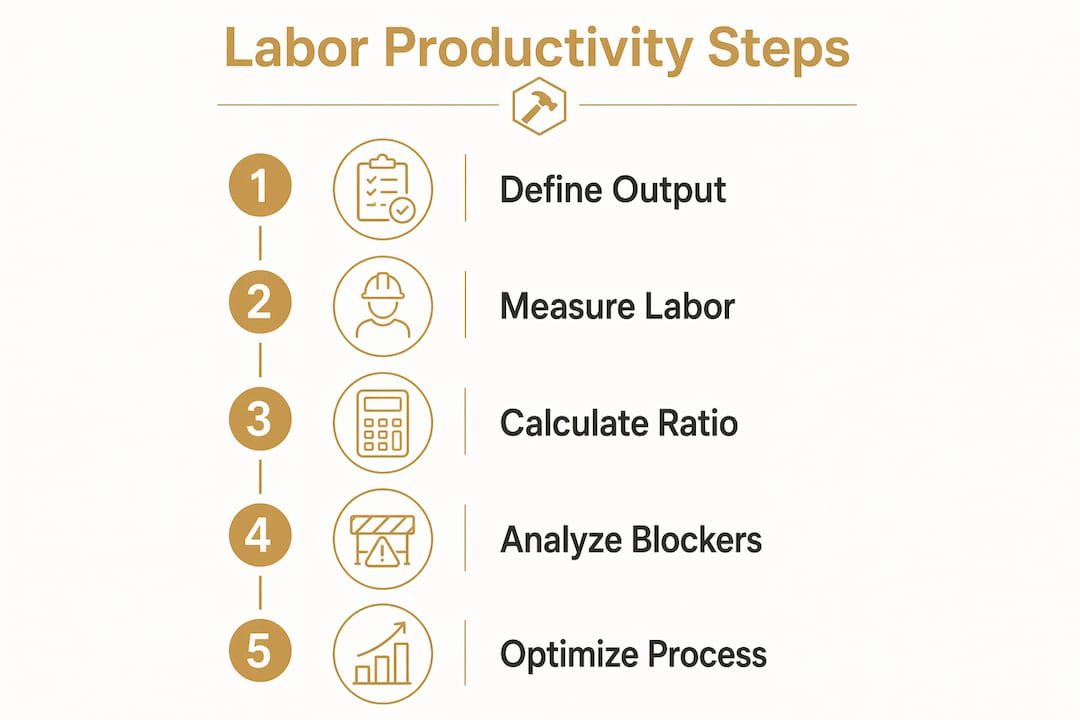
Collecting data is only half the job. The other half is acting on it. These steps give construction managers a practical path from measurement to improvement.
-
Set a baseline before making changes. Run two to four weeks of tracking before drawing conclusions. Baseline data shows you what normal looks like for your crew and project type, which makes anomalies visible.
-
Map your blockers by category. Sort your blocker resolution records into categories: material delays, inspection waits, design clarifications, and equipment issues. The category with the highest frequency or longest resolution time is your first target.
-
Protect focus blocks on the schedule. Build uninterrupted work periods into the daily plan. Protecting deep work periods in skilled trades boosts output and reduces the risks that come with constant task switching. A two-hour focus block for a framing crew produces more than four interrupted one-hour windows.
-
Use async updates to reduce coordination overhead. Daily log entries, photo documentation, and brief written status updates replace time-consuming check-in meetings. This approach works especially well for multi-crew sites where a single meeting pulls multiple foremen off the floor.
-
Adjust staffing based on output data, not gut feel. If your output per labor hour drops on Fridays, check whether crew fatigue, reduced supervision, or late material deliveries are the cause before adding headcount. Adding workers to a broken workflow increases cost without fixing the underlying problem.
-
Track RFI response times as a productivity metric. Unanswered RFIs are one of the most common hidden blockers in commercial construction. Measuring how long each RFI sits before resolution gives you a direct line of sight into design coordination efficiency.
-
Review and share data weekly, not monthly. Monthly reviews are too slow for active job sites. Weekly reviews let you catch a productivity drop before it compounds into a schedule delay.
Key takeaways
Labor productivity tracking works when managers measure output per labor hour, act on blocker data, and frame tracking as a system improvement tool rather than a performance judgment.
| Point | Details |
|---|---|
| Core formula | Divide total output value by total labor hours to get your baseline productivity ratio. |
| Time vs. productivity | Time logs show hours worked; productivity tracking shows how effectively those hours produced output. |
| Behavioral metrics | Deep work ratio, blocker resolution time, and focus block density give more accurate signals than surveillance tools. |
| Transparency reduces distortion | Tell your crew what you track and why; honest framing produces more accurate and useful data. |
| Act on systems, not people | Low productivity scores often point to workflow or supply chain problems, not individual worker failure. |
What I have learned from tracking productivity in the trades
Most managers I have spoken with start productivity tracking the wrong way. They install a time clock, count hours, and call it done. That approach tells you when people showed up. It does not tell you whether the work moved forward.
The shift that actually changes outcomes is moving from surveillance to intelligence. Stop asking “was my crew on site?” and start asking “what did the crew complete, and what stopped them?” Those two questions produce completely different management decisions.
The transparency tax is real, and I have seen it kill otherwise good tracking programs. When a foreman thinks the data is being used to build a case against him, he will find ways to make the numbers look acceptable. You lose the signal you needed. The fix is simple but requires consistency: explain the purpose of every metric you collect, share the results with the crew, and show them how the data led to a change that helped them. Do that three times, and skepticism drops significantly.
One more thing worth saying directly: protecting uninterrupted work time on a job site is not a productivity theory. It is a safety practice. A pipefitter switching between three tasks is more likely to make an error than one who finishes a single run before moving on. Focus block density is not just an output metric. It is a risk metric. Managers who treat it that way get buy-in from crews who would otherwise dismiss productivity tracking as office thinking applied to field work.
— SEAN
Field software built for trades productivity
Debecorp builds field operations software specifically for skilled trades managers who need more than a generic time clock.

CHERP, Debecorp’s core platform, captures the labor metrics and workflow data that matter on active job sites: time and attendance, daily logs, safety compliance, and task progress, material orders and back log, all organized by trade. That means your productivity data reflects how your specific crew actually works, not a generic office workflow. Managers who want to move from manual tracking to structured labor productivity measurement can explore the platform to see how field-built software changes what you can measure and act on.
FAQ
What is the basic formula for labor productivity?
Labor productivity equals total output value divided by total labor hours worked. The Bureau of Labor Statistics uses this formula as the standard measure of workforce efficiency across industries.
How does productivity tracking differ from time tracking?
Time tracking records how long work takes. Productivity tracking measures how much output was produced and how effectively blockers were resolved, giving managers a fuller picture of workforce performance.
What metrics matter most for construction productivity?
Blocker resolution time, focus block density, and output velocity are the most useful metrics for construction managers. These signals come from daily logs and project records without requiring invasive monitoring tools.
Why do low productivity scores not always mean poor worker performance?
The BLS notes that labor productivity is influenced by capital investment, management decisions, and supply chain conditions, not just individual effort. A low score often points to a systemic issue that managers need to fix.
How often should construction managers review productivity data?
Weekly reviews give managers enough frequency to catch drops before they affect the schedule. Monthly reviews are too slow for active job sites where conditions change daily.