Engaged workers are 70% less likely to experience a safety incident than their disengaged counterparts, according to Gallup’s global study of 1.8 million employees. That single figure reframes the entire conversation around jobsite safety. Compliance programs, posted rules, and mandatory toolbox talks matter, but they are not what separates a site with three recordable incidents per year from one with thirty. Engagement is.
The core claim here is straightforward: when workers are genuinely invested in their jobs, they watch out for each other, flag hazards before they become accidents, and treat safety as something they own rather than something imposed on them. Safety consultant Shawn M. Galloway has argued for years that sustainable safety culture cannot be built on rules alone. It requires workers who choose safe behavior because they care about the outcome.
“Engagement shifts safety from forced compliance to shared value, fostering discretionary safety efforts and ownership among employees.”
The practical payoff is measurable. Engaged employees are 5 times less likely to have a safety incident and 7 times less likely to experience a lost-time incident, with incident costs running 6 times lower on average. For a safety manager trying to move the needle, those numbers point directly at engagement as the lever worth pulling.
Key benefits of high engagement on jobsites:
- Fewer recordable incidents and near-misses
- Lower incident-related costs and workers’ compensation claims
- Faster return to work after injuries
- Stronger hazard reporting and proactive risk identification
- Higher morale and reduced turnover among trades workers
Table of Contents
- Why engagement drives jobsite safety more than compliance alone
- How leadership shapes engagement and safety culture
- Core strategies that make engagement work in safety programs
- What workforce trends are doing to engagement and safety
- How Debecorp’s platforms connect engagement to daily safety work
- How do you measure whether engagement is actually improving safety?
- Key Takeaways
- Debecorp gives your crews the tools engagement actually requires
Why engagement drives jobsite safety more than compliance alone
Employee engagement, in a safety context, means the physical, cognitive, and emotional investment a worker brings to their job every day. It goes well beyond showing up and following the rules. A worker who is merely compliant does the minimum required. An engaged worker notices the unsecured load, says something about it, and helps fix it before the shift starts.
The Worker Engagement Maturity Model developed for construction occupational safety and health defines engagement as a process where every worker is motivated and empowered to participate in improving health and safety through meaningful discussion, influencing others, and sharing knowledge. That definition matters because it places the responsibility on both workers and managers. Engagement is not a personality trait. It is a condition that management either creates or fails to create.
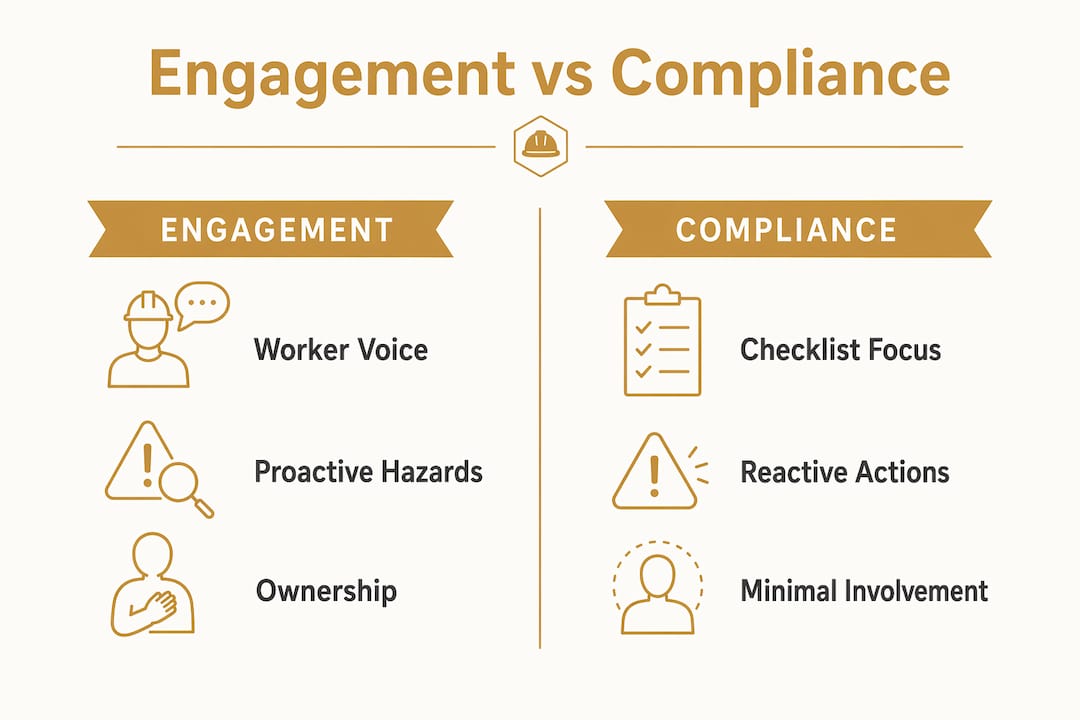
Psychological safety sits at the foundation of that condition. When workers trust that raising a concern will not get them sidelined or labeled a troublemaker, they report hazards. When they fear retaliation, they stay quiet. The difference between those two cultures often shows up in the incident log months later.
The dimensions of engagement that matter most on a jobsite:
- Physical involvement: actively participating in safety inspections, pre-task planning, and hazard identification
- Cognitive investment: understanding why safety procedures exist, not just what they require
- Emotional commitment: caring about coworkers’ wellbeing and taking personal ownership of outcomes
- Autonomy: having the authority to stop work when conditions are unsafe
- Feedback access: receiving timely, honest responses when safety concerns are raised
| Engagement Dimension | What It Looks Like on a Jobsite |
|---|---|
| Physical | Worker participates in daily safety walk-arounds |
| Cognitive | Worker understands the hazard behind each procedure |
| Emotional | Worker speaks up when a colleague skips PPE |
| Autonomy | Worker stops a task when conditions change unexpectedly |
| Feedback | Supervisor responds promptly to reported hazards |
How leadership shapes engagement and safety culture
Leadership is the single biggest variable in whether engagement takes root on a jobsite. Transformational leadership creates work environments where employees feel valued and committed, which directly increases safe behaviors. The mechanism is trust. When a foreman genuinely cares about the people on their crew, those workers reciprocate with discretionary effort, including the kind that prevents accidents.
Frontline supervisors carry the most weight here. A site superintendent sets the tone for every crew under them. If they treat safety conversations as interruptions, workers notice. If they stop what they are doing to walk a new hire through a hazard assessment, that signals something different entirely.
“Managers do things right, while leaders do the right thing. The goal of most managers is to focus on logistics and metrics, while leaders connect the company’s mission to the well-being of those performing the work.”
— Richard D. Fulwiler, ScD, CIH, FAIHA, Harvard T.H. Chan School of Public Health
Leadership actions that consistently build engagement on jobsites:
- Conducting genuine two-way safety conversations, not just briefings
- Recognizing workers who identify and report hazards
- Involving crews in pre-task risk planning before work begins
- Responding visibly and quickly to safety concerns raised by workers
- Modeling the safety behaviors they expect from others
Pro Tip: Ask your foremen one question at the end of each week: “Did anyone on your crew raise a safety concern this week?” If the answer is consistently “no,” the problem is not that the site is perfectly safe. It is that workers do not feel safe enough to speak up.
Core strategies that make engagement work in safety programs
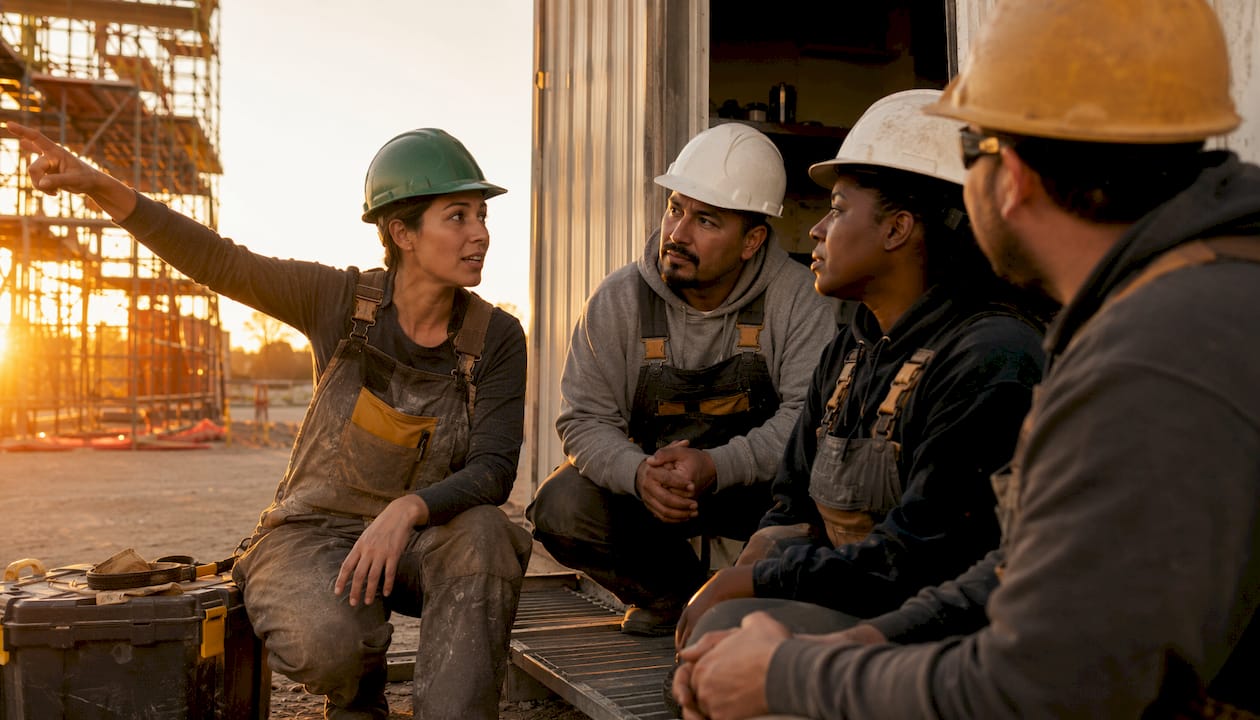
Engagement does not happen by accident. It requires deliberate structures that give workers a real voice in safety decisions and close the loop when they use it. The most effective programs share a few common elements: meaningful participation, consistent feedback, recognition tied to safety behavior, and communication that flows in both directions.
Behavior-based safety practices work best when workers help design them. A checklist created by the crew that uses it gets followed. One handed down from corporate often does not. The same logic applies to training. Generic online modules check a compliance box. Hands-on sessions where workers practice the actual tasks they perform, and where they can ask questions without feeling judged, build real competence and confidence.
Technology plays a growing role in keeping engagement alive between formal safety meetings. Digital tools that capture real-time hazard reports, track near-misses, and push safety updates directly to workers’ phones close the communication gap that often exists between the office and the field. Debecorp’s jobsite communication tools are built specifically for this gap, connecting trades workers to the information and feedback loops that keep them engaged.
Proven engagement strategies for safety managers:
- Build pre-task hazard assessments into daily workflow, not just project kickoffs
- Create a simple, anonymous channel for workers to report concerns
- Tie recognition programs to safety participation, not just incident-free streaks
- Use digital platforms to push real-time safety updates to field crews
- Review near-miss reports in crew meetings and share what changed as a result
Pro Tip: Recognition tied to incident-free days can backfire by discouraging workers from reporting near-misses. Recognize the behavior you actually want: hazard identification, speaking up, and participation in safety planning.
What workforce trends are doing to engagement and safety
The construction workforce is changing faster than most safety programs have adapted. Demographic shifts, persistent labor shortages, and the growing presence of workers from diverse language backgrounds all create friction in the engagement equation. A worker who cannot fully understand a safety briefing delivered in English is not disengaged by choice. The system has failed to meet them where they are.
Labor shortages push crews to work with higher proportions of newer, less experienced workers. That changes the risk profile of every jobsite. Experienced workers carry institutional knowledge about site-specific hazards. When turnover is high, that knowledge walks out the door. Engagement correlates with lower turnover, which means it also preserves the safety knowledge that keeps sites safer over time.
Shift work and irregular schedules fragment the communication patterns that engagement depends on. A worker who rotates shifts may never attend the same toolbox talk twice. Digital communication tools that deliver safety updates asynchronously, and that workers can access on their own schedule, help bridge that gap. Construction signal intelligence platforms like Shovld address exactly this problem by using data to surface safety behavior patterns across crews and shifts.
Key challenges and practical responses:
- Language barriers: Provide safety materials and briefings in workers’ primary languages
- High turnover: Build onboarding that embeds safety culture from day one, not week three
- Shift fragmentation: Use digital tools to deliver safety updates outside of scheduled meetings
- Workforce inexperience: Pair newer workers with experienced mentors for the first 90 days
- Psychological safety gaps: Train supervisors to respond to concerns without defensiveness
How Debecorp’s platforms connect engagement to daily safety work
Debecorp built CHERP and SiteComm from the ground up with input from tradespeople who work in the field, not from software developers guessing at what crews need. That origin matters because the gap between a safety tool that gets used and one that collects dust usually comes down to whether it fits how workers actually operate.

SiteComm handles real-time communication across the jobsite, including stand-up meeting coordination, risk updates, and crew-to-crew messaging. CHERP manages field operations including time and attendance, daily logs, and safety compliance documentation, all tailored to specific trades. Together, they create the feedback loops and communication channels that reduce miscommunication on jobsites and keep workers connected to safety information throughout the day.
The platforms support the engagement strategies covered throughout this article. Pre-task hazard assessments can be logged digitally and pushed to the crew before work begins. Near-miss reports go directly to supervisors in real time. Safety compliance data is visible to managers without requiring workers to fill out paper forms at the end of a shift.
Features that directly support worker engagement and safety:
- Real-time hazard reporting from any mobile device on the jobsite
- Daily log tools that capture safety observations alongside productivity data
- Attendance tracking that flags when crew composition changes unexpectedly
- Trade-specific compliance workflows that match how each craft actually works
- Communication tools that connect field crews to supervisors without delay
Pro Tip: Use Debecorp’s daily log feature to track not just what happened, but what workers flagged as concerns. Over 30 days, that data tells you more about your site’s real risk profile than any formal audit.
How do you measure whether engagement is actually improving safety?
Measuring engagement’s impact on safety requires tracking both leading and lagging indicators. Lagging indicators, like recordable incident rates and lost-time frequency, tell you what already went wrong. Leading indicators tell you whether the conditions for safety are improving before an incident occurs.
The most useful leading indicators for engagement include:
- Hazard report rate: How many hazards are workers identifying and reporting per week? A rising number usually signals growing psychological safety, not a more dangerous site.
- Near-miss reporting frequency: Near-misses are free lessons. Sites where workers report them have better safety cultures than sites where they go unrecorded.
- Safety participation rate: What percentage of workers actively contribute to pre-task planning, toolbox talks, or safety inspections?
- Supervisor response time: How quickly do supervisors close the loop on reported concerns? Slow response kills future reporting.
- Turnover rate: High turnover is both a symptom of low engagement and a driver of increased incident risk.
Tracking worker satisfaction alongside safety metrics gives safety managers a fuller picture. A crew that scores low on satisfaction surveys and high on incident rates is telling you something consistent. A crew that scores high on both is showing you what the target looks like.
Pair quantitative metrics with periodic qualitative check-ins. A five-minute conversation with a crew member at the end of a shift often surfaces more actionable information than a quarterly survey. The goal is not to collect data for its own sake. It is to close the loop fast enough that workers believe their input actually changes something.
Key Takeaways
Engaged workers are significantly less likely to have safety incidents and lost-time incidents, making employee involvement a key lever for safety managers.
| Point | Details |
|---|---|
| Engagement outperforms compliance | Workers who own safety outcomes report more hazards and take proactive steps that rules alone cannot mandate. |
| Leadership sets the ceiling | Transformational supervisors who respond visibly to safety concerns create the trust that makes engagement possible. |
| Measure leading indicators | Hazard report rate, near-miss frequency, and supervisor response time predict safety outcomes before incidents occur. |
| Workforce trends demand adaptation | Labor shortages, language diversity, and shift fragmentation require digital tools and flexible communication to sustain engagement. |
| Debecorp connects engagement to daily workflow | CHERP and SiteComm give trades workers real-time communication and safety compliance tools built around how they actually work. |
Debecorp gives your crews the tools engagement actually requires
Safety managers who understand the engagement-safety link still face a practical problem: most field software was not built to support it. Forms designed for office workers, communication tools that require a laptop, and compliance workflows that ignore trade-specific differences all create friction that erodes the engagement you are trying to build.
Debecorp’s CHERP and SiteComm platforms were designed by people who have worked in the trades, for crews who spend their days on jobsites rather than at desks. CHERP handles the operational layer, including attendance, daily logs, and trade-specific safety compliance, so workers spend less time on paperwork and more time on the work itself. SiteComm keeps communication flowing in real time between field crews and supervisors, closing the feedback loop that engagement depends on. The result is a jobsite where workers stay connected, concerns get addressed, and safety data reflects what is actually happening on the ground. See what CHERP and SiteComm can do for your crews and request a demo today.