
Track worker performance fairly by combining role-aligned KPIs, continuous evidence collection, and structured calibration. That’s the whole system. Everything else is execution.
Here’s where to start today:
- Set one role-specific KPI for each direct report before your next shift. Not a generic goal — something tied to what that person actually does (safety compliance rate for a site safety officer, task completion rate for a journeyman).
- Schedule a biweekly 1:1 of 45 minutes. Block it now. McKinsey’s research on procedural fairness shows that transparent goals and consistent coaching are what make employees perceive a performance system as fair — not just the rating itself.
- Document one concrete work example per worker this week. A specific behavior, a completed task, a safety observation. One entry. That’s how the evidence habit starts.
The EEOC recommends communicating performance standards early and applying them consistently across all employees. Debecorp’s CHERP platform handles exactly this for field crews: time and attendance, daily logs, and safety records in one place, with role-based access so the right people see the right data. SiteComm adds the community and communication layer. Together, they give managers documented, timestamped evidence before calibration season arrives.
Key Takeaways
Fair performance tracking requires combining role-aligned KPIs, continuous documented evidence, and structured calibration — with procedural fairness as the standard every step of the way.
| Point | Details |
|---|---|
| Start with role-aligned KPIs | Define measurable, role-specific success criteria before the review period begins to reduce subjectivity. |
| Document evidence continuously | Log one behavioral example per worker per week; biweekly 1:1s turn reviews into summaries, not surprises. |
| Calibrate before finalizing ratings | Cross-manager calibration sessions catch bias and inconsistency before ratings become official. |
| Separate development from evaluation | Keep coaching notes in a distinct stream; only include peer feedback in evaluations with explicit consent. |
| Debecorp’s CHERP and SiteComm | Provide timestamped field evidence, role-based KPI configuration, and separated data streams for fair trades-specific tracking. |
Table of Contents
- How do you track worker performance fairly?
- How do you set clear, role-aligned goals and KPIs?
- What evidence types give you the fairest picture of a worker?
- What meeting cadences and checklists support continuous tracking?
- How should you use software without creating surveillance concerns?
- How do calibration meetings and manager training reduce bias?
- How do you document reviews and run fair conversations?
- How do you handle underperformance fairly before and during a PIP?
- How CHERP and SiteComm support fair performance tracking in the trades
- Why procedural fairness matters more than you think
- CHERP and SiteComm: built for the way trades teams actually work
- Sources
How do you track worker performance fairly?
The short answer: build a system where every rating can be traced back to documented evidence, applied the same way for every worker in the same role. These eight practices form that system.
- Set role-aligned KPIs before the review period starts. Vague goals produce vague ratings. Define what success looks like for each role, not each person.
- Document specific behavioral examples continuously. One entry per worker per week is enough to build a defensible record over a quarter.
- Use multi-source feedback. Output metrics alone miss how someone works. Peer input, self-assessments, and supervisor observations each catch different things.
- Schedule regular check-ins, not just annual reviews. Continuous 1:1s reduce recency bias and turn the formal review into a summary of an ongoing conversation rather than a surprise.
- Separate development data from evaluation data. Coaching notes and growth experiments belong in a different stream than the evidence used to assign ratings.
- Run calibration sessions before ratings are finalized. Cross-manager review catches outliers, halo effects, and inconsistencies before they become grievances.
- Train managers on behavior-based feedback. HBR’s guidance is direct: grounding feedback in observed behaviors rather than impressions prevents bias and makes evaluations more objective.
- Keep records with retention schedules. Notes, KPI snapshots, peer feedback summaries, and meeting logs should be stored, tagged, and retrievable for calibration or legal review.
How do you set clear, role-aligned goals and KPIs?
OPM’s supervisor guide is clear: KPIs must be relevant to the role and balance quantitative and qualitative measures. A KPI that doesn’t match what someone actually does will produce ratings that feel arbitrary — because they are.
The table below maps four common trades roles to example KPIs and measurement methods.
| Role | Example KPIs | How to Measure |
|---|---|---|
| Field foreman | On-time task completion rate; crew safety incident rate | Daily logs, project management records, safety reports |
| Journeyman electrician | Rework rate; tasks completed per shift | Supervisor observation, daily log entries |
| Site safety officer | Inspection completion rate; near-miss reports filed | Safety compliance records, incident logs |
| Admin / project coordinator | Document turnaround time; scheduling accuracy | Project management system timestamps |
Mini-template for a goal entry:
What: [Specific task or outcome] Measure: [How success is quantified or observed] Target: [Threshold or benchmark] Timeframe: [Review period or milestone date]
When business context shifts — a new contract type, a crew restructure, a regulatory change — revisit KPIs at the start of the next review period. A KPI that no longer reflects the job is worse than no KPI at all, because it creates the appearance of objectivity without the substance.
Pro Tip: Link every KPI to a specific job duty from the role description. If you can’t trace the KPI back to a documented responsibility, it probably shouldn’t drive a rating.
What evidence types give you the fairest picture of a worker?
No single data source tells the whole story. A worker who hits every output metric but creates friction on the crew is not performing at the same level as one who hits the same numbers and mentors two apprentices. The evidence pack needs both.
Evidence types to collect:
- Output metrics: KPI results, task completion rates, production logs
- Behavioral observations: Supervisor notes on how work is done, not just what gets done
- Peer and 360 feedback: Input from coworkers, crew leads, or adjacent teams
- Self-assessments: The worker’s own account of the period — often surfaces context a supervisor missed
- Customer or client feedback: Relevant for foremen and coordinators with external contact
- Safety records: Incident reports, near-miss logs, inspection results
- Attendance logs: Patterns that affect crew reliability and project timelines
Weightings should reflect the role. A field foreman’s rating might weight output metrics and safety records at roughly 60% and behavioral/peer evidence at 40%. A project coordinator’s might flip that balance, since relationship quality and communication drive most of their impact. There’s no universal split — the point is to decide the weighting before the review period, not after you’ve seen the results.
Pro Tip: Keep development-only feedback in a separate stream from evaluation evidence. Peer coaching notes, growth experiments, and candid 1:1 reflections should not automatically flow into a formal rating without the worker’s explicit consent. Get that consent in writing, and document where each piece of evidence lives.
Gathering worker feedback on construction sites requires a clear protocol — especially for peer input — so workers trust the process and participate honestly.

What meeting cadences and checklists support continuous tracking?
Annual reviews fail because they ask managers to reconstruct 12 months from memory. The fix is a cadence that generates evidence continuously, so the review is a summary, not a reconstruction.
Recommended cadence:
- 15-minute weekly touch (manager-led, standing)
- 45-minute biweekly 1:1 (structured, documented)
- Monthly progress snapshot (KPI update, trend note)
- Quarterly calibration (cross-manager, rating alignment)
15-minute weekly touch checklist:
- Worker shares one win and one blocker from the past week.
- Manager confirms KPI progress is on track or flags a gap.
- Log one behavioral observation or output note in the system.
- Confirm next week’s priorities are clear.
45-minute biweekly 1:1 checklist:
- Worker reviews their own KPI progress before the meeting.
- Manager reviews documented examples from the past two weeks.
- Discuss one development area with a specific next action.
- Update the worker’s dashboard record: current KPI status, trend indicator, latest example, peer feedback summary, planned development action.
- Both parties confirm what was agreed and when the next check-in is.
Dashboard fields to maintain per worker:
- Current KPI status (on track / at risk / off track)
- Trend indicator (improving / stable / declining)
- Latest documented behavioral example (date and description)
- Peer feedback summary (most recent input, source noted)
- Planned development action (what, by when)
- Last check-in date
Real-time jobsite updates feed directly into this kind of dashboard when the platform is configured correctly — managers get timestamped evidence without chasing it down manually.
How should you use software without creating surveillance concerns?
Technology should generate evidence, not replace judgment. The risk isn’t using tools — it’s using them without telling workers what the data is for.
| Tool category | Evidence it supports | Best suited for | Main fairness risk |
|---|---|---|---|
| Time & attendance platforms | Hours worked, attendance patterns, punctuality | Field crews, hourly workers | Treating presence as performance |
| Task / project management | Task completion, deadlines, workload distribution | Project coordinators, foremen | Overweighting visible tasks |
| Performance management platforms | KPI tracking, review records, goal history | HR, managers across all roles | Rating inflation if not calibrated |
| Peer recognition apps | Positive behavioral signals, team contributions | All roles | Popularity bias, participation gaps |
| Dashboards / analytics | Trend data, KPI aggregation, period comparisons | HR, senior managers | Decontextualized numbers |
The fairness principle here is transparency. Workers should know what data is collected, how it’s used in evaluations, and what stays in the development stream only. Time tracking methods for field workers vary in how much visibility they give workers — the best deployments let workers see their own records and flag errors.
Pro Tip: At the start of each review period, share a one-page data map with your team: what gets tracked, where it goes, and what it influences. Workers who understand the system trust it more — and that trust is what makes the data useful.
How do calibration meetings and manager training reduce bias?
Calibration is the step most organizations skip and then wonder why their ratings feel inconsistent. It’s the mechanism that turns individual manager judgment into an organizational standard.
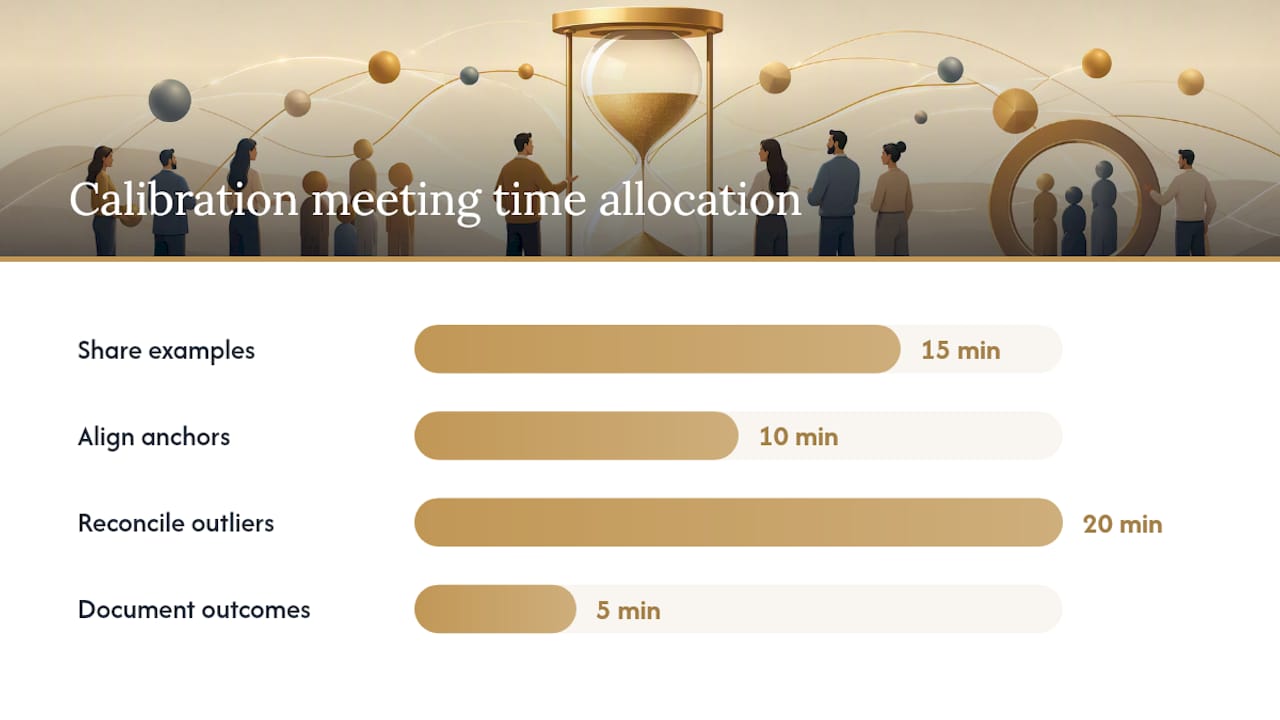
Calibration meeting agenda (quarterly):
- Prep data (before the meeting): each manager brings KPI summaries, documented examples, and draft ratings for their direct reports.
- Share examples (15 minutes): each manager presents one high performer and one developing performer with supporting evidence.
- Align anchors (10 minutes): agree on what a “meets expectations” rating looks like for each role, using real examples from the group.
- Reconcile outliers (20 minutes): flag ratings that sit significantly above or below the group norm and require additional evidence to defend.
- Document outcomes (5 minutes): record agreed adjustments and the rationale for each.
UNC’s workshop guide on fair appraisals identifies manager preparation — reviewing the period, gathering multiple perspectives, and reading self-assessments — as the foundation of balanced ratings.
Manager training highlights:
- Behavior-based feedback: Describe what you observed, not what you inferred. “She completed the safety walkthrough checklist on time for 11 of 12 weeks” beats “she’s generally reliable.”
- Documenting facts: Every rating should trace back to at least two documented examples from the review period.
- Bias awareness: Train specifically on halo bias (one strong trait inflating the whole rating), recency bias (overweighting the last month), and affinity bias (rating people like yourself more favorably).
- Monthly audit checklist: Review whether all direct reports have at least one documented example in the system; confirm no worker has gone more than three weeks without a check-in note.
HBR’s research on vague feedback found that imprecise, personality-based feedback disproportionately harms certain groups — a concrete reason to make behavior-based documentation a non-negotiable standard, not a best practice.
How do you document reviews and run fair conversations?
The review conversation is where the evidence you’ve collected either lands well or falls apart. Structure it so the worker does at least 40% of the talking.
Review conversation template:
- Opening (5 minutes): State the purpose, confirm the period under review, and set a collaborative tone.
- Evidence review (15 minutes): Walk through KPI results and two or three documented behavioral examples. Stick to facts.
- Employee perspective (10 minutes): Ask the worker to share their own view of the period. Listen without interrupting.
- Development plan (10 minutes): Agree on one or two specific growth actions with timelines.
- Close (5 minutes): Summarize what was agreed, confirm next steps, and schedule the follow-up.
Required fields to save after each review:
- Date, attendees, review period covered
- KPI results vs. targets
- Documented examples discussed (minimum two)
- Employee’s self-assessment summary
- Agreed development actions and timelines
- Manager’s rating and rationale
Sample phrasing for common scenarios:
- Praise: “Over the past quarter, you completed safety inspections on schedule in 10 of 11 weeks. That consistency directly supported our zero-incident run on the north site.”
- Development area: “In three of our check-ins, we discussed turnaround time on material requests. The target is 24 hours; the average this quarter was 38. Here’s what I’d like us to try next period.”
- Negotiating next steps: “You’ve flagged that the scheduling tool creates extra steps. Let’s agree on a 30-day trial of the new workflow and review the data together.”
Documentation checklist:
- Store meeting notes, KPI snapshots, peer feedback summaries, and agreed actions in the worker’s record.
- Retain records for a minimum of one year after the review date, or longer per your organization’s legal guidance.
- Tag records by role, review period, and rating outcome for fast retrieval during calibration or an EEOC inquiry.
How do you handle underperformance fairly before and during a PIP?
A performance improvement plan that arrives without warning is a legal and cultural liability. The fair sequence starts well before the PIP document.
Manager checklist before starting a PIP:
- Confirm you have at least three documented examples of the specific performance gap, each with dates.
- Verify that prior coaching attempts are on record — verbal feedback, check-in notes, agreed actions.
- Check whether the worker has the resources, tools, and role clarity to meet the standard. A gap caused by unclear expectations or missing equipment is a management problem, not a performance problem.
- Consult HR and, if applicable, legal counsel before issuing the PIP.
- Review the worker’s full record for context: attendance, safety, peer feedback, KPI trend.
PIP mini-template:
Objective: [Specific performance standard the worker must meet] Success measures: [Quantified or observable indicators] Timeline: [Start date, check-in dates, end date] Supports offered: [Training, mentoring, tool access, schedule adjustment] Check-in cadence: [Weekly or biweekly documented meetings]
If progress occurs during the PIP period, document it explicitly and pivot the plan toward development rather than discipline. A PIP that ends in a promotion is a better outcome than one that ends in termination — for the worker, the team, and the organization’s culture. If the gap persists after the full timeline with documented support, escalate through your HR process with the complete evidence record in hand.
How CHERP and SiteComm support fair performance tracking in the trades
Most trades managers don’t lack the intention to track fairly — they lack the infrastructure. Paper logs get lost. Memory is unreliable. Calibration sessions stall because no one has the same evidence in front of them.
Before CHERP: A foreman on a mid-size electrical subcontract kept performance notes in a personal notebook. When a calibration session came around, he had strong opinions about two crew members but couldn’t produce documented examples to support either rating. Both ratings were adjusted downward by the calibration group — not because the foreman was wrong, but because he couldn’t defend the evidence.
After CHERP: The same foreman logs daily task completions, safety observations, and attendance directly in CHERP. By calibration time, each worker’s record includes timestamped entries across the full review period. Ratings hold up because the evidence holds up.
SiteComm vignette: A site safety officer used SiteComm’s structured incident reporting to log near-misses, inspection completions, and crew safety briefings throughout the quarter. When her own performance review came up, her manager had a clear, dated record of her contributions — not a vague impression of whether she “seemed on top of things.”
Deployment checklist for CHERP and SiteComm:
- Configure role-based access so workers see their own records and managers see their crew’s.
- Separate development notes from evaluation data at the field level — CHERP is configured to support this distinction.
- Obtain explicit consent before including peer feedback in formal evaluations.
- Run a two-hour manager training session on the platform before the first review cycle.
- Define which export fields feed into calibration reports (KPI summary, example count, attendance trend, safety record).
Pro Tip: Use CHERP’s labor productivity tracking features to generate the quantitative half of each worker’s evidence pack automatically. Pair that with supervisor-entered behavioral notes for a complete, defensible record.
Why procedural fairness matters more than you think
The conventional wisdom on performance management focuses almost entirely on the rating — getting the number right. That’s the wrong target.
McKinsey’s research shows that employees who perceive the process as fair are far more likely to view the system as effective, regardless of whether their own rating was favorable. Procedural fairness — transparent goals, consistent standards, genuine coaching — is what drives trust. The rating is almost secondary.
Here’s a 30-minute team exercise to surface fairness gaps before they become grievances:
“Align on Role KPIs” workshop:
- Gather the team (8–12 people, one role group at a time).
- Ask each person to write down the three things they believe they’re primarily evaluated on.
- Collect the responses anonymously and read them aloud.
- Compare against the official KPIs for the role.
- Gaps between what workers believe and what managers measure are your fairness problem. Address them before the next review cycle.
Expected output: a revised, co-created KPI list that workers understand and accept. That buy-in is worth more than any rating scale you could design.
CHERP and SiteComm: built for the way trades teams actually work
If you’ve read this far, you have a complete framework. The gap between a framework and a working system is usually infrastructure — somewhere to log evidence, a way to separate development from evaluation, and a platform your crew will actually use in the field.
CHERP and SiteComm from Debecorp were built from the ground up with input from tradespeople, not adapted from office software. Three things that matter for fair tracking:
- Documented evidence at the point of work: Daily logs, attendance, safety records, and task completions captured in the field — not reconstructed from memory at review time.
- Role-based KPI configuration: Set trade-specific metrics that match what each worker actually does, from journeyman electricians to site safety officers across 14 trade categories.
- Separated development and evaluation streams: Coaching notes stay in the development layer; only consented, evaluation-relevant data flows into formal reviews.
See how CHERP and SiteComm work for your crew at Debecorp.
Sources
These sources directly support the practices in this guide and are worth bookmarking when building or defending organizational policy.
- 5. I’m conducting performance evaluations. | U.S. Equal Employment Opportunity Commission
- Measuring employee performance – A Supervisor’s Quick Guide (OPM)
- 6 ways to make performance reviews more fair (HBR)
- Research: Vague feedback is holding women back (HBR)