
Start with short, anonymous pulse surveys combined with foreman-led check-ins and a visible close-the-loop process. That combination works because it meets crews where they are: no app download, no login, no literacy barrier. Workers on mixed-hire sites are far more likely to respond honestly when they know their answers cannot be traced back to them.
Two immediate steps for this week: pick three questions (one on safety, one on leadership, one open-ended) then choose your delivery channel (QR code at site entry, SMS link, or paper drop box). Commit to acknowledging responses promptly, even if the only message is “We heard you. Here’s what we’re looking at.” That acknowledgment is what keeps participation alive past week one.
Week-1 checklist:
- Choose 3 questions covering safety perception, leadership clarity, and one open prompt
- Pick 2 delivery channels that match your crew’s tech access
- Schedule a foreman briefing before launch so supervisors can encourage participation without pressuring anyone
- Commit to a 72-hour acknowledgment and a 1–4 week fix cycle for operational items
Run a one-week pilot on a single site before scaling. The data you collect, even from a small crew, will show you which questions land and which channels your workers actually use.
Table of Contents
- What feedback methods work best on active jobsites?
- How do you design surveys that construction crews actually complete?
- How do you collect feedback on an active jobsite without disrupting work?
- How do you turn raw feedback into fixes that workers can see?
- What privacy and anti-retaliation safeguards do you need?
- Ready-to-use templates you can copy today
- How CHERP and SiteComm make this practical at scale
- Key Takeaways
- Why listening is the job, not a nice extra
- CHERP and SiteComm: built for the feedback loop your sites need
- Useful sources and further reading
What feedback methods work best on active jobsites?
The right method depends on your crew’s size, tech access, and the sensitivity of what you’re trying to learn. No single channel covers everything, so most effective programs run two or three in parallel.
Pulse surveys (3–8 questions) are the workhorse. They align with shifting project phases, surface local problems fast, and take under three minutes to complete. Delivered via QR code or SMS, they require no login and no app. Response rates climb when the survey is short enough to finish before the morning safety briefing ends.
Toolbox talks are already part of most sites’ daily rhythm, which makes them a natural vehicle for verbal check-ins. A foreman can ask two structured questions at the end of a talk and record answers on a tablet. The tradeoff: social pressure is real. Workers are less likely to flag a concern about their direct supervisor when that supervisor is standing in front of them.
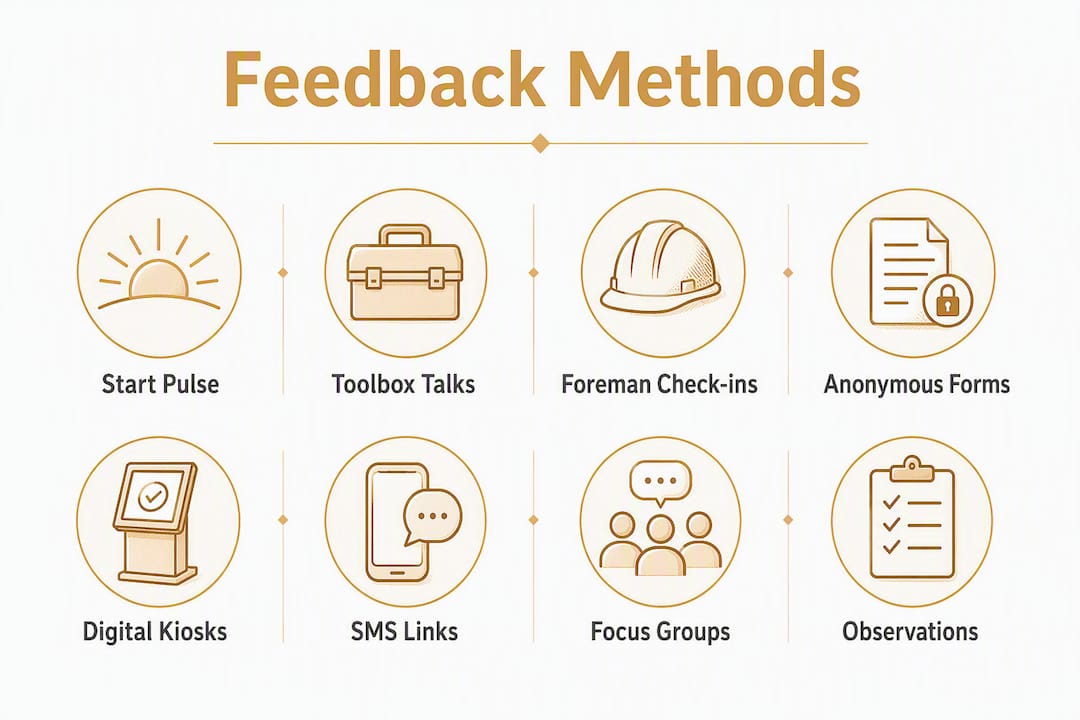
Foreman-led 1:1 check-ins work well for sensitive topics, especially when a foreman has built genuine trust with the crew. Keep them short (5–10 minutes), use a structured prompt list, and train foremen to listen without defending.

Anonymous drop boxes and paper forms remain the most accessible option for low-literacy or low-tech crews. They are slow to aggregate but carry high trust because workers can see the physical separation between their response and management.
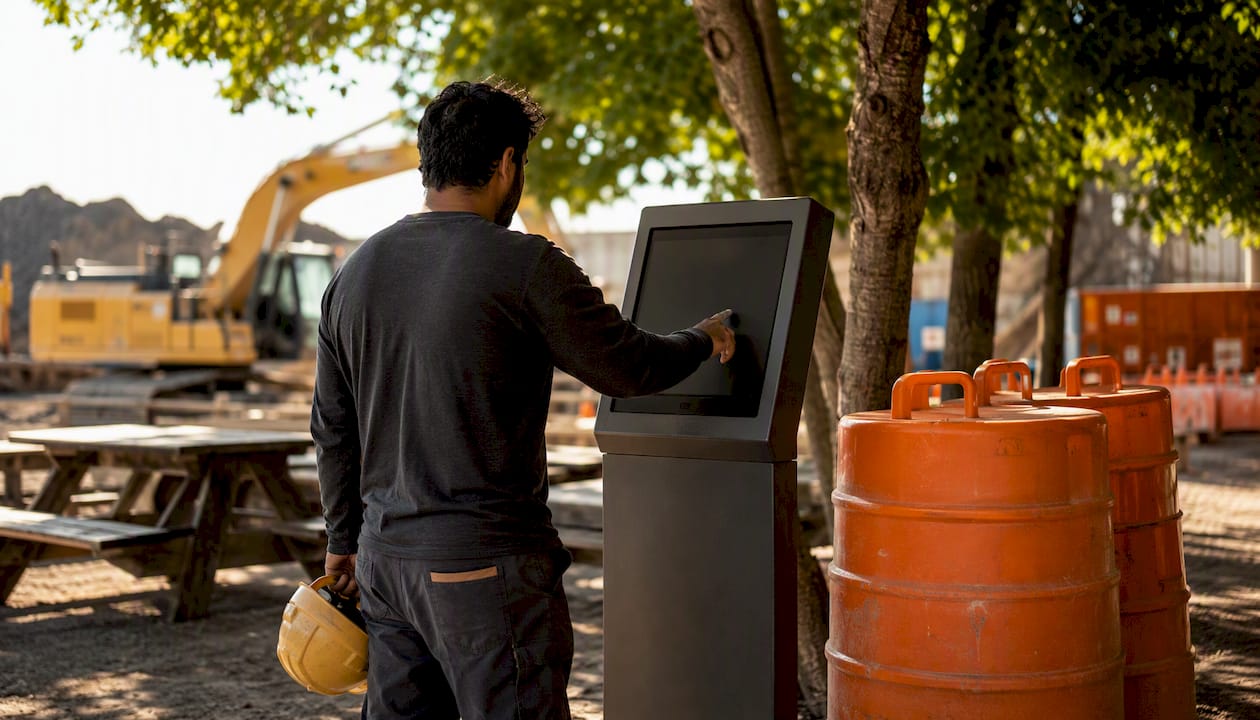
QR-code kiosks at site entry or break areas combine the anonymity of paper with digital aggregation. A shared tablet or printed QR sheet costs almost nothing to set up and works even on sites with patchy Wi-Fi if the form is cached offline.
SMS and WhatsApp links reach workers on their personal phones without requiring a company account. Response rates on SMS tend to be higher than email for field crews, and the format forces brevity on both sides.
Focus groups are worth running once per project phase when you need depth rather than breadth. Keep them to 6–8 workers, use an external or neutral facilitator for sensitive topics, and never record without consent.
Observation and ride-alongs give you behavioral data that surveys miss: where crews slow down, where workarounds appear, where safety shortcuts happen. Pair observation with a short debrief survey to get the “why” behind what you saw.
360-style feedback (peer and upward reviews) is most useful for foreman development. It requires more structure and stronger anonymity controls than a pulse survey, so it fits better in a quarterly cycle than a weekly one.
| Method | Best for | Anonymity | Speed to insight | Depth |
|---|---|---|---|---|
| Pulse survey (QR/SMS) | Weekly morale, safety flags | High | 24–72 hours | Low |
| Toolbox talk check-in | Quick verbal pulse | Low | Same day | Medium |
| Foreman 1:1 | Sensitive issues, development | Medium | Same day | High |
| Paper drop box | Low-tech/low-literacy crews | High | 3–5 days | Low |
| Focus group | Phase-level deep dives | Medium | 1–2 weeks | High |
| Observation | Behavioral/safety gaps | N/A | 1–2 weeks | High |
| 360 review | Foreman development | High (aggregated) | Quarterly | High |
A feedback culture in construction depends on running multiple channels consistently, not just launching one survey and waiting.
Pro Tip: For multilingual crews, pair every QR or SMS link with a language selector as the first screen. A Spanish-speaking carpenter who hits an English-only form will close it in seconds.
How do you design surveys that construction crews actually complete?
The single biggest design mistake is length. A 20-question survey built for an office worker will get a 10% response rate on a jobsite. Three to eight questions, plain language, one idea per question: that’s the target.
Design rules that hold up in the field:
- Use a 1–5 scale or a simple yes/no for most questions. Emoji scales () work well for low-literacy crews and require zero translation.
- Include exactly one open-text field per survey. More than one and completion rates drop sharply.
- Never require a login. Every extra step cuts participation.
- Offer the survey in the languages your crew actually speaks. Even a rough translation signals respect.
- Put the safety question first. Workers are most alert at the start, and it signals that safety is the priority.
Sample pulse questions (3-question version):
- On a scale of 1–5, how safe did you feel on site this week?
- Does your foreman give you clear instructions before each task? (Yes / Sometimes / No)
- What’s one thing that would make your job easier this week? (Open text)
Sample engagement survey questions (for a deeper monthly or quarterly pulse):
- My supervisor treats me with respect. (1–5)
- I receive the tools and materials I need to do my job well. (1–5)
- Safety concerns I raise are taken seriously. (1–5)
- I understand what is expected of me on this project. (1–5)
- I feel like my work is valued by the company. (1–5)
- Communication between trades on this site is effective. (1–5)
- I have received adequate training for my current tasks. (1–5)
- I would recommend this company to another tradesperson. (1–5)
- What is working well on this site? (Open text)
- What needs to change? (Open text)
Voluntary turnover in construction is driven more by poor leadership, ineffective communication, and feeling undervalued than by pay alone. Surveys that focus on those three areas surface early warning signs before a worker starts looking elsewhere.
Survey design principle: A question that workers can answer in under 10 seconds will get answered. A question that requires them to think about company policy for 30 seconds will get skipped. Write for the person standing at a QR kiosk in work boots, not the person sitting at a desk.
Worker satisfaction survey best practices for construction HR go deeper on question sequencing and scale choices if you want to refine your template further.
Pro Tip: Order questions from least sensitive (safety, tools) to most sensitive (leadership, intent to stay). Workers who answer the first two questions are far more likely to complete the rest.
How do you collect feedback on an active jobsite without disrupting work?
Timing and channel setup are where most programs fail. A survey link sent at 6:00 AM before a crew has coffee, or at 4:45 PM when everyone is loading out, will get ignored.
Five-step deployment checklist for a site pilot:
- Set up your channel. Print QR codes and laminate them at site entry, the break area, and the tool crib. For SMS delivery, load the survey link into a short text message and send it from a project number workers already recognize.
- Brief your foremen. Spend 10 minutes explaining what the survey is, why it’s anonymous, and what you’ll do with the results. Foremen who understand the purpose will encourage participation; foremen who feel blindsided will undermine it.
- Choose your timing window. The last 10 minutes of the morning safety meeting or the first 10 minutes of the lunch break are the two highest-participation windows on most sites. Avoid end-of-shift when workers are focused on getting home.
- Set a cadence. Weekly during peak activity phases, fortnightly during steady phases. More frequent than weekly creates survey fatigue; less frequent than fortnightly misses fast-moving project problems.
- Communicate the incentive. On-site catered meals during collection periods are one of the most effective response-rate tactics in construction. Even a simple “coffee and donuts at the break area while you fill out the 3-question survey” works. Short, focused surveys with tangible incentives consistently outperform longer surveys with no incentive.
Channel options by crew type:
- Direct-hire crews with smartphones: SMS link or QR scan
- Subcontractor crews with mixed tech access: QR kiosk + paper backup
- Low-literacy or ESL workers: foreman-assisted verbal administration with paper recording
- Remote or low-connectivity sites: offline-capable forms with bulk upload when connectivity returns
Pro Tip: On low-connectivity sites, use a form tool that caches responses locally and syncs when the device reconnects. Foreman-assisted paper-to-digital capture is a reliable fallback: the foreman reads questions aloud, marks answers on a paper form, and enters them into a tablet at the end of the day.
For SMS and messaging channel setup, the construction team messaging guide covers foreman workflows and channel configuration in detail.
How do you turn raw feedback into fixes that workers can see?
Collecting responses is the easy part. The gap that kills most feedback programs is the silence between “we got your answers” and “here’s what changed.” Workers who submit feedback and hear nothing back will not submit again.
Segmentation first. Before you analyze anything, split your data by site, trade, shift, and employment type (direct hire vs. subcontractor vs. labor-hire). Site-level dashboards and segmentation by project phase reveal hotspots that company-wide averages hide. A safety concern that affects only the concrete crew on Site B will be invisible in a company-wide average. Mixed-workforce environments will dilute or hide localized morale and safety issues if you don’t segment.
Triage by urgency:
- 24–72 hours: Any safety flag, near-miss report, or harassment concern. Acknowledge it publicly (without identifying the respondent) and state the next step.
- 1–4 weeks: Operational friction (tool availability, scheduling gaps, communication breakdowns). Assign an owner and a deadline.
- Quarterly: Policy and HR-level changes (training programs, pay structures, onboarding). Feed these into the next planning cycle.
Sample KPI tracking table:
| Metric | What it measures | Target (week 1 pilot) |
|---|---|---|
| Response rate | Participation level | Aim for substantial participation of crew |
| Net positivity score | % positive vs. negative responses | Baseline only |
| Safety flag rate | Safety concerns per responses | Track trend |
| Intent-to-stay indicator | % who would recommend the company | Baseline only |
| Action close rate | % of flagged items with a documented response | Aim to close all within a timely period |
Set a minimum response threshold before releasing results to site managers. Very few responses from a small crew can inadvertently identify individual workers. Aggregate and delay reporting when crew sizes are small.
Pro Tip: Post a one-page “What We Heard / What We Did” summary on the site noticeboard within two weeks of each survey cycle. Workers who see their input reflected in a visible change are the most reliable repeat respondents.
Reducing miscommunication on jobsites is often the first operational fix that emerges from feedback data, and it has a direct effect on both safety and retention.
What privacy and anti-retaliation safeguards do you need?
Workers will give honest feedback when they believe it is anonymous and when they see rapid, visible action on what they share. Both conditions require deliberate design.
Privacy checklist:
- Do not collect names, badge numbers, or device IDs unless a worker voluntarily identifies themselves for follow-up
- Explain clearly, before the first question, how responses will be stored, who will see them, and what they will be used for
- Set a minimum aggregation threshold (typically 5 responses) before any site-level results are shared with managers
- Keep identifiable escalations (harassment, safety violations) in a separate HR-only channel, never in the general dashboard
- Use delayed reporting for small crews: hold results until enough responses accumulate to prevent identification
Anti-retaliation steps:
- Train foremen explicitly on what retaliation looks like (schedule changes, task reassignment, exclusion) and document that training
- Publish a response timeline so workers know when to expect acknowledgment
- Include a named HR contact for confidential escalation in every survey communication
- For high-sensitivity sites (recent incidents, union activity, leadership disputes), use an external facilitator rather than internal staff
Protecting minority voices in small crews requires aggregation thresholds, delayed reporting, and sometimes external facilitation. These are not optional extras; they are what separates a program workers trust from one they ignore.
Pro Tip: Stage your results release. Share company-wide aggregates first, then site-level summaries, and only release trade-level breakdowns when the sample size is large enough to prevent identification. This sequencing protects workers and still gives managers the granularity they need.
Ready-to-use templates you can copy today
These three templates are designed to be copied directly into your survey tool, printed as paper forms, or read aloud by a foreman. Adapt the language and scale format for your crew.
3-question pulse survey
10-question engagement survey
Engagement Survey (Monthly or Quarterly)
Rate each statement from 1 (strongly disagree) to 5 (strongly agree):
- My supervisor treats me with respect.
- I receive clear instructions before starting a task.
- Safety concerns I raise are taken seriously.
- I have the tools and materials I need.
- I feel like my work is valued.
- Communication between trades on this site works well.
- I have received adequate training for my current role.
- I understand what is expected of me on this project.
- I would recommend this company to another tradesperson.
- What is one thing leadership could do differently? (Open text)
1:1 foreman check-in checklist
Use this as a 5-minute structured conversation, not a formal review:
- What went well for you this week?
- Was there anything that slowed you down or made the job harder?
- Do you have any safety concerns you haven’t raised yet?
- Is there anything you need from me or from the company?
- How are you feeling about the project overall?
Notes for adaptation:
- For low-literacy crews, replace 1–5 scales with emoji faces ( / / ) or thumbs up/down
- For ESL workers, translate the three-question pulse first; it’s short enough to translate accurately in under 30 minutes
- For verbal administration, the foreman reads each question and marks the response; the worker never needs to touch a device
Regular engagement surveys reveal the leadership and communication drivers of retention that turnover data alone cannot explain.
How CHERP and SiteComm make this practical at scale
Running a feedback program manually across multiple sites is manageable for a pilot. Scaling it to 10 sites, three trades, and a mixed workforce is where the logistics break down without a platform built for the field.
Debecorp’s CHERP and SiteComm platforms are built specifically for the skilled trades, which means the feedback infrastructure is designed around how construction crews actually work: no mandatory app install, QR and SMS delivery, offline capture with sync, and role-based access so foremen see their crew’s data and HR sees the company-wide picture.
What the platforms handle that spreadsheets and generic survey tools don’t:
- Multi-channel delivery (QR, SMS, in-app) from a single dashboard
- Offline capture that syncs automatically when connectivity returns
- Multilingual prompt support for mixed-language crews
- Aggregation thresholds and delayed reporting built into the privacy settings
- Segmentation by trade, site, and employment type so hotspots surface at the right level
- Peer recognition and jobsite chat in SiteComm, which creates a feedback-adjacent culture that makes formal surveys feel less transactional
A construction company piloting CHERP on a single site typically sees response rates climb within the first two survey cycles, once workers confirm that their input is anonymous and that something actually changes as a result. The most common first fix is a communication or scheduling gap that was invisible to management but obvious to the crew.
On platform design: The tools that get used on jobsites are the ones that require the least from the worker. One QR scan, three questions, done. CHERP is built around that principle — not around what’s convenient for the software, but around what a tradesperson will actually do at 7:00 AM before a shift starts.
Surveillance-heavy platforms that track GPS or require constant check-ins reduce trust and participation. CHERP focuses on qualitative morale and operational data, which preserves worker privacy and keeps participation rates healthy over time. For a full breakdown of how the platforms map to jobsite needs, the construction team collaboration tools comparison covers the key differences between field-first and office-first platforms.
Pro Tip: Start your CHERP pilot on your highest-turnover site, not your easiest one. The feedback signal will be stronger, the fixes more visible, and the business case for scaling will be clearer.
Key Takeaways
Short, anonymous pulse surveys combined with foreman-led check-ins and a visible close-the-loop process are the fastest, highest-impact way to collect and act on worker feedback in construction.
| Point | Details |
|---|---|
| Start with 3 questions | A pulse survey with one safety, one leadership, and one open question gets completed; longer surveys get abandoned. |
| Anonymity drives honesty | Set aggregation thresholds and avoid collecting identifiers so workers trust the process enough to give candid answers. |
| Close the loop in 72 hours | Acknowledge responses within 72 hours and post a “What We Heard / What We Did” update within two weeks to sustain participation. |
| Segment by site and trade | Company-wide averages hide local problems; always break results down by site, trade, and employment type before acting. |
| Debecorp’s CHERP and SiteComm | Purpose-built for the trades with QR/SMS delivery, offline capture, aggregation controls, and trade-level segmentation across sites. |
Why listening is the job, not a nice extra
There’s a version of this conversation that treats worker feedback as a compliance checkbox: run a survey, file the results, move on. That version produces exactly the outcome you’d expect: workers who stop responding after the second cycle because nothing changed.
The construction managers who build genuinely low-turnover sites share one habit that doesn’t show up in any safety manual. They treat the information their crews give them as operational intelligence, not HR paperwork. A foreman who hears “the material deliveries are always late and we’re standing around for an hour” and actually fixes the delivery schedule has done more for retention than any bonus program.
What gets missed in most feedback guides is the foreman’s role as the first line of response. Workers don’t primarily trust “the company.” They trust their direct supervisor. A foreman who listens without getting defensive, who follows up on what was raised, and who says “I brought that up with the super and here’s what’s happening” is the mechanism that makes any feedback program work. Training foremen to do that, specifically, is where the real leverage is.
The platforms matter because they remove friction and protect anonymity. But the culture change happens in the 10 minutes after a toolbox talk when a foreman asks two questions and actually writes down the answers.
CHERP and SiteComm: built for the feedback loop your sites need
Most feedback tools are built for offices. CHERP and SiteComm are built for the trades, which means the gap between “we collected feedback” and “we acted on it” is measured in hours, not quarters.
With CHERP, you get QR and SMS delivery, offline capture, trade-level segmentation, and privacy controls that protect workers on small crews. SiteComm adds peer recognition and jobsite chat, so feedback becomes part of how your crew communicates every day, not a separate event. You can pilot on a single site in under a week: set up your three-question pulse, brief your foremen, and have your first actionable data before the end of the month.
The CHERP and SiteComm product page has the full feature breakdown and a contact form to schedule a demo. If you want to see how the platforms map to your specific trade and crew size, the trades-specific feature guide shows what each platform does for your craft before you commit to a pilot.
Useful sources and further reading
The guidance in this article draws on industry practice research and Debecorp’s direct experience building field software for the trades. The sources below are worth reading if you want the original data or want to go deeper on specific topics.
External research and guidance:
- Building a feedback culture in construction organizations — CultureMonkey: multi-channel collection and anonymity controls
- What Your Field Crews Won’t Say — But Your Turnover Data Will — Lorman: retention drivers and engagement survey templates
- How to Conduct a Great Performance Review — Harvard Business Review: structured 1:1 and review frameworks applicable to foreman check-ins
Debecorp resources:
- Worker Satisfaction Survey Best Practices — question design and response-rate tactics
- Labor Turnover in Construction: Benchmarks and Action Plan — turnover drivers and prioritization
- How to Measure Worker Satisfaction in the Trades — KPI definitions and measurement methods
- Foreman Communication Tools: Your 2026 Field Guide — foreman training and check-in workflows
Start here if you’re short on time: The three-question pulse template in Section 7 and the five-step deployment checklist in Section 4 are the two pieces you need to run a pilot this week. Everything else in this article supports those two starting points.