
For most mobile trades crews, a GPS-enabled mobile time-and-attendance app with offline mode, per-job cost-code entry, and payroll integrations is the right default. Paper timesheets and spreadsheets cost you accuracy and hours of reconciliation every pay period. Platforms built specifically for the trades, like Debecorp’s CHERP and SiteComm, solve the problems that generic tools miss: split-day assignments, intermittent connectivity, and job-level cost visibility.
Three reasons this matters immediately:
- Payroll accuracy: Geofencing ties clock-ins to verified job-site coordinates, cutting down on end-of-week reconciliation.
- Job costing: Time entries linked to cost codes give you real-time project cost, not just a payroll total.
- Compliance footing: The Department of Labor requires accurate records of all hours worked, including overtime.
Pro Tip: Before evaluating any tool, list every site type your crews visit in a typical week. A solution that works for a single fixed location often fails the moment a technician splits a day across three addresses.
Table of Contents
- Why accurate time tracking is a business-critical problem for field crews
- What time tracking methods field teams actually use
- Must-have features for a field-ready time tracking system
- How to evaluate and choose the right solution
- A step-by-step rollout playbook for mobile crews
- U.S. legal and privacy considerations for tracking mobile workers
- Why CHERP and SiteComm are built for this problem
- Key Takeaways
- The adoption problem is the real problem
- CHERP and SiteComm: a trades-first option worth piloting
- Useful sources and further reading
Why accurate time tracking is a business-critical problem for field crews
Payroll errors in the field are rarely small. A foreman who fills out paper timesheets on Friday afternoon is reconstructing a week from memory, and that reconstruction is almost always wrong in ways that compound: missed overtime, misallocated hours, and job costs that bear no resemblance to reality.
The operational stakes are specific:
- Split-day assignments: A crew member who works two sites in one day needs hours logged to each job code, not lumped into a single daily total.
- Travel time: Drive time between sites is compensable under federal rules in many scenarios, yet most paper systems never capture it.
- Foreman overhead: When supervisors spend 30–45 minutes per day collecting and correcting timesheets, that time comes off the job.
- Stale reconciliation: Payroll teams reconciling week-old paper entries spend time chasing discrepancies that a real-time system would have flagged immediately.
Mid-size general contractors commonly run multiple active projects simultaneously, and without centralized tracking, payroll reconciliation fragments across every one of those sites. Linking labor hours to specific service orders and materials is what reveals true project cost in real time, not just a payroll summary at week’s end.
What time tracking methods field teams actually use
The range runs from a clipboard to fully automated GPS tracking. Each method fits a different crew size, site type, and connectivity reality.

Paper timesheets and the honor system
Still common on small single-site jobs. Zero technology barrier, but accuracy depends entirely on worker memory and honesty. No job-code granularity, no overtime alerts, and reconciliation is manual. Acceptable for a crew of three on a single long-term site; a liability for anything more complex.
Spreadsheets
A step up from paper, but not by much for field work. Spreadsheets work well for office-based time entry after the fact, and Microsoft’s business timesheet templates are a reasonable starting point for very small operations. The problem: no GPS verification, no offline sync, and version control breaks down the moment two supervisors edit the same file.
Shared kiosk or time clock
A tablet or terminal at a fixed site entrance. Works well for a single-location crew but collapses the moment workers move between sites. Buddy punching is a real risk without biometric verification.
Mobile apps with manual clock-in
Workers clock in and out on their phones without location verification. Faster than paper, easier to attach job codes, but still relies on the worker remembering to clock in at the right moment and the right job.
GPS and geofence-enabled mobile apps
The current standard for multi-site field operations. Geofencing restricts clock-ins to verified job-site coordinates, which cuts payroll inaccuracies and eliminates manual reconciliation. The trade-off: GPS jitter on large sites can cause false rejections, so geofence radius needs tuning during rollout.

Automated background trackers
Apps that log location continuously without requiring manual clock-in. High accuracy, but significant privacy implications. Requires clear employee notice and consent policies, especially in states with stricter location-monitoring laws.
Vehicle telematics
GPS units in company vehicles that log drive time and site arrivals automatically. Useful for service route technicians but captures vehicle movement, not individual worker hours. Works best as a supplement to a mobile app, not a replacement.
Pro Tip: For service technicians running a daily route, combine a geofence-enabled mobile app with vehicle telematics. The app captures individual clock-ins; the telematics data provides an independent audit trail for disputed entries.
| Method | Accuracy | Admin burden | Job-cost ready | Offline support | Multi-site fit |
|---|---|---|---|---|---|
| Paper timesheets | Low | High | No | Yes | Poor |
| Spreadsheets | Low–Medium | Medium | Partial | Yes | Poor |
| Shared kiosk | Medium | Low | Partial | No | Poor |
| Manual mobile app | Medium | Low | Yes | Varies | Fair |
| GPS/geofence mobile | High | Very low | Yes | Yes (with sync) | Excellent |
| Automated background | Very high | Very low | Yes | Yes | Excellent |
| Vehicle telematics | High (vehicle only) | Very low | Partial | Yes | Good |
Must-have features for a field-ready time tracking system
Generic time-tracking tools are built for office workers. Field crews need a different feature set, and missing even one of these capabilities creates a gap that paper workarounds will fill.
- Photo and signature proof: — For service technicians, a timestamped photo or customer signature at clock-out creates an audit trail that protects against billing disputes.
- Role-based approvals: Foremen approve their crew’s entries; project managers approve foremen. This is the supervisor hierarchy that keeps approval workflows from bottlenecking at the top.
Pro Tip: Start your geofence radius at a moderate distance, not the tightest possible setting. Parking lots, staging areas, and GPS jitter on large sites will generate false rejections at 50 feet. Run a week of live data, then tighten or expand based on actual clock-in patterns.
For a detailed breakdown of mobile attendance tracking features specific to job sites, Debecorp’s deployment guide covers offline sync and geofence configuration in depth.
How to evaluate and choose the right solution
Start with integrations, not price. A tool that cannot export to your payroll system or job-costing software will create a parallel data entry problem, which is exactly what you are trying to eliminate.
Evaluation checklist:
- Does it support Android and iOS, and does it work on the devices your crews already carry?
- Does offline mode sync automatically, or does it require manual intervention?
- Can you configure multiple geofences for different active sites simultaneously?
- What payroll and accounting formats does it export to natively?
- Does it support role-based admin with crew-level, foreman-level, and project-manager-level permissions?
- Who owns the data, and can you export raw time entries at any time without vendor assistance?
- What is the SLA for support, and is there phone or chat support during field hours?
Pricing models to understand before you sign:
- Per-seat monthly: Most common. Scales with headcount, which can surprise you mid-project when crew size spikes.
- Per-location or per-project: Less common but worth asking about for contractors with variable crew sizes.
- Hidden costs to ask about: Geofence setup fees, payroll integration connectors, training, and data export charges.
Red flags:
- No ability to export raw time entries in a standard format (CSV, Excel, or direct API).
- Forced screenshot or screen-recording surveillance features with no opt-out.
- Opaque data ownership terms that make it unclear whether you can retrieve your own records.
- No offline mode at all.
Consolidated dashboards and overtime alerting are worth prioritizing if you manage crews across multiple active sites, since a single delayed alert on overtime can cost more than a month of software fees.
A step-by-step rollout playbook for mobile crews
A short, controlled pilot prevents long, painful rollouts. Four to eight weeks is enough to verify accuracy, fix edge cases, and build crew confidence before you touch payroll.
| Phase | Duration | Key actions |
|---|---|---|
| Pilot | Weeks 1–2 | Select one crew (8 workers), configure geofences, run parallel with existing method |
| Refine | Week 3 | Adjust geofence radii, fix cost-code mapping, address missing clock-ins |
| Phased deployment | Weeks 4–6 | Roll out crew by crew; supervisors approve entries daily |
| Full integration | Weeks 7–8 | Connect payroll export, retire parallel system, run first full payroll cycle |
Implementation checklist before you start:
- Get sign-off from HR, payroll, and operations on the pilot scope and timeline.
- Confirm device readiness: OS versions, storage, and data plans for field workers.
- Brief supervisors on the approval workflow before workers ever open the app.
- Define the exception-handling process: what happens when a worker forgets to clock in.
- Run a data verification step after week one: compare app entries against the parallel paper record.
KPIs to track during the pilot:
- Clock-in accuracy rate (percentage of shifts with a verified clock-in and clock-out)
- Missing clock-ins per day
- Payroll reconciliation time (hours spent by payroll team)
- Job-cost variance between app data and project manager estimates
- Adoption rate by end of week two
For KPI benchmarks and measurement tactics, Debecorp’s guide on labor productivity tracking covers what to measure and how to interpret early pilot data.
U.S. legal and privacy considerations for tracking mobile workers
Location tracking for legitimate business purposes is legal in the U.S., but “legal” does not mean “no policy required.” The specifics matter.
- Overtime recording: — The Department of Labor requires employers to keep accurate records of all hours worked. Automated tracking that captures off-the-clock activity creates an obligation to pay for that time if it is work-related.
Pro Tip: Draft a one-page employee notice before your pilot launch. It should cover: what the app tracks, when tracking is active, who reviews the data, and how to dispute an entry. Run it past HR and legal before distribution. Storing signed acknowledgments centrally protects you in any future audit.
This article is general information, not legal advice. Confirm your state’s specific monitoring and overtime rules with a qualified employment attorney or your state labor agency.
Why CHERP and SiteComm are built for this problem
Most time-tracking tools were designed for office workers and adapted for the field. CHERP and SiteComm were built from the ground up with input from tradespeople, which shows up in the feature set in ways that matter during a real rollout.
| Field requirement | CHERP / SiteComm capability |
|---|---|
| GPS and geofencing | Multi-site geofence configuration with adjustable radii |
| Offline mode | Local entry storage with automatic sync on reconnect |
| Job and cost-code timestamps | Per-trade job codes tied to daily logs and work orders |
| Payroll and export integrations | Structured export formats for payroll and job-costing systems |
| Role-based approvals | Crew, foreman, and project-manager approval tiers |
| Safety and compliance | Safety compliance tools integrated alongside time and attendance |
| Trade-specific UX | Per-trade field calculators and customizable trade profiles |
CHERP connects time and attendance directly to daily logs, safety compliance, and job records, so a foreman’s approval does more than sign off on hours: it closes the loop on the full day’s field data in one step.
The trades-informed design reduces the adoption friction that kills most rollouts. When the app reflects how a plumber or electrician actually works, including trade-specific workflows and terminology, workers use it correctly from day one instead of finding workarounds by week two.
Pro Tip: During your pilot, assign one foreman as the “exception manager” for the crew. Their job is not to enter time for everyone but to flag and resolve the two or three missing clock-ins that happen every week. This keeps the foreman’s role light and the data clean.
For a full look at how CHERP and SiteComm map to specific trades, Debecorp’s trades-specific capabilities page shows per-trade feature sets and deployment examples.
Key Takeaways
A GPS-enabled mobile app with offline mode, cost-code timestamps, and payroll integrations is the most reliable time tracking method for field workers managing multi-site crews.
| Point | Details |
|---|---|
| Method selection | GPS/geofence mobile apps outperform paper and spreadsheets for multi-site field crews on every accuracy and admin metric. |
| Pilot timeline | A pilot over several weeks (one crew, parallel tracking, then phased rollout) prevents costly full-deployment failures. |
| Compliance baseline | The Department of Labor requires accurate records of all hours worked; configure tracking windows to avoid capturing off-the-clock activity. |
| Feature non-negotiables | Offline mode, cost-code timestamps, role-based approvals, and payroll export are the four features that determine whether a tool actually works in the field. |
| Debecorp recommendation | CHERP and SiteComm deliver trades-built time and attendance with geofencing, offline sync, and integrated job records, designed for the way field crews actually work. |
The adoption problem is the real problem
Most rollouts fail not because the software is wrong but because the change management is thin. I have seen contractors buy solid GPS-enabled platforms and still end up with 40% of their crew clocking in from the parking lot or not at all by week three, because nobody told the foremen what “exception manager” meant in practice.
The conventional wisdom says: pick the tool with the most features and train everyone at once. That approach almost always produces a two-week spike in adoption followed by a slow drift back to paper. What actually works is narrower: start with your most organized foreman and your most predictable crew. Get the data clean on that one crew first. Then let that foreman explain it to the next one.
The other thing people underestimate is how much the app’s UX matters for trades workers specifically. A generic time-tracking tool that uses office-software language and requires five taps to log a job code will get abandoned. An app that speaks the trades, uses familiar terminology, and surfaces the right fields for the right trade, gets used. That is not a marketing claim. It is the difference between a tool that survives a pilot and one that gets quietly uninstalled.
CHERP and SiteComm: a trades-first option worth piloting
Debecorp built CHERP and SiteComm specifically for field operations in the trades, not as a retrofit of an office tool. The concrete difference for managers running a 4–8 week pilot: the platform covers geofencing, offline sync, cost-code timestamps, and role-based approvals in one place, so you are not stitching together a time-tracking app, a payroll export tool, and a separate safety log.
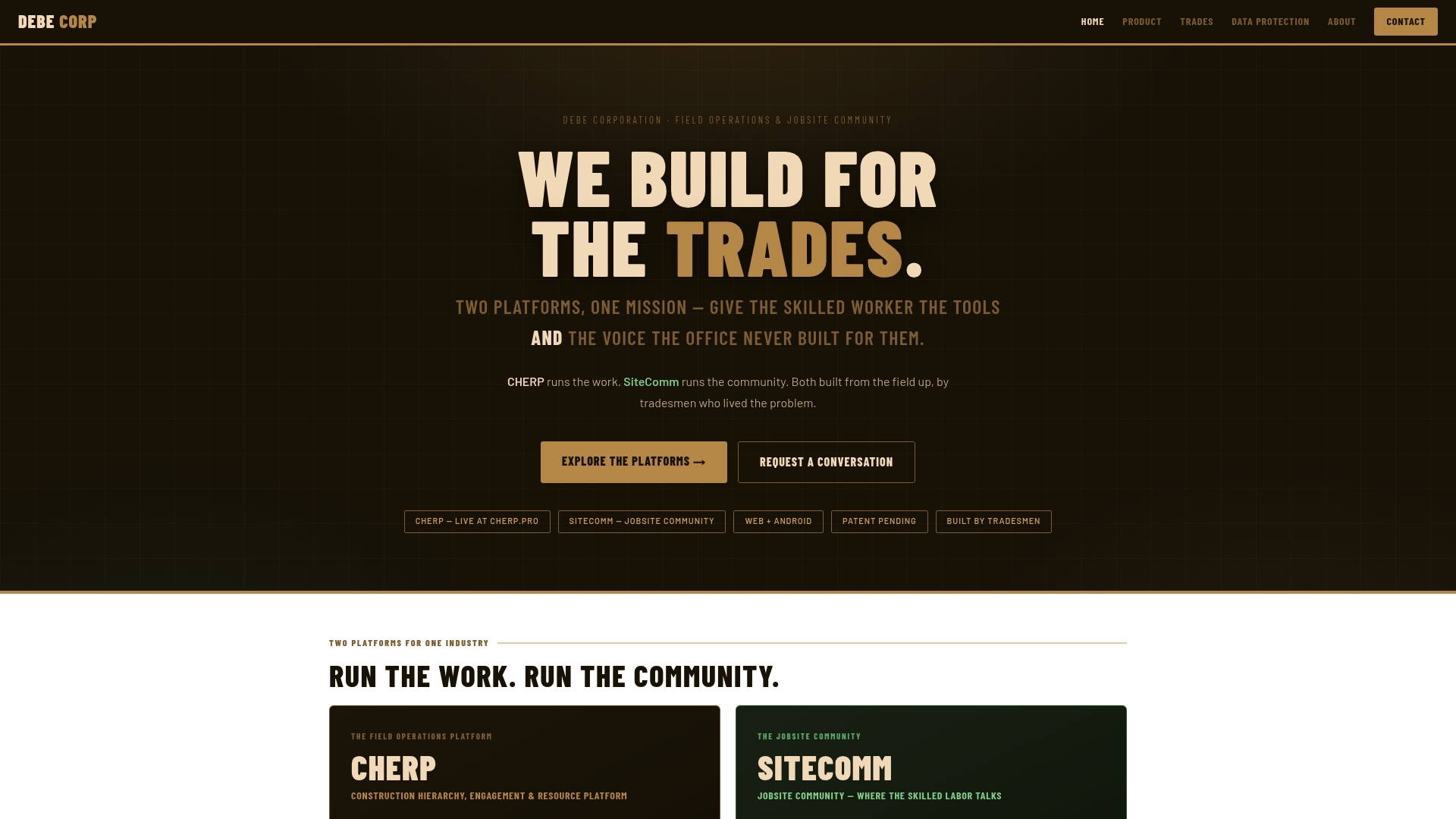
For a pilot, the practical starting point is straightforward: pick one crew of several workers, configure geofences for your most active sites, and run CHERP alongside your current method for an initial two-week period. Compare clock-in accuracy, reconciliation time, and job-cost variance. The CHERP and SiteComm platform page has the feature detail and pilot support information you need to get started. If you want to see how the platform maps to your specific trade before committing, the trades capabilities page breaks it down by craft.
Useful sources and further reading
- U.S. Department of Labor — Back Pay and Hours Worked
- Mobile Attendance Tracking for Jobsites: 2026 Guide — Debecorp
- Labor Productivity Tracking for Construction Managers — Debecorp
- Construction Workforce Intelligence: A Field-First Guide — Debecorp
- Field Worker Productivity Tools Explained for 2026 — Debecorp
- Types of Labor Management Approaches for HR Teams — Debecorp
- Microsoft Business Timesheet Templates