
Labor management approaches are the structured methods organizations use to direct, measure, and improve how their workforce operates day to day. The right approach determines whether your teams hit productivity targets or fall short, whether employees stay engaged or quietly disengage, and whether your operations scale without breaking. Workforce management now integrates planning, skills development, and real-time analytics, moving well beyond traditional headcount control. Understanding the main types of labor management approaches gives managers and HR professionals a real advantage in building teams that perform consistently.
1. What are the main types of labor management approaches?
The most effective types of labor management approaches fall into two broad categories: classical models built around structure and authority, and modern models built around participation and engagement. The strongest organizations do not pick one and stick with it. They apply both, depending on the task and the team.
Organizational behavior models include four core types: autocratic, custodial, supportive, and collegial. Each one matches a different level of employee need and a different operational context.
- Autocratic: The manager holds authority and employees follow directives. Works well for safety-critical tasks and compliance-heavy environments.
- Custodial: The organization provides economic security (benefits, stability) in exchange for employee compliance. Common in large, process-driven industries.
- Supportive: Managers focus on employee growth and motivation. Employees take ownership of their work quality.
- Collegial: Teams operate as partners. Managers act as coaches. Best suited for creative, knowledge-driven, or innovation-focused work.
Classical and modern theories work best as complementary tools, not rivals. A construction foreman running a safety inspection uses autocratic authority. That same foreman running a post-project debrief benefits from a collegial approach.
Pro Tip: Map your tasks before choosing a management style. Routine, compliance-driven tasks respond to classical structure. Complex, judgment-heavy tasks respond to participative models.

2. Strategic workforce planning
Strategic Workforce Planning (SWP) is the most forward-looking of all workforce management strategies. It connects your long-term business goals to the people decisions you make today.
SWP uses a six-year planning horizon with a mandatory three-year midpoint review. That midpoint review is where the real work happens. It forces organizations to check whether their workforce trajectory still matches their business direction, and to set concrete intermediate targets if it does not.
SWP works best when HR and operations leaders collaborate directly. HR brings workforce data. Operations brings project pipelines and skill gap forecasts. Together, they build a plan that is neither too rigid to adapt nor too vague to execute.
3. Time and attendance tracking
Time and attendance tracking is the operational backbone of any labor management system. Without accurate data on when and where people work, every other approach operates on guesswork.
Approximately 70% of construction firms now use time-tracking software to improve workforce efficiency. That adoption rate reflects a broader shift: manual timesheets introduce errors, disputes, and compliance risk that digital systems eliminate. Of those firms using tracking software, 63% favor mobile applications for their accuracy and convenience in the field.
For HR professionals, time and attendance data feeds directly into payroll accuracy, overtime analysis, and labor cost forecasting. For managers, it provides the real-time visibility needed to redeploy crews before a delay becomes a crisis.
4. Performance management systems
Performance management is a continuous labor management technique, not an annual event. The most effective systems set clear expectations, track progress in real time, and give employees feedback they can act on immediately.
Modern performance management connects individual output to team and organizational goals. A skilled trades worker who understands how their daily productivity affects project margin performs differently than one who receives no context. That connection between individual effort and business outcome is what separates high-performing teams from average ones.
Performance data also feeds workforce planning. When you track output consistently, you can identify skill gaps early, recognize top performers before they leave, and build development plans grounded in actual evidence rather than manager impressions.
5. Flexible work arrangements
Flexible work arrangements are a labor relations strategy that directly affects retention and engagement. They give employees control over when and how they work, within the boundaries the operation requires.
Flexibility takes different forms depending on the industry. In office environments, it means remote work options and flexible start times. In field operations and the trades, it means shift flexibility, compressed workweeks, and predictable scheduling that respects workers’ personal commitments. The principle is the same: workers who feel their time is respected perform better and stay longer.
Flexible arrangements also help organizations manage labor costs. Staggered shifts reduce overtime. Compressed schedules lower absenteeism. These are not soft benefits. They show up directly in labor cost per unit of output.
6. Engineered labor standards
Engineered labor standards are one of the most technically precise labor management techniques available. They define work by discrete physical motions, such as travel distance and process steps, rather than by historical time averages.
Task definition by discrete motions enables automated and accurate performance measurement. This matters because historical averages embed inefficiency. If your benchmark includes the time a worker spent waiting for materials, your standard is already inflated. Physics-based task models strip that out and give you a true baseline.
In construction and manufacturing, engineered labor standards prevent schedule compression and fatigue by setting realistic, evidence-based expectations. Managers who use them stop arguing about whether a task took too long. The data answers that question objectively.
Pro Tip: Engineered labor standards require upfront investment in task analysis. Start with your highest-cost, most-repeated tasks. The return on that analysis compounds over every project cycle.
7. Shared buffer management
Shared buffer management is an advanced labor efficiency approach that most organizations overlook. Instead of padding each individual task with contingency time, it pools that contingency across a group of related tasks.
Grouping contingency buffers across specialized tasks reduces inflated costs and allows teams to absorb delays without triggering overtime. The logic is straightforward: not every task will hit its worst-case scenario simultaneously. Shared buffers account for that statistical reality. Individual task padding does not.
In high-stakes projects with multiple specialized trades, shared buffer management prevents the cascade effect where one delayed task inflates the schedule for every task that follows. Project managers who apply this approach consistently report tighter labor cost control and fewer emergency overtime calls.
8. Non-union employee participation strategies
Non-union labor strategies are a legitimate and often underused category of employee management models. Open-door policies and suggestion schemes serve as direct channels for surfacing operational insights and building collaboration when implemented with genuine follow-through.
The key word is “genuine.” A suggestion scheme that collects ideas and never acts on them damages trust faster than having no scheme at all. When managers respond to worker input with visible action, the participation rate increases and the quality of suggestions improves. Workers closest to the work often identify inefficiencies that management cannot see from a distance.
These strategies also reduce the conditions that make unionization attractive. When workers feel heard and treated fairly, they have less reason to seek external representation. That is not a cynical calculation. It is the natural result of a well-run workplace.
9. Technology-enabled labor management
Technology is not a labor management approach on its own. It is the infrastructure that makes every other approach more effective. Real-time visibility through GPS geofencing and compliance alerts differentiates successful field operations from struggling ones by enabling instant labor reallocation.
For managers in the trades and construction, this means knowing exactly where crews are, whether safety compliance steps have been completed, and whether a task is running behind before it affects the schedule. That level of visibility used to require a supervisor walking the site. Now it happens automatically.
For HR professionals, technology-enabled systems feed skills management, training compliance, and workforce analytics into a single view. Field software for the trades built specifically for skilled workers delivers this without the configuration overhead of generic enterprise platforms.
10. Selecting the right approach for your context
No single labor management approach fits every organization. The right choice depends on workforce size, task complexity, union presence, and how much flexibility your operation can absorb.
Manufacturing environments with high task standardization and large crews respond well to classical hierarchical models combined with engineered labor standards. Creative firms and knowledge-work teams perform better under collegial and supportive models. Field operations in the trades benefit most from hybrid approaches that combine real-time tracking, flexible scheduling, and participative feedback channels.
The table below maps common organizational contexts to the approaches that fit them best.
| Organizational context | Best-fit approaches |
|---|---|
| Large manufacturing, high standardization | Autocratic or custodial model, engineered labor standards |
| Construction and skilled trades | Real-time tracking, shared buffer management, SWP |
| Creative or knowledge-work teams | Collegial model, performance management, flexible arrangements |
| Mixed workforce, varied task types | Hybrid diagnostic approach, SWP, non-union participation |
| Small teams, high autonomy | Supportive or collegial model, flexible work arrangements |
The most common mistake managers make is selecting an approach based on personal preference rather than workforce context. A manager who prefers direct authority will default to autocratic methods even when a collegial approach would produce better results. Diagnostic self-awareness is as important as technical knowledge of the models themselves.
Key takeaways
Hybrid labor management approaches that match the model to the task consistently outperform organizations that apply a single fixed style across all workforce contexts.
| Point | Details |
|---|---|
| Hybrid models outperform fixed styles | Apply autocratic methods for compliance tasks and collegial methods for innovation-driven work. |
| SWP requires a long view | Use a six-year planning horizon with a three-year midpoint review to keep workforce plans aligned with business goals. |
| Engineered standards beat averages | Define tasks by discrete motions, not historical averages, to get accurate labor cost baselines. |
| Shared buffers reduce overtime | Pool contingency time across related tasks instead of padding each task individually. |
| Technology enables every approach | Real-time tracking, GPS geofencing, and compliance alerts make all other labor management techniques more effective. |
What I have learned about picking the right labor management model
The biggest mistake I see managers make is treating labor management like a personality test. They find one model that feels right and apply it everywhere. That approach works until it does not, and by then the damage to team performance or morale is already done.
The organizations that get this right treat their management approach the way a good doctor treats a diagnosis. They assess the situation first. They ask: what does this task require? What does this team need right now? Then they choose the method that fits, not the one they are most comfortable with.
The other thing I have seen consistently is that technology adoption without model clarity makes things worse, not better. A GPS tracking system installed in a team that already feels micromanaged will accelerate disengagement. The same system installed in a team with clear expectations and a supportive management culture becomes a tool workers actually appreciate because it removes ambiguity about their own performance.
The practical advice I give managers is this: start with the four organizational behavior models and honestly assess where your current approach sits. Then identify two or three task categories where a different model would produce better results. Run that as a deliberate experiment. Measure the output. Adjust. That cycle of diagnosis, application, and review is what separates managers who grow their teams from managers who just manage them.
— SEAN
Debecorp’s platforms for field labor management
Managing a skilled trades workforce requires tools built for the realities of the field, not adapted from office software.
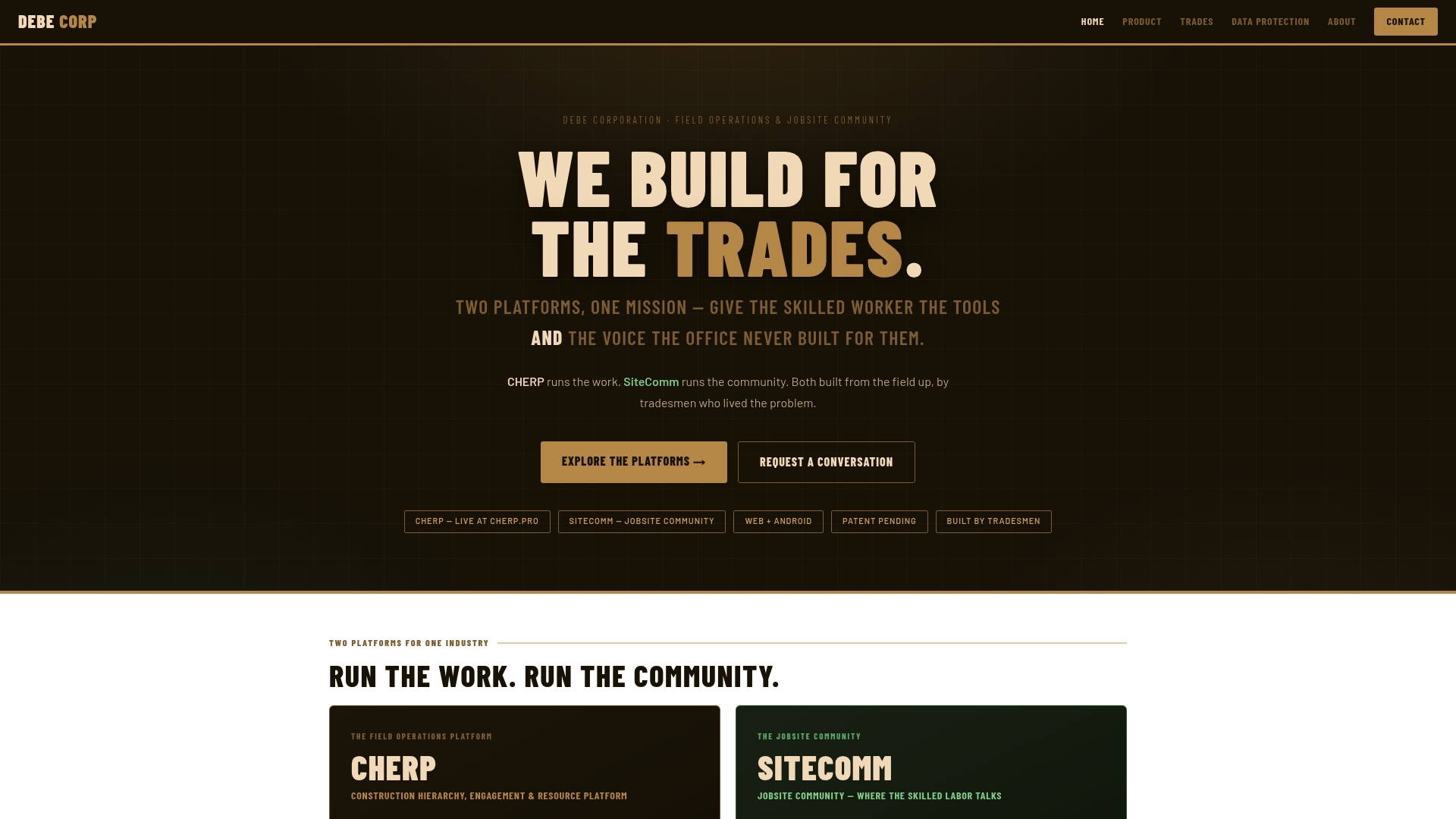
Debecorp’s CHERP and SiteComm platforms are built from the ground up with input from tradespeople who understand what actually happens on a jobsite. CHERP handles time and attendance, daily logs, and safety compliance, all organized by trade. SiteComm connects field crews with real-time communication and coordination tools. Together, they give managers the real-time workforce visibility needed to apply the labor management approaches covered in this article, from engineered standards to flexible scheduling, without adding administrative burden. If your operation runs in the field, these platforms are worth a close look.
FAQ
What are the main types of labor management approaches?
The main types include Strategic Workforce Planning, time and attendance tracking, performance management, engineered labor standards, shared buffer management, flexible work arrangements, and non-union participation strategies. Most effective organizations apply a hybrid of these based on task type and workforce context.
What is the most effective labor management approach overall?
Hybrid approaches that combine classical models for routine tasks with participative models for complex work consistently outperform single-style management. The key is diagnosing the task and team context before selecting the method.
How does Strategic Workforce Planning differ from standard scheduling?
SWP operates on a six-year planning horizon with a three-year midpoint review, connecting long-term business strategy to workforce decisions. Standard scheduling addresses short-term coverage. SWP addresses long-term capability gaps and talent pipelines.
What are engineered labor standards and why do they matter?
Engineered labor standards define tasks by discrete physical motions rather than historical time averages. They produce accurate performance baselines that prevent schedule inflation and give managers objective data for labor cost control.
How do non-union participation strategies improve workforce management?
Open-door policies and suggestion schemes give workers a direct channel to surface operational insights and raise concerns. When managers act visibly on that input, participation rates rise and the quality of workforce feedback improves significantly.