
Design activity-based, OSHA-compliant incentives that reward controllable safety behaviors, not injury-free streaks. That single shift in design philosophy separates programs that genuinely reduce risk from ones that quietly suppress reporting.
Here are three steps to start immediately:
- Pick 3–5 leading indicators to reward: near-miss reports, completed inspections, verified hazard corrections, training attendance, and safety committee participation.
- Write the rules down. A documented written program is both an OSHA expectation and your first line of defense against disputes.
- Run a 90-day pilot on one crew or one site before scaling. Collect behavioral data weekly, not monthly.
The evidence behind this approach is straightforward. 29 CFR 1904.35 makes it a violation to discourage workers from reporting injuries or illnesses, and OSHA has explicitly flagged rate-based programs as a reporting-deterrence risk. Behavior-based designs sidestep that risk entirely while building the kind of safety culture that actually reduces incidents over time.
Key Takeaways
A behavior-based safety incentive program, designed around leading indicators and documented in writing, is the most defensible and effective approach under current OSHA and IRS rules.
| Point | Details |
|---|---|
| Reward behaviors, not outcomes | Tie points to near-miss reports, inspections, and hazard corrections, not zero-incident streaks. |
| OSHA compliance requires safeguards | Parallel behavior rewards, reporting-rights training, and willingness assessments protect against citation risk. |
| IRS tax exclusion requires a written plan | Qualified plan awards can exclude up to $1,600 per employee per year; cash and gift cards are always taxable. |
| Frequent small rewards outperform annual prizes | Monthly point conversion keeps the behavior-to-reward connection strong for field crews. |
| Debecorp’s CHERP platform | Logs behaviors, tracks near-miss reports, and exports audit-ready records for compliant program management. |
Table of Contents
- What should a safety incentive program accomplish?
- What do OSHA and the IRS require from your program?
- What are the most common design mistakes, and how do you avoid them?
- How do you roll out a safety incentive program step by step?
- What are practical incentive ideas for field crews and office teams?
- How do you know if the program is improving safety or hiding it?
- What does a copy-ready program template look like?
- What field experience actually teaches you about safety incentives
- How CHERP and SiteComm help you run a compliant, trackable program
- Sources
What should a safety incentive program accomplish?
A safety incentive program is a structured system that rewards employees for taking specific, measurable safety actions rather than simply for avoiding injuries. The distinction matters more than most leaders initially realize.
The primary objectives are concrete: reinforce leading indicators like near-miss reporting and hazard identification, increase worker participation in safety activities, support corrective action by making hazard reporting feel safe and normal, and produce measurable improvements in lagging metrics over 12 months or more.
What the program cannot do is equally worth stating. It does not replace engineering controls, proper PPE, or supervisory accountability. A well-designed program supports safety culture; it does not substitute for it. If your ventilation system is inadequate or your scaffolding standards are inconsistent, no incentive structure fixes that. The ASSP’s guidance is direct on this point: rewards should reinforce preventive behaviors and management systems, not paper over hazard-control gaps.
Think of the program as a signal amplifier. It makes the behaviors you already want more visible, more frequent, and more valued. The underlying safety management system still has to be sound.
What do OSHA and the IRS require from your program?
This is where most programs go wrong, and the consequences run in two directions: OSHA citations and IRS tax liability.
OSHA’s position on rate-based programs
Under 29 CFR 1904.35, employers cannot discourage workers from reporting work-related injuries or illnesses. OSHA’s 2018 standard interpretation extended this to incentive programs: a program that withholds a reward or cancels a team prize when someone reports an injury creates implicit pressure not to report. That pressure is a potential violation even if no one explicitly tells workers to stay quiet.
OSHA’s docket of rate-based program examples illustrates exactly how this plays out. Programs using “safety banks,” “blackout cards,” and team drawings that reset after any recordable incident all carry the same structural flaw: the reward depends on an outcome the worker can only influence by not reporting.
OSHA recommends three safeguards when rate-based elements exist in a program:
- Parallel behavior-based incentives that reward reporting and preventive actions regardless of incident counts
- Reporting-rights training so every worker knows they are protected when they report an injury
- Reporting-willingness assessments or third-party audits to detect whether underreporting is occurring
Statistic: According to the National Safety Council, the average cost of a single recordable workplace injury to an employer runs into tens of thousands of dollars when you factor in medical costs, lost productivity, and administrative burden. A modest annual incentive budget is a straightforward trade.
IRS rules on employee achievement awards
The IRS draws a clear line between qualified and non-qualified recognition. Under current IRS rules, awards given as part of a qualified plan award (a written, established program that does not favor highly compensated employees) can be excluded from an employee’s taxable income up to certain annual limits for tangible personal property. Non-qualified awards have lower exclusion limits. Cash, gift cards, and cash-equivalent awards do not qualify for exclusion and are always taxable wages.
The practical implications, as legal analysis of OSHA and IRS interactions confirms, are that your program structure affects both your OSHA exposure and your tax treatment simultaneously. A written plan is not optional. It is what converts a taxable perk into a compliant, tax-favored recognition program.
Documentation expectations include: a written program document, records of who received awards and why, training records showing employees were informed of reporting rights, and periodic assessments of reporting culture.
What are the most common design mistakes, and how do you avoid them?
The failure modes in safety incentive design are well-documented. Most of them share a common root: rewarding outcomes instead of behaviors.
Do reward behaviors employees control directly. Near-miss reports, completed pre-task inspections, participation in safety committee meetings, verified hazard corrections, and training completion are all within a worker’s direct control. Reward those.
Don’t make eligibility hinge solely on zero incidents. A crew that goes 60 days without a recordable incident may have genuinely improved, or may have stopped reporting. You cannot tell from the incident count alone. Tying the entire reward to that number creates the exact conflict OSHA is concerned about.
Do use frequent, small rewards. The behavioral science here is consistent: the closer a reward follows the behavior, the stronger the reinforcement. A $15 gift card given the same week someone submits a near-miss report does more for your safety culture than a $500 prize announced at the annual banquet. OSHA Education Center guidance on field crews reinforces this: frequency preserves the behavior-to-reward connection that makes the program work.
Don’t rely on infrequent grand prizes. A single annual drawing for a big-ticket item rewards luck as much as behavior. Workers who participate consistently all year but miss the drawing feel the system is arbitrary.
Do document the written program and train on reporting rights. Every worker who participates needs to understand that reporting an injury will not cost them their reward eligibility. That training is both an OSHA safeguard and a trust-building step.
Don’t let a single injury automatically cancel team rewards without safeguards. If your program structure means one person’s injury report wipes out the whole crew’s points, you have built a peer-pressure machine. Add a parallel behavior track so the crew can still earn something even when an incident occurs.
Pro Tip: Announce reward periods in advance and keep them short, 30 days at most. Longer periods create a “cutoff effect” where workers who have already had an incident mentally opt out for the rest of the period. Monthly resets keep everyone engaged.
How do you roll out a safety incentive program step by step?
The ASSP’s implementation model and practitioner playbooks converge on a phased approach. Here is how to execute it:
-
Gain leadership buy-in. Present the NSC cost data and OSHA compliance risk to leadership. Deliverable: a signed budget authorization and a named executive sponsor. Owner: safety director.
-
Conduct a needs analysis with employee input. Survey crews and foremen on what behaviors they think matter most and what rewards they would actually value. Deliverable: a ranked list of target behaviors and a preferred reward menu. Owner: safety manager with HR support. Use structured worker feedback methods to get honest input from field crews.
-
Write the program document. Define eligibility, point values, reward conversion, anti-retaliation language, and the appeals process. Deliverable: a signed, dated written program. Owner: safety manager, reviewed by legal or HR.
-
Train employees and supervisors. Cover what earns points, how to submit reports, and reporting-rights protections. Deliverable: signed training attendance records. Owner: safety manager. Onboarding new field workers into the program at hire is the cleanest way to set expectations early.
-
Run a 90-day pilot. Select one crew or one site. Track weekly: number of near-miss reports submitted, inspections completed, hazard corrections verified, and rewards issued. Success criteria: near-miss report volume holds steady or increases; no evidence of reporting suppression; participant satisfaction above neutral. Owner: site safety lead.
-
Full launch. Roll out to all sites with consistent rules. Communicate the program through crew meetings, posted summaries, and digital channels. Deliverable: launch communications package. Owner: safety manager and operations leads.
-
Continuous monitoring and annual review. Review leading and lagging metrics monthly. Conduct a formal annual program review comparing TRIR, near-miss volume, and participation rates year-over-year. Deliverable: annual program report to leadership. Owner: safety director.
For disputed reports, designate a two-person review panel (safety manager plus one neutral supervisor) with a 10-business-day resolution window. Document every appeal and its outcome.
What are practical incentive ideas for field crews and office teams?
The best incentive ideas are specific to the work environment and tied directly to the behaviors you want to see more of. Generic rewards feel generic. Trade-specific rewards feel earned.
High-frequency rewards for field crews
Field workers respond best to rewards they can use on the job or take home the same week. SafetyFolio’s principles for effective programs recommend a points-based system with monthly conversion, keeping the behavior-to-reward cycle short enough to stay motivating.
- Low cost ($5–$25): Branded safety gear (gloves, hard hat stickers, insulated tumblers), small gift cards to hardware or grocery stores, extra paid break time (15 minutes added to a shift), recognition on the crew board.
- Medium cost ($25–$100): Larger gift cards, branded work apparel, tool accessories, team lunch for the crew, paid half-day for a top performer.
- Higher cost (>$100): Power tool accessories, premium PPE upgrades, an extra PTO day, or a contribution to a training course.
A practical point system that works for small crews: 10 points per near-miss report submitted, 5 points per inspection completed, 15 points per verified hazard correction. Monthly conversion at roughly $10–$25 per 50 points keeps the math simple and the payouts frequent. Pairing this with a mobile safety checklist makes it easy for workers to log qualifying behaviors in real time.
Office and supervisory rewards
Office staff and supervisors respond well to recognition that signals professional standing: a mention in a company-wide communication, a development opportunity tied to safety training completion, PTO hours, or a team lunch. The WorldatWork guidance frames this well: treat safety as a hygiene factor in total rewards design, and reward the preventive actions and management systems that produce safety rather than the absence of failure.

For supervisors specifically, reward behaviors like completing all required safety observations for the month, submitting corrective action documentation on time, and running toolbox talks on schedule. These are the management behaviors that drive crew-level safety performance.
How do you know if the program is improving safety or hiding it?
Tracking the right metrics is what separates a program that genuinely works from one that just looks good on paper.
Leading indicators to reward and track
- Near-miss reports submitted per crew per month
- Hazard observations completed vs. scheduled
- Verified hazard corrections closed within 48 hours
- Training completion rates by crew and trade
- Safety committee participation counts
These are the numbers that tell you whether workers are engaged with safety before an incident happens.
Lagging indicators to monitor
Track your Total Recordable Incident Rate (TRIR) and Days Away, Restricted, or Transferred (DART) rate monthly, but analyze trends quarterly. A single month’s TRIR is noise. A 12-month trend is signal. The pattern you want to see: near-miss reports rising while TRIR falls over the same period. That combination suggests real improvement, not suppression.
Red flags for underreporting
This is the metric most programs ignore, and it is the most important one. Watch for:
- A sudden drop in near-miss reports or hazard observations at the same time incident counts fall
- Near-miss volume that is consistently lower than industry benchmarks for your crew size
- Workers who stop submitting reports shortly before a reward period closes
Any of these patterns warrants a reporting-willingness assessment or a confidential crew survey. Construction workforce intelligence tools can help you visualize these trends across sites and flag anomalies before they become OSHA issues.
Sample dashboard for leadership reporting
| Metric | Frequency | What to show |
|---|---|---|
| Near-miss reports submitted | Monthly | Count, trend vs. prior 3 months |
| Hazard corrections closed | Monthly | Count, average days to close |
| Training completion rate | Monthly | Percentage by crew |
| TRIR | Monthly (trend quarterly) | Rate, 12-month rolling average |
| DART rate | Quarterly | Rate, year-over-year comparison |
| Reward participation rate | Monthly | Percentage of eligible workers earning points |
What does a copy-ready program template look like?
Use this as a starting point. Edit the bracketed fields to match your organization.
Sample policy text
Program name: [Organization Name] Safety Recognition Program
Eligibility: All full-time and part-time employees on active assignment at [site/division]. Employees on disciplinary suspension are ineligible during the suspension period.
What earns points:
- Submitting a near-miss report: 10 points
- Completing a scheduled safety inspection: 5 points
- Verified hazard correction: 15 points
- Attending a safety committee meeting: 5 points
- Completing an assigned safety training module: 10 points
Point conversion: Points convert to [gift cards / branded gear / PTO hours] at a rate of [X points = $Y value]. Conversion occurs monthly on the last business day of each month.
Anti-retaliation statement: No employee will lose points, be disqualified, or face any adverse action for reporting a work-related injury, illness, or near-miss in good faith. Reporting an injury does not affect eligibility for behavior-based rewards.
Appeals process: Any disputed reward decision may be appealed in writing to the safety manager within 10 business days. A two-person review panel will respond within 10 business days of receiving the appeal.
Launch checklist
- Written program document signed and dated
- Leadership budget authorization on file
- Employee training completed and attendance records signed
- Reporting-rights training delivered and documented
- Pilot site and crew selected
- Baseline metrics recorded (near-miss volume, TRIR, training completion)
- Reward inventory or gift card budget secured
- Program posted on crew boards and shared digitally
- Supervisor briefing completed
- 90-day pilot review date scheduled
Reporting log columns
- Report ID (sequential)
- Reporter name or anonymous ID
- Date submitted
- Category (near-miss / hazard observation / inspection / training)
- Description (brief)
- Verification status (pending / verified / rejected)
- Corrective action assigned (yes/no, owner, due date)
- Reward issued (yes/no, amount, date)
Store records for a minimum of five years. OSHA’s recordkeeping requirements under 29 CFR 1904 set a three-year retention floor for injury logs, but keeping incentive program records longer gives you a cleaner audit trail and supports your annual program review.
What field experience actually teaches you about safety incentives
Most safety incentive programs fail for the same reason: they are designed in a conference room and announced to crews who had no input. The program lands as a policy, not as something workers feel any ownership over. Participation is polite at best.
The programs that actually move the needle share a different origin story. Workers helped design them. A foreman suggested the near-miss reporting threshold. A crew member asked for branded gear instead of gift cards because they wanted something visible on the job. Those details sound small, but they signal that the program was built for the people doing the work, not for the safety manager’s annual report.

Two practical lessons from working with field teams: First, make the submission process frictionless. If reporting a near-miss requires filling out a three-page form, workers will not do it consistently, especially at the end of a long shift. A short digital log that takes 90 seconds beats a comprehensive paper form that takes 10 minutes. Second, supervisors are the program’s real delivery mechanism. If a foreman never mentions the program, never acknowledges a near-miss submission, and never celebrates a crew member’s participation, the program is invisible to that crew regardless of what the policy document says.
Incentives are a tool. The hazard controls, the training, and the supervisory culture are the foundation. No reward structure compensates for a site where workers genuinely believe reporting will get them in trouble.
How CHERP and SiteComm help you run a compliant, trackable program
Running a safety incentive program without a system to log behaviors, verify reports, and export records for audits is harder than it needs to be. Spreadsheets drift. Paper logs get lost. And when OSHA asks for documentation, “we tracked it informally” is not a useful answer.
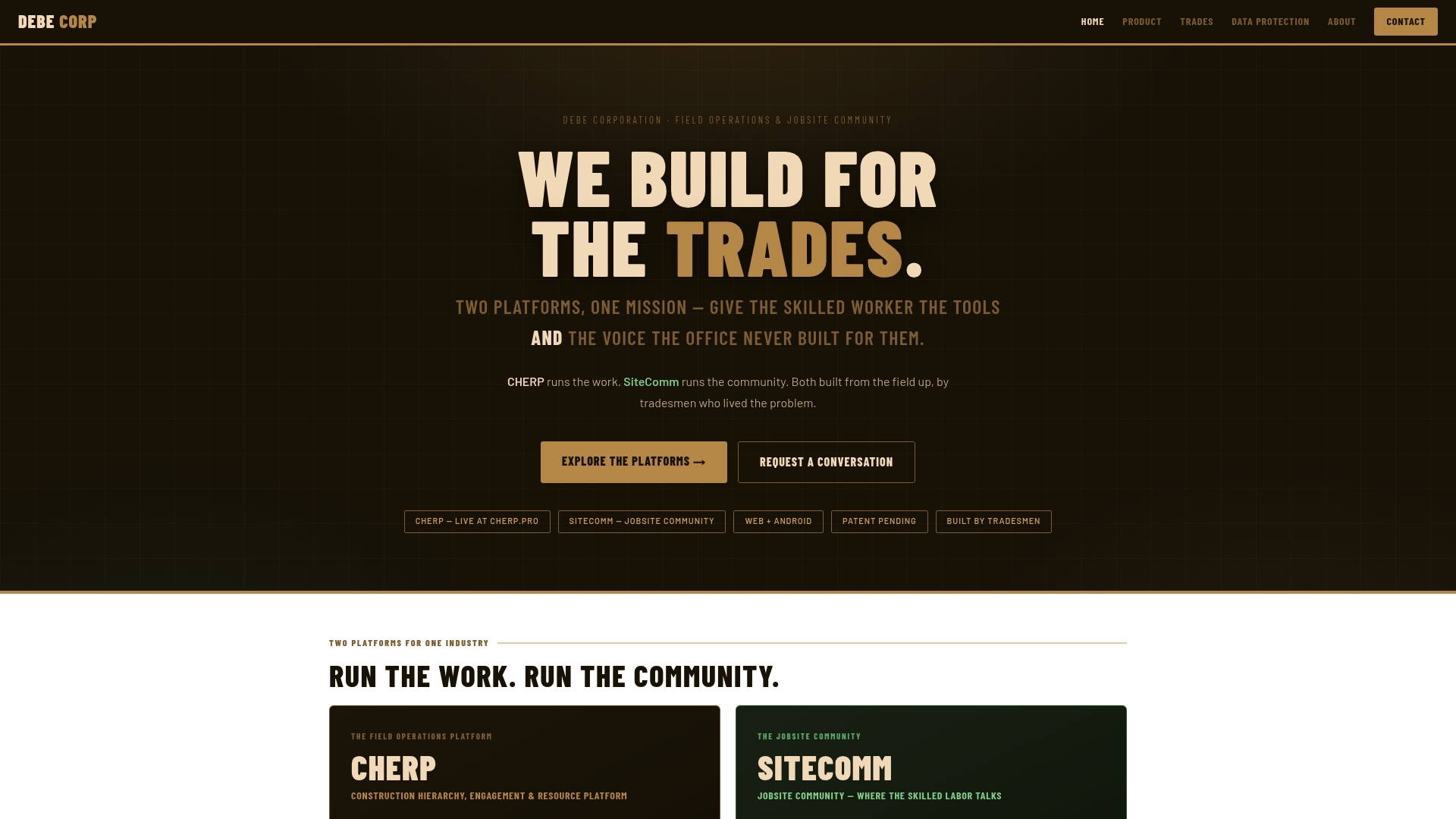
Debecorp’s CHERP and SiteComm platforms are built specifically for field operations in the skilled trades, and they map directly to what a compliant incentive program requires. CHERP handles behavior logging, near-miss report submission, daily safety logs, and audit-ready records, all in a format that field workers can use from a phone on the jobsite. SiteComm adds the crew communication and recognition layer: supervisors can acknowledge a near-miss submission in the same platform where it was filed, keeping the behavior-to-recognition cycle tight.
For a 90-day pilot, the workflow is straightforward: workers log qualifying behaviors through CHERP, supervisors verify and close out hazard corrections, and the dashboard exports a clean summary for leadership review at the end of each month. No manual compilation, no missing records.
See how CHERP and SiteComm support your program at Debecorp, or visit Debecorp to request a demo.
Sources
The guidance in this article draws on primary regulatory sources, industry standards, and practitioner playbooks. For compliance decisions, always verify current rules directly with OSHA and a qualified legal or HR professional.
- 29 CFR 1904.35
- Do You Need a Safety Incentive Program? Here’s How to Start
- Principles of effective safety incentive programs | SafetyFolio
- Injury facts - workplace injury costs
This article provides general information about safety incentive program design and is not a substitute for legal, tax, or compliance advice. Confirm current OSHA regulations and IRS rules with a qualified professional before implementing or modifying a program.