
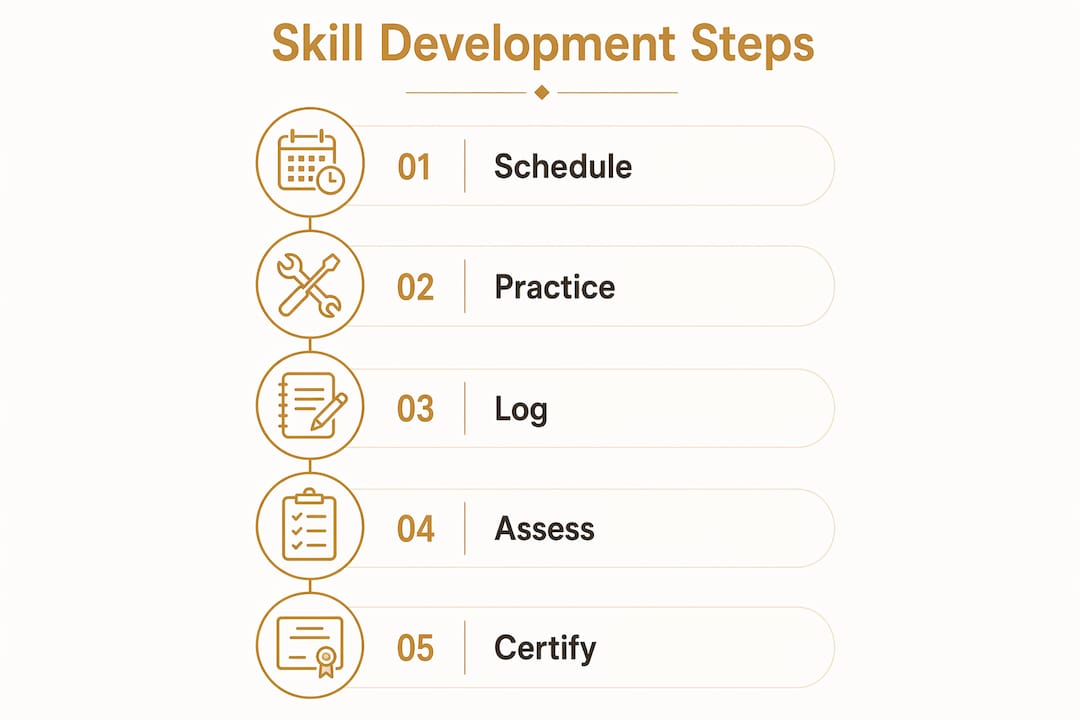
Run short, paid on-the-job training cycles integrated with daily operations and tracked with field software. That single shift, from informal knowledge transfer to structured, measurable learning, is what separates crews that grow from crews that churn.
Start here today:
- Slot a mentor pair. Match one experienced hand with one newer worker on a specific task this week.
- Issue a micro-credential. Pick one certifiable skill (conduit bending, fall protection, EPA 608) and schedule the assessment within 30 days.
- Protect paid learning time. Block 30–60 minutes per shift for structured practice, separate from billable production hours. The DOL’s earn-as-you-learn guidance identifies paid training as a primary driver of program completion.
- Log it. Use a field app or daily log to record what was practiced, by whom, and what comes next.
Programs like Hiring Our Heroes Skilled Trades Academy and Harbor Freight Tools for Schools have already proven this model at scale. Debecorp’s CHERP and SiteComm platforms bring the same structure to your job site.
Table of Contents
- Why workplace-integrated skill development changes outcomes
- Hands-on approaches that actually encourage trades skill development
- Which tools make on-the-job learning repeatable and auditable?
- How to build feedback loops with local training providers
- How do you measure the ROI of on-the-job upskilling?
- Your 90-day checklist to launch an on-site skill development program
- How CHERP and SiteComm support on-the-job skill development
- Key Takeaways
- The part most supervisors skip
- CHERP and SiteComm give your training program a backbone
- Useful sources and further reading
Why workplace-integrated skill development changes outcomes
Hands-on, paid training embedded in daily operations does three things classroom-only programs cannot: it builds confidence on real tasks, it keeps workers engaged, and it produces skills that hold up under job-site pressure. That last point matters more than most supervisors realize. A NORC survey found a large majority of U.S. voters agreed government should fund AI-resilient career training, reflecting broad recognition that physical, hands-on trade skills are not automatable.
The business case is equally direct:
- Retention. Workers who see a clear skill path stay longer. Losing a journeyman-level electrician or pipefitter costs far more than the hours spent training a replacement. Explore the turnover drivers that training programs directly address.
- Safety. Crews with documented competency records have fewer rework events and fewer incidents. Training is not separate from safety compliance; it is part of it.
- Productivity. A worker who has been formally assessed on a task performs it faster and with fewer callbacks.
94% of U.S. voters support government funding for AI-resilient career training, according to a NORC survey cited in Harbor Freight Tools for Schools reporting.
Bloomberg Philanthropies announced a $90M initiative to accelerate high school students into registered apprenticeships and paid work-based learning across multiple U.S. regions. That level of investment signals where the industry is heading. Supervisors who build the same structure internally get ahead of the curve.
Hands-on approaches that actually encourage trades skill development
The most effective on-site strategies combine structured mentorship, short paid training windows, and milestone-based credentials. Here is how to layer them:
- Mentorship pairing. Assign a journeyman to a specific apprentice for a defined task set, not just “shadow me.” Define what the apprentice should be able to do independently by week four.
- Microlearning modules. Ten-to-fifteen-minute focused practice sessions between tasks, tied to a single skill (reading a wiring diagram, torque specs, OSHA lockout/tagout). Schedule these during low-traffic windows like early morning or post-lunch.
- Stretch assignments. Give a worker a task one level above their current certification, with a mentor present. This is how confidence actually builds.
- Cross-training rotations. Rotate workers across related tasks quarterly. An HVAC tech who understands basic electrical is more valuable and less likely to leave.
- Certification milestones. Use programs like Hiring Our Heroes’ six-week Skilled Trades Academy or Central Piedmont’s 12-week electrical lineworker and 16-week HVAC courses as external benchmarks for what a defined training window can produce.
Sample 12-week progression:
- Weeks 1–4: Mentor pairing, baseline skill assessment, daily microlearning logs
- Weeks 5–8: Stretch assignment introduction, first micro-credential attempt
- Weeks 9–12: Cross-training rotation, credential completion, KPI review
Pro Tip: Schedule microlearning during the first 30 minutes after crew briefing, before production ramps up. That window is consistently underused and rarely affects billable output.
Which tools make on-the-job learning repeatable and auditable?
Pairing short learning cycles with field software is what turns informal training into a measurable, repeatable process. Without a system to log it, training disappears into memory.

| Feature category | Concrete benefit for training |
|---|---|
| Scheduling | Block paid learning windows without conflicting with production shifts |
| Time & attendance | Separate training hours from billable hours for accurate cost tracking |
| Daily logs | Record what was practiced, by whom, and the outcome |
| Skill tracking / badges | Create auditable competency records tied to individual workers |
| Safety compliance | Verify training completion against OSHA and site safety requirements |
A typical workflow: a supervisor schedules a 45-minute paid microlearning block in the field app, the worker logs the task completed, and the system auto-generates a timestamped record. That record feeds payroll (training hours vs. productive hours), safety compliance, and the worker’s skill profile. When OSHA asks for documentation, it is already there.
One legal note: the Fair Labor Standards Act requires that training time meeting certain conditions be compensated. Keeping training hours logged separately in your field software is the cleanest way to stay compliant and avoid disputes. Align your records with your site safety plan and any applicable union agreement. For projects where construction draw schedules govern payment milestones, having clean training-hour records also protects you during audits.
How to build feedback loops with local training providers
Employer-led feedback loops are what keep training aligned to what the job actually requires, not what a curriculum committee decided three years ago. The PISA-VET framework published in npj Science of Learning recommends occupation-specific assessments and direct employer engagement to close the gap between vocational curricula and real job demands.
Steps to build a partnership:
- Identify two or three local providers: community colleges, workforce boards, or programs like Hiring Our Heroes.
- Contact the program coordinator with a specific ask: “We need workers who can pass EPA 608 within 16 weeks. Can we align your curriculum to our site tasks?”
- Propose on-site learning opportunities: guest visits, tool access, or co-op placements.
- Set shared competency metrics: what does “job-ready” look like in your trade?
- Formalize a pathway: pre-apprenticeship credit for on-site hours, or direct entry into a registered apprenticeship.
Sample outreach email:
Central Piedmont’s accelerated courses and Hiring Our Heroes’ employer networking events are both designed for exactly this kind of outreach. The Bloomberg Philanthropies initiative funds co-designed curricula and lab upgrades at the district level, so regional employers who engage early often shape what gets taught.
How do you measure the ROI of on-the-job upskilling?
Measure both leading indicators (what is happening now) and lagging indicators (what changed over time). Leading indicators tell you whether the program is running; lagging indicators tell you whether it is working.
Recommended KPIs:
- Training hours per employee per month
- Micro-credential attainment rate (credentials issued / workers enrolled)
- First-time fix rate on assigned tasks
- Turnover rate change (compare 90 days pre- and post-program)
- Safety incident rate per 100 workers
Sample cost-benefit calculation:
Replacing one mid-level tradesperson typically costs 50–200% of annual salary in recruiting, onboarding, and lost productivity. If a 12-week training program retaining one worker costs $2,000 in paid training hours and instructor time, and prevents one turnover event worth $15,000, the ROI is clear before you count productivity gains.
Milestone cadence: 30 days: first micro-credential issued. 90 days: KPI baseline vs. current comparison. 180 days: turnover and productivity trend review.
For deeper measurement frameworks, Debecorp’s guide on labor productivity tracking pairs directly with these KPIs.
Your 90-day checklist to launch an on-site skill development program
Day 1:
- [ ] Identify two workers to pilot the mentor-pair model
- [ ] Choose one certifiable skill as the first micro-credential target
Week 1:
- [ ] Block paid learning windows in the schedule (30–60 min/shift)
- [ ] Enable daily log entries for training activities in your field app
Month 1:
- [ ] Contact one local training provider (community college or workforce program)
- [ ] Set baseline KPIs: training hours, turnover rate, safety incidents
- [ ] Issue first micro-credential assessment
By 90 days:
- [ ] Complete first 12-week progression cycle
- [ ] Review KPIs against baseline
- [ ] Formalize one education partnership with shared competency metrics
If training time gets canceled: Reschedule within the same week, not the next. One missed session becomes a pattern fast. If adoption stalls, check whether mentors are being compensated or recognized for the extra responsibility. Unpaid mentoring rarely lasts.
How CHERP and SiteComm support on-the-job skill development
Purpose-built field platforms reduce admin, free up paid training windows, and create auditable skill records. Debecorp built CHERP and SiteComm from the ground up with input from working tradespeople, which means the workflows reflect how job sites actually run.
- Time & attendance: Log training hours separately from productive hours. Clean records for payroll, compliance, and ROI calculations.
- Daily logs: Supervisors record what was practiced, by whom, and the outcome, directly from the field.
- Skill badges: Issue micro-credentials tied to completed tasks. Workers build a visible competency profile.
- Scheduling: Block paid learning windows without disrupting production shifts.
- SiteComm: Coordinate mentor assignments and training updates across the crew in real time.
Workflow example: A foreman schedules a 45-minute EPA 608 prep session in CHERP. The worker logs completion in the daily log. CHERP auto-generates a timestamped record tied to that worker’s profile. At the 90-day KPI review, the supervisor pulls a credential attainment report without touching a spreadsheet.
Pro Tip: Use CHERP’s daily log as your training journal. A two-line entry per session, what was practiced and what is next, takes 90 seconds and creates the documentation trail that protects you during audits and makes the ROI case at review time.
Key Takeaways
Workplace-integrated training, tracked with field software and tied to micro-credentials, is the most direct way to build a crew that stays, performs, and stays safe.
| Point | Details |
|---|---|
| Start with paid learning windows | Block 30–60 minutes per shift for structured practice, separate from billable hours. |
| Use micro-credentials as milestones | Target one certifiable skill per 30-day cycle to keep progress visible and measurable. |
| Measure leading and lagging KPIs | Track training hours and credential rates now; review turnover and productivity at 90 and 180 days. |
| Partner with local providers | Community colleges and programs like Hiring Our Heroes can align curricula to your site’s skill requirements. |
| Debecorp’s CHERP and SiteComm | Log training hours, issue skill badges, and generate compliance records directly from the field. |
The part most supervisors skip
The hardest part of running training on a job site is not finding the content. It is protecting the time. Production pressure is real, and the first thing that gets cut when a deadline moves is the learning window. Every time.
What actually works is treating training time the same way you treat a safety briefing: non-negotiable, logged, and owned by someone specific. When a mentor knows their name is on a record and that their extra effort is tracked and recognized, they show up for it. When a worker sees a credential attached to their profile, they ask for the next one. The system does not have to be complicated. It has to be consistent.
The other thing most guides miss: resistance to training on job sites is almost never about motivation. It is about trust. Workers who have watched “training initiatives” come and go without follow-through are skeptical by default. The fastest way to earn that trust back is to pay for the time, issue the first credential within 30 days, and then show the crew the data. Numbers on a screen are harder to dismiss than a supervisor’s word.
CHERP and SiteComm give your training program a backbone
Scheduling training, logging it, tracking credentials, and pulling compliance records from four different spreadsheets is exactly the kind of friction that kills programs before they reach 90 days. CHERP handles time and attendance, daily logs, safety compliance, and skill tracking in one platform built specifically for trades crews. SiteComm keeps mentor assignments and training updates moving across the job site without the phone-tag.
Debecorp built both platforms directly with tradespeople, so the workflows match how field operations actually run, not how a software team imagined they might. If you are ready to run a training program that produces auditable records and measurable outcomes, start with the CHERP and SiteComm platform overview. You can also explore trade-specific features to see how the platform maps to your craft.
Useful sources and further reading
These references back the claims in this article and give supervisors a starting point for deeper research.
- Hiring Our Heroes Skilled Trades Academy — Six-week, no-cost hands-on program with built-in employer networking; approved as a SkillBridge opportunity for transitioning service members.
- Harbor Freight Tools for Schools — Paid, hands-on summer programs; source of the 94% NORC voter-support figure and the L.A. County Skilled Trades Summers program data.
- Central Piedmont Community College — Skilled Trades — Accelerated 12- and 16-week trade courses with certification targets; a model for realistic upskilling timelines.
- Bloomberg Philanthropies National Skilled Trades Initiative — $90M initiative funding paid work-based learning and employer-aligned curricula across U.S. regions.
- npj Science of Learning — VET Research — PISA-VET framework recommending occupation-specific assessments and employer engagement to align curricula with job demands.
- DOL Earn-as-You-Learn Guidance — Federal framework identifying paid training and supportive services as key to program success.
- Debecorp — Career Development in Skilled Trades — Overview of career pathway strategies for trades supervisors and operations managers.
- Debecorp — Workforce Wellbeing in Trades — Retention and wellbeing strategies that pair with structured training programs.