
The fastest way to stop losing bids and blowing schedules is a three-track program: stabilize your crews this quarter, lift productivity with targeted tech and prefabrication, and build a durable talent pipeline through apprenticeships and school partnerships. None of these tracks works alone. Pay bumps without career pathways just churn workers to the next contractor; technology without stable crews has nobody to run it.
Here’s the one-sentence version: fix pay and onboarding now, deploy productivity tools and modular methods over the next two quarters, and commit to registered apprenticeships and workforce partnerships as a multiyear investment that outlasts any single project cycle. The Bureau of Labor Statistics tracks the churn, the Associated General Contractors of America surveys the pain points, and NCCER and apprenticeship.gov supply the training infrastructure most firms have never fully tapped. Programs modeled on Boston’s Building Pathways show what a disciplined, employer backed pipeline looks like when it runs for years instead of one hiring season.
Start this week with these four moves running in parallel:
- Run a market rate pay audit against local competitors and correct any position more than 5% below market.
- Launch or refresh an employee referral bonus, paid at 90 days to encourage retention, not just a signed offer.
- Book temp staffing or subcontractor coverage for your most schedule critical trades for the next 60 days.
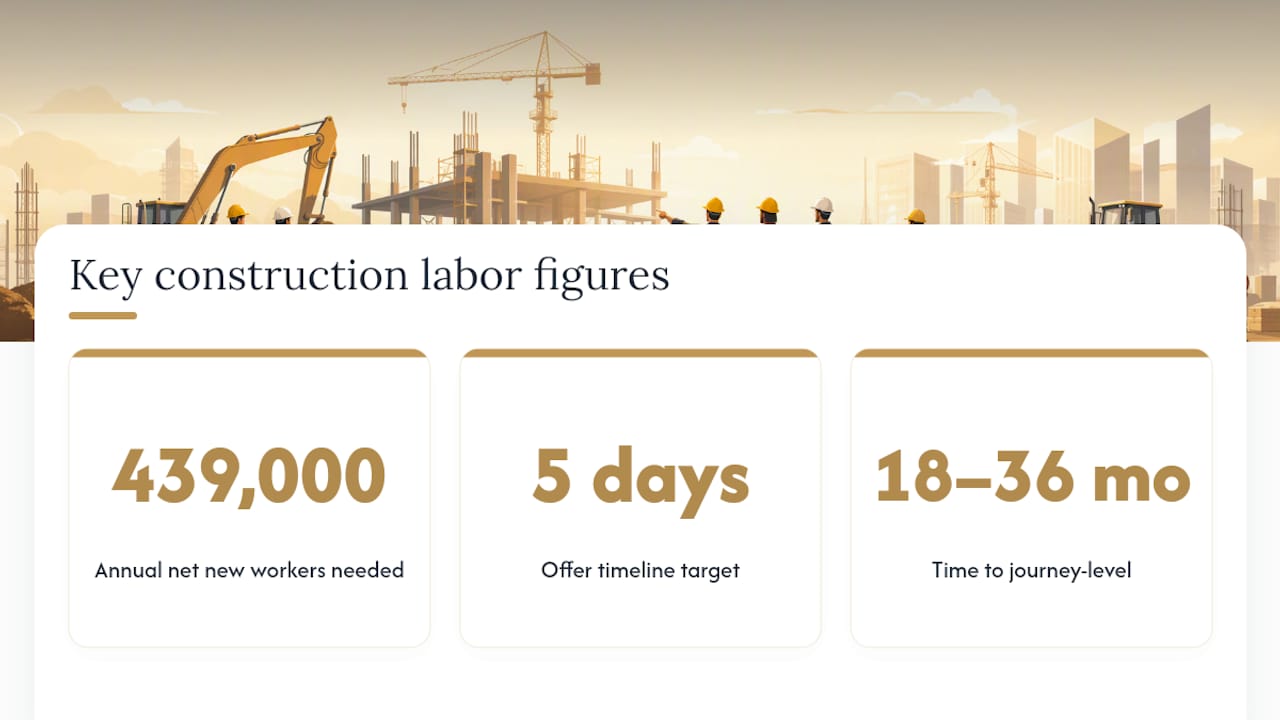
- Compress your hiring process so a qualified candidate gets an offer within five business days of applying.
Key Takeaways
The construction labor shortage responds best to firms that run stabilization, productivity, and pipeline building as one coordinated effort instead of three separate initiatives.
| Point | Details |
|---|---|
| Fix pay and onboarding first | Correct wage gaps and cut time-to-offer under a week before investing elsewhere. |
| Pilot one technology category | Test time and attendance or daily logs for 60 to 90 days before scaling company wide. |
| Commit to apprenticeships this year | Start a registered apprenticeship or school partnership even though yield takes 18 to 36 months. |
| Track 90-day retention first | Use it as your leading indicator before turnover shows up in annual numbers. |
| Use a field operations platform | CHERP and SiteComm from Debecorp centralize compliance, time tracking, and crew communication to free supervisor time for retention work. |
Table of Contents
- Construction Labor Shortage Solutions: How Big Is the Gap Right Now?
- What Is Driving the Construction Labor Shortage?
- How Labor Shortages Show Up on Your Projects
- What Can You Do This Quarter to Stabilize Your Workforce?
- How Do You Retain Skilled Craft Workers Once You’ve Hired Them?
- How Do You Build a Long-Term Construction Talent Pipeline?
- What Policy Changes Would Actually Ease the Shortage?
- Which Technology Investments Actually Reduce Labor Strain?
- What Does a Successful Field Operations Rollout Look Like?
- Where Should You Focus Over the Next 12 Months?
- How CHERP and SiteComm Fit Into This Playbook
- Where to Read More on Construction Workforce Solutions
- Frequently Asked Questions
- Sources
Construction Labor Shortage Solutions: How Big Is the Gap Right Now?
The U.S. construction industry needs roughly 439,000 net new workers annually just to keep supply and demand in balance, and that number does not account for retirements pulling experienced tradespeople out the door. The same AGC analysis found that a large majority of contractors report meaningful difficulty filling open positions, a figure that has stayed stubbornly high for several survey cycles running.
The trend line is not improving on its own. Immigration enforcement activity is now cited by nearly a third of firms as a factor limiting available labor, adding a policy dimension on top of the demographic one. Regional variance is real: metro markets with heavy data center and infrastructure spending report the tightest labor pools, while some slower growth regions see modest easing.
Pro Tip: Treat the 439,000 figure as your industry’s baseline demand curve, not an abstract statistic. If your firm employs 200 people, your fair share of that annual gap is roughly proportional to your regional market share. Calculate it and use it to justify your training budget to ownership.
What Is Driving the Construction Labor Shortage?
You can’t out recruit demographics. The workforce building America’s infrastructure is aging out faster than replacements are entering, and that single driver touches every other item on this list.
- Aging workforce and retirements: A wave of experienced journeymen and foremen are retiring within the next decade, taking institutional knowledge with them. This is a long-term structural drain that shows up as lost supervisory capacity, not just headcount.
- Weak K-12 and CTE pipeline: Fewer high schools offer robust career and technical education tracks in the trades than a generation ago, and school counselors still steer college-bound students away from apprenticeships. Medium-term fix; it takes years to rebuild a pipeline once it atrophies.
- Underinvestment in apprenticeships: Many firms treat training as a cost center rather than a recruiting engine, so registered apprenticeship enrollment lags what the industry actually needs. Medium-term, and directly within a firm’s control.
- Immigration and policy effects: Immigration accounted for 83% of net U.S. population growth between 2020 and 2024, and foreign-born workers make up close to 29% of the construction workforce. Short to medium-term impact, heavily dependent on federal policy.
- Perception and culture issues: Decades of “go to college” messaging left trades work undervalued in public perception, even as wages for skilled tradespeople often outpace many white collar entry roles. Long-term, cultural, and slow to shift.
The highest leverage move a firm can make against the aging workforce driver is incumbent worker upskilling. Instead of only recruiting externally, identify your journeymen five to ten years from retirement and pair them formally with less experienced crew as documented mentors. It costs almost nothing and it captures knowledge that no job posting can replace.
How Labor Shortages Show Up on Your Projects
The shortage doesn’t announce itself as a line item labeled “labor shortage” on your P&L. It shows up as a dozen smaller symptoms that, added together, quietly eat your margin.
- Schedule slippage on trade-dependent milestones, especially electrical, HVAC, and finish carpentry
- Overtime and shift premium spend climbing as supervisors patch gaps with existing crew
- Subcontractor no-shows or partial crews on days you need full coverage
- Quality rework from less experienced hires rushed onto critical path tasks
- Safety incident rates ticking up when tenure on a crew drops
Watch five KPIs closely: time-to-fill for open positions, crew productivity measured in units installed per day, overtime as a percentage of total labor hours, labor cost per installed unit, and turnover rate by role and tenure cohort. Tracking these consistently, ideally through a labor productivity tracking system, turns “we feel understaffed” into a number you can act on.
Firms using digital workforce analytics tools reduced time-to-hire by an average of 27 days and cut overtime costs by an average of 30%, according to ADP research on construction HR trends. That’s not a small efficiency gain; that’s the difference between hitting a milestone date and explaining a delay claim to your client.
What Can You Do This Quarter to Stabilize Your Workforce?
You have three months to move the needle before the next bidding cycle. Here’s the priority order, cheapest and fastest first.
- Market rate pay audit: Compare every craft position against current local wage data and correct gaps immediately, not at the next review cycle.
- Referral bonus program: Pay it in two installments, half at hire and half at 90 days, so it rewards retention as much as recruiting.
- Streamlined hiring and onboarding: Cut your time-to-offer to under a week and digitize paperwork so new hires spend their first day learning the jobsite, not filling out forms.
- Temp staffing and subcontractor coverage: Line up backup labor agreements now for your most schedule critical trades, before you’re scrambling mid-project.
- Targeted recruitment channels: Move recruiting spend toward local trade schools, veteran transition programs, and social ads targeted by trade and geography rather than generic job boards.
A useful 30/60/90 framework keeps this from stalling out:
Onboarding deserves special attention because it’s where new hires decide whether they’re staying. Firms running a mandatory regional safety orientation and hands-on onboarding day for every craft hire, including experienced ones, report meaningfully lower early attrition. It standardizes safety expectations and signals from day one that this employer runs a tight operation.

Pro Tip: Speed up candidate screening without cutting corners on compliance by front-loading license and certification verification into your applicant tracking workflow. Verify credentials before the interview, not after the offer, so a compliance gap never derails a hire you’ve already committed to.
How Do You Retain Skilled Craft Workers Once You’ve Hired Them?
Retention starts with supervision, not compensation. A crew that leaves usually isn’t leaving the company; they’re leaving a foreman. Investing in field leadership training and structured mentoring for the people who run your crews prevents more turnover than any signing bonus.
Pay structure matters too, but not the way most firms think. Wage compression, where a five-year employee earns barely more than a new hire, is one of the fastest ways to lose your best people. Fixing compression and presenting total compensation, meaning benefits, schedule predictability, and bonus structure, alongside base pay gives workers a fuller picture of what staying is actually worth. ADP’s research on the construction workforce notes that pay alone rarely solves retention for younger workers; onboarding, benefits clarity, and visible career pathways matter just as much to a workforce that skews increasingly Gen Z.
The first 90 days on the job set the retention trajectory for the entire employment relationship. A checklist worth running for every hire:
- Complete yard orientation and safety onboarding before first jobsite assignment.
- Assign a formal mentor, not just a rotating buddy, for the first 90 days.
- Document a visible career path with timelines toward journeyman or supervisory roles.
- Check in formally at 30, 60, and 90 days rather than waiting for an exit interview.
Track turnover rate broken out by cohort (new hire versus tenured), retention specifically at the 90-day mark, and internal promotion rate. A labor turnover benchmark that separates new hire churn from experienced worker attrition tells you exactly where to intervene.
Pro Tip: Require the regional yard orientation day for every new hire, no exceptions, even for a journeyman with fifteen years elsewhere. It codifies your culture and safety standards before old habits from a previous employer take root.
How Do You Build a Long-Term Construction Talent Pipeline?
Short-term tactics buy you a season. A real pipeline buys you a decade. Registered apprenticeships remain the single most durable tool for this, and most firms underuse them because starting one feels bureaucratically heavier than it actually is.
- Contact your state apprenticeship office or visit apprenticeship.gov to review the construction industry factsheet, which walks through program standards and setup steps trade by trade.
- Align curriculum with NCCER standards so your program is portable and recognized industry wide, which also makes it easier to recruit apprentices who want credentials that transfer.
- Partner with a local high school or community college to build a dual enrollment or early exposure track, similar in spirit to Building Pathways style programs that pair classroom time with paid site experience.
- Apply for available funding, including WIOA formula grants, state workforce development grants, and employer tax incentives tied to registered apprenticeship sponsorship.
- Set a measurement cadence tracking placement rate, retention at 12 and 24 months, and time-to-productivity for each apprentice cohort.
The Department of Labor’s own talent strategy framework pushes exactly this direction: scale registered apprenticeships, tie training to real career pathways, and hold funding accountable to measurable outcomes rather than enrollment counts alone. Harvard’s Joint Center for Housing Studies reaches a similar conclusion in its analysis of rebuilding the trades workforce, pointing to employer-led training and school partnerships as the levers with the longest payoff.
| Timeframe | What to expect |
|---|---|
| under 3 months | Program design, NCCER alignment, first cohort recruited |
| over 3 months | Apprentices working paid site hours, first competency milestones |
| 18-36 months | First cohort approaching journey-level productivity |
AGC and NCCER’s own workforce survey found that 42% of firms increased training spending and 52% engaged directly with school-based career-building programs, evidence that the firms already ahead of the curve treat pipeline building as a budget line, not a nice-to-have. Guidance on structuring these ladders in more depth lives in this career development framework for skilled trades.
What Policy Changes Would Actually Ease the Shortage?
No amount of internal recruiting fully offsets a labor pool shaped by national demographics and immigration policy. AGC’s own economists have said domestic recruiting alone cannot close the gap; lawful immigration pathways remain a necessary piece of any credible national solution, not a political side issue.
- Construction-specific visa and temporary work pathways that match seasonal and project-based labor demand more closely than current general visa categories allow.
- Licensing reciprocity across state lines, so a licensed electrician or plumber can work in a neighboring state without re-certifying from scratch.
- Increased workforce development funding directed specifically at registered apprenticeships and employer-led training rather than diffuse general education budgets.
Firms don’t have to wait on Washington to engage. Active participation in AGC’s advocacy efforts, forming public-private partnerships with local workforce boards, and expanding local apprenticeship capacity are all moves an individual firm can make this year. For further reading on the policy landscape, AGC’s workforce survey and the Conference Board’s labor market analysis both offer deeper detail than any single article can cover.
Pro Tip: Call your regional workforce development board before you assume WIOA funding is out of reach. Many boards have unspent training dollars specifically earmarked for construction trades and are actively looking for employer partners to deploy them.
Which Technology Investments Actually Reduce Labor Strain?
Technology doesn’t replace craft workers. It gives the workers you already have back hours they used to lose to paperwork and guesswork, which is functionally the same as hiring more people without the recruiting headache.
- Workforce management and time and attendance: Digital clock-in and certified payroll reporting cut administrative hours for supervisors and reduce compliance errors on multistate projects.
- Productivity tracking: Measuring units installed per crew per day surfaces bottlenecks before they become schedule crises, detailed further in this productivity tracking guide.
- Scheduling optimization: Software that models crew availability against project sequencing reduces the overtime spikes that come from reactive scheduling.
- Prefabrication and offsite manufacturing: Shifting repeatable scope offsite can move up to half of related labor hours off the jobsite entirely, easing pressure on your tightest trades.
- Safety monitoring and wearables: Real-time hazard alerts reduce incident rates, which in turn reduces the downtime and turnover that follow a serious injury.
- VR and AR training: Simulated environments let new hires practice high-risk tasks before ever touching a live jobsite, shortening time-to-competency.
When you’re evaluating any of these categories, judge them against ease of deployment, whether they handle certified payroll and multistate compliance requirements, how well they work for a crew using phones in the field rather than desktop workstations, and how cleanly they integrate with your existing payroll system. A tool that looks impressive in a demo but requires desktop logins is dead on arrival for field crews.
Run a pilot before you commit company wide. Pick one trade or one repetitive task, run it for 60 to 90 days, and track the productivity delta, time saved on administrative work, adoption rate among the crew, and compliance accuracy compared to your old process.
Pro Tip: Start your pilot with daily logs or time and attendance, not something ambitious like AI scheduling. These are the highest-friction, most-hated tasks on most jobsites, and a fast win there builds crew buy-in for whatever technology you roll out next.
What Does a Successful Field Operations Rollout Look Like?
A platform is only as useful as the adoption behind it, which is why pilot design matters more than feature lists. Field-operations platforms that centralize time and attendance, certified payroll, daily logs, and jobsite communication measurably shrink the administrative load carried by supervisors, freeing them to spend that recovered time coaching crews and catching retention problems early instead of buried in paperwork.
Expect to track a specific set of metrics when you deploy: turnover reduction among crews using the platform, time saved per week on daily logs and reporting, onboarding completion rate for new hires, and how much faster crew communication resolves compared to phone tag and paper forms. Firms centralizing team updates and jobsite comms typically see the communication gains show up first, often within the first pilot cycle.
A practical rollout checklist:
- Select one pilot site with a supportive supervisor, not your most difficult crew.
- Build a short training plan, ideally under an hour, so adoption doesn’t stall on complexity.
- Secure visible supervisor buy-in before day one; crews follow their foreman’s lead on new tools.
- Set clear KPIs upfront and a feedback loop to adjust within the first 30 days.
DeBe Corporation is compiling detailed customer proof points and rollout case studies from firms running CHERP and SiteComm in the field; specific benchmark figures from those deployments will be published as that data set matures.
Where Should You Focus Over the Next 12 Months?
Most firms treat labor shortage response as a hiring problem when it’s really a sequencing problem. The mistake I see most often is a firm throwing money at recruiting while ignoring the leaky bucket of retention sitting right underneath it. Raise pay without fixing a broken onboarding process and you’ve just funded a more expensive round of turnover.
Here’s the sequencing that actually reinforces itself instead of fighting itself. Start with pay correction and onboarding overhaul in month one, because those are cheap, fast, and stop the bleeding. Layer in a technology pilot, ideally time and attendance or daily logs, by month three, once your workforce is stable enough to actually adopt something new without adding chaos on top of chaos. Commit to your first apprenticeship cohort or school partnership by month six, understanding that yield from this investment won’t show up until year two or three. And treat policy engagement, whether that’s AGC advocacy or workforce board partnerships, as a background thread you run continuously rather than a project with an end date.
The firms that get this wrong usually invert the order: they chase apprenticeship headlines for PR value while ignoring the fact that half their current crew is one bad week away from quitting. Fix the leaky bucket before you turn on the tap harder. Measure success quarterly against time-to-fill, 90-day retention, and crew productivity, and be willing to reallocate budget from whichever tactic isn’t moving those numbers.
How CHERP and SiteComm Fit Into This Playbook
Every solution in this article requires one thing you can’t fake: visibility into what’s actually happening on your jobsites, day to day, crew by crew. That’s the specific gap Debecorp built CHERP and SiteComm to close. CHERP handles time and attendance, daily logs, safety compliance, and certified payroll reporting in one field-tested system built from the ground up with tradesmen, not adapted from generic office software. SiteComm handles the jobsite communication and crew recognition side, giving workers a sense of belonging that pay alone never fully delivers.
If you’re running the 30/60/90 pilot framework from this article, CHERP shortens the timeline considerably. Digital onboarding gets new hires productive faster, centralized certified payroll reporting removes a major multistate compliance headache, and supervisors get back hours they used to spend chasing paperwork. That’s time they can reinvest exactly where this article says it matters most, which is coaching and retaining the crew they already have.
See how the CHERP and SiteComm platforms work for your trade, and reach out through Debecorp to schedule a demo or discuss a pilot rollout for one of your current jobsites.
Where to Read More on Construction Workforce Solutions
- The AGC workforce shortage analysis breaks down the 439,000 worker gap and contractor hiring difficulty survey in full detail.
- America’s Talent Strategy from the Department of Labor lays out the federal framework for apprenticeship scaling and training funding.
- The Conference Board’s labor shortage brief explains the immigration and demographic forces shaping labor supply nationally.
- Harvard’s Joint Center for Housing Studies analysis covers the case for employer-led training and school partnerships in more depth.
- NCCER’s training standards, referenced throughout apprenticeship program design, remain the industry benchmark for portable craft credentials.
Frequently Asked Questions
What is the single fastest way to address a construction labor shortage this quarter? Correct any wages sitting below local market rate and cut your hiring process down to a five-day offer timeline. Both moves cost relatively little and address the two most common reasons candidates disappear mid-process.
How many workers does the construction industry actually need each year? The industry needs roughly 439,000 net new workers annually just to keep pace with demand and retirements, according to AGC’s most recent workforce analysis.
Do apprenticeship programs actually work for smaller contractors? Yes. Registered apprenticeships scale down to firms of any size, and apprenticeship.gov’s construction resources walk smaller employers through setup without requiring a dedicated training department.
Can technology really replace the need for more workers? No, and it shouldn’t be framed that way. Technology and prefabrication reduce the labor hours required per unit of output, easing pressure on your existing crew rather than eliminating the need to hire and train new workers.
How long does it take to see results from an apprenticeship investment? Expect 18 to 36 months before apprentices reach journey-level productivity, though early cohorts contribute meaningful site labor well before that milestone.
Is immigration really a major factor in the construction labor shortage? Yes. The construction workforce](https://www.conference-board.org/research/solutions-briefs/responding-to-us-labor-shortages), and immigration policy changes have a direct, measurable effect on available labor supply in the trades.
Sources
- Construction Workforce Shortages Are Leading Cause Of Project Delays As Immigration Enforcement Affects Nearly One-Third Of Firms | Associated General Contractors of America
- America’s Talent Strategy: Building the Workforce for the Golden Age (DOL news release / strategy document)
- Responding to U.S. labor shortages (The Conference Board research brief)
- The HR trends shaping the construction industry in 2026 | ADP
- Rebuilding the Construction Trades Workforce (Harvard JCHS blog)