
Enterprise field management is defined as the coordination of workers, assets, schedules, and information across distributed job sites to deliver consistent service outcomes. The most common enterprise field management challenges fall into three interconnected clusters: scheduling inefficiencies, poor information flow, and lack of real-time visibility. These are not isolated problems. Scheduling, information flow, and visibility compound each other, meaning a breakdown in one area accelerates failures in the others. The construction industry has seen only 1% annual productivity growth over two decades, compared to 2.8% economy-wide. That gap exists largely because field management obstacles have gone unresolved at the systems level.
1. Common enterprise field management challenges start with scheduling
Scheduling inefficiencies are the most visible and costly field management hurdle enterprises face. Poor routing, overlapping crew assignments, and reactive responses to emergency work orders create a cascade of wasted time and lost revenue. Companies lose 15–20% of billable hours due to scheduling inefficiencies alone. For a ten-technician team, that translates to more than $300,000 in annual revenue loss.

The root cause is almost always stale data. Dispatchers working from yesterday’s crew locations and job statuses cannot make accurate decisions today. Without integration between scheduling tools and live field data, managers default to reactive planning. A job runs long, a crew sits idle, and a customer waits.
Key scheduling failures that drive enterprise field issues include:
- Overlapping assignments caused by manual dispatch boards with no conflict detection
- Poor routing that ignores real-time traffic, crew proximity, or skill matching
- Emergency disruptions that collapse the day’s plan with no automated rebalancing
- Stale job status data that prevents dispatchers from making informed reassignments
Pro Tip: Audit your last 30 days of completed work orders. If more than 20% required same-day schedule changes, your dispatch process is reactive by design, not by exception.
Dynamic scheduling tools that pull live GPS data, job completion signals, and technician skill profiles can cut emergency rescheduling by a significant margin. The technology exists. The barrier is usually integration with existing systems, not the scheduling logic itself.
2. Poor information flow breaks field workforce productivity
Information decay is the silent killer of field productivity. When data captured on a job site takes 3–5 days to reach the office, report delays prevent timely intervention and compound problems that a same-day update would have stopped. A supervisor who learns about a material shortage on Friday cannot fix what happened on Monday.
The most common causes of broken information flow in enterprise field operations are:
- Paper forms that require manual transcription before anyone can act on the data
- Siloed systems where ERP, CRM, and field apps do not share data automatically
- Visual data overload where legacy systems fail to integrate photos and video, leaving critical documentation trapped on individual devices
- Duplicate data entry that forces technicians to log the same job details in multiple places
The consequences are direct. Duplicate work, late billing, and compliance gaps all trace back to information that did not move fast enough. Disconnected ERP, CRM, and field systems create reactive scheduling, duplicated entry, and delayed billing simultaneously. One broken link in the data chain affects every downstream process.
Workflows improve dramatically when field data moves digitally and in real time. A technician who submits a digital daily log at job completion triggers automatic billing, updates the project record, and flags any safety items for review. That same workflow on paper takes two to three days and introduces transcription errors at every step. Reducing miscommunication on the jobsite starts with eliminating the gap between when data is created and when it reaches the people who need it.
Pro Tip: Map every data handoff in your current field reporting process. Any step where information moves from digital to paper, or paper to digital, is a delay and an error point. Eliminate those transitions first.
3. Lack of real-time field visibility drives poor decisions
Real-time visibility means knowing where your crews are, what job status each work order holds, and whether any site needs immediate attention, all at the moment you need that information. Without it, dispatchers operate on assumptions. Assumptions produce bad decisions.
The practical consequences of missing live field updates include:
- Delayed job reassignment when a crew finishes early but dispatch does not know for 30 minutes
- Bottleneck blindness where a single blocked task holds up three downstream jobs and no one sees it until the end of the day
- Customer dissatisfaction from missed arrival windows that could have been corrected with a five-minute reroute
- Inability to identify underperforming sites because managers receive summary reports rather than live feeds
GPS tracking and mobile status updates are the two most direct fixes for visibility gaps. A technician who marks a job complete on a mobile app instantly updates the dispatch board. A manager who sees a crew stalled at a location for 90 minutes can intervene before the delay becomes a missed deadline. Real-time jobsite updates give field managers the same situational awareness that air traffic controllers rely on: current, accurate, and actionable.
The visibility problem also affects customers. When a field team cannot provide accurate arrival estimates, customer trust erodes. That erosion is not recovered by a good repair. It is recovered by consistent, reliable communication, which requires live data.
4. Asset and parts management failures multiply repeat visits
Limited asset visibility is a field service management difficulty that rarely gets the attention it deserves. When technicians arrive on site without accurate records of installed equipment, they spend diagnostic time reconstructing history that should already be in the system. Fragmented asset and service data across systems causes longer diagnostics, repeat visits, and compliance risks.
Parts inventory inaccuracies make the problem worse. A technician who drives to a job expecting a part to be on the truck, only to find it missing, cannot complete the repair. That visit becomes a callback. First-time fix rates below 70% correlate strongly with thin margins and high customer churn. The math is simple: every repeat visit costs travel time, labor, and customer goodwill.
| Challenge | Root Cause | Operational Impact |
|---|---|---|
| Asset data fragmentation | Siloed systems with no central record | Longer diagnostics, avoidable downtime |
| Parts inaccuracy | Manual inventory tracking | Repeat visits, missed SLAs |
| High admin burden | Manual reporting requirements | Reduced wrench time, lower morale |
| Inconsistent service execution | No standardized field workflows | Variable quality across regions |
Technicians spend excessive time on manual reporting, which reduces the hours available for actual field work. That administrative burden also lowers data quality, because a technician rushing through paperwork at the end of a shift makes more errors than one using a structured digital form at job completion. Integrated asset, inventory, and service data enable predictive maintenance planning and reduce reactive emergency call-outs, cutting operational costs at the source.
5. Inconsistent workflows create regional service gaps
Enterprise field teams operating across multiple regions face a challenge that smaller operations rarely encounter: the same job gets done differently depending on who is on the crew and which site manager is running the work. Inconsistent service execution is a field management obstacle that compounds over time. One region develops workarounds. Another region never adopts the standard process. Quality diverges, and customers in different locations receive different levels of service from the same company.
The cause is almost always a lack of standardized digital workflows. When procedures live in binders, tribal knowledge, or individual supervisors’ heads, they do not scale. Coordinating crews across job sites requires a single source of truth for how work gets done, not a collection of regional variations.
Technology adoption resistance compounds this challenge. Mobile tools with complex interfaces get abandoned in the field. Mobile UX complexity causes technician resistance. Simplicity drives adoption and better data quality. A platform built with input from the tradespeople who use it daily produces far better adoption rates than one designed by software engineers who have never been on a job site.
Key Takeaways
The most effective approach to enterprise field management is addressing scheduling, information flow, and visibility as one connected system rather than three separate problems.
| Point | Details |
|---|---|
| Scheduling drives revenue loss | Inefficient scheduling costs enterprises 15–20% of billable hours annually. |
| Information delays compound problems | Report delays of 3–5 days prevent timely intervention and increase rework. |
| Real-time visibility enables fast decisions | Live GPS and mobile updates let dispatchers reassign crews and prevent bottlenecks. |
| Asset and parts accuracy cuts repeat visits | First-time fix rates below 70% signal systemic parts and data management failures. |
| Integrated systems outperform point fixes | Connected ERP, scheduling, and field data transform field operations from a cost center to a revenue asset. |
What I’ve learned about fixing field management the hard way
Field managers often ask me which challenge to fix first. My honest answer is that the question itself is the problem. Scheduling, information flow, and visibility are not a ranked list. They are a loop. Fix scheduling without fixing information flow, and your dispatchers will still be working from stale data. Fix visibility without fixing scheduling, and you will see your problems more clearly without being able to act on them faster.
The enterprises that make real progress treat their field operations as a strategic asset, not a cost to manage down. That shift in thinking changes what they invest in and how they measure success. They stop counting how much field operations costs and start counting how much revenue it generates when it runs well.
The second thing I have seen consistently is that technology adoption fails when the people in the field were not part of the design process. A platform built by tradespeople, for tradespeople, gets used. A platform built by a software team and handed to the field gets worked around. Information silos in construction teams persist not because people want to hoard data, but because the tools for sharing it are too cumbersome to use under pressure. Simplicity is not a nice-to-have. It is the adoption strategy.
Change management matters as much as the technology itself. The best platform in the world fails if supervisors do not enforce its use and if technicians do not trust that it makes their day easier, not harder.
— SEAN
How Debecorp’s platforms address these field management hurdles
Field managers who want to move from reactive to proactive operations need platforms built by people who have worked the trades, not just studied them. Debecorp built CHERP and SiteComm from the ground up with direct input from tradespeople, which is why adoption rates in the field are higher than with generic enterprise tools.
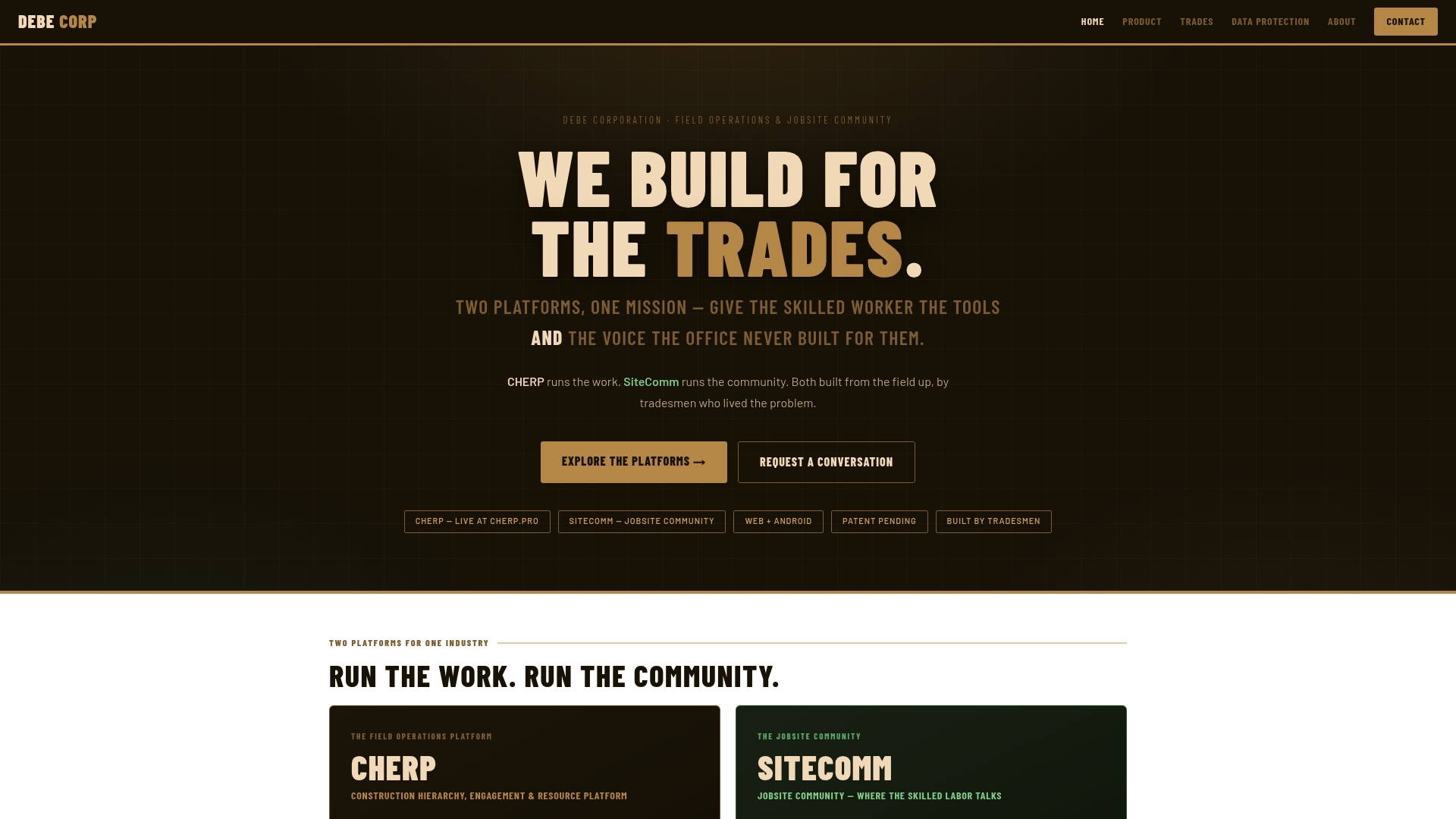
CHERP handles time and attendance, daily logs, and safety compliance in one connected platform, eliminating the paper-to-digital handoffs that create information delays. SiteComm addresses the communication gaps that leave crews and managers working from different versions of reality. Together, they give enterprise field teams the connected field operations they need to close the gap between what happens on site and what managers see in the office. Field managers ready to reduce repeat visits, cut scheduling waste, and improve first-time fix rates can explore both platforms at Debecorp.
FAQ
What are the most common enterprise field management challenges?
The three most common challenges are scheduling inefficiencies, poor information flow, and lack of real-time field visibility. These problems compound each other and require integrated solutions rather than isolated fixes.
How much revenue do scheduling inefficiencies cost field service teams?
Scheduling inefficiencies cause enterprises to lose 15–20% of billable hours. For a ten-technician team, that loss exceeds $300,000 annually.
Why does poor information flow hurt field productivity?
Information delays of 3–5 days prevent managers from intervening before small problems become large ones. Disconnected ERP and field systems also force duplicate data entry, which slows billing and increases compliance risk.
What is a good first-time fix rate for field service teams?
A first-time fix rate below 70% signals systemic problems with parts management or job data accuracy. Rates above 70% correlate with stronger margins and lower customer churn.
How does real-time visibility improve field operations?
Live GPS tracking and mobile job status updates let dispatchers reassign crews within minutes of a job completion, reducing idle time and improving on-time arrival rates for customers.