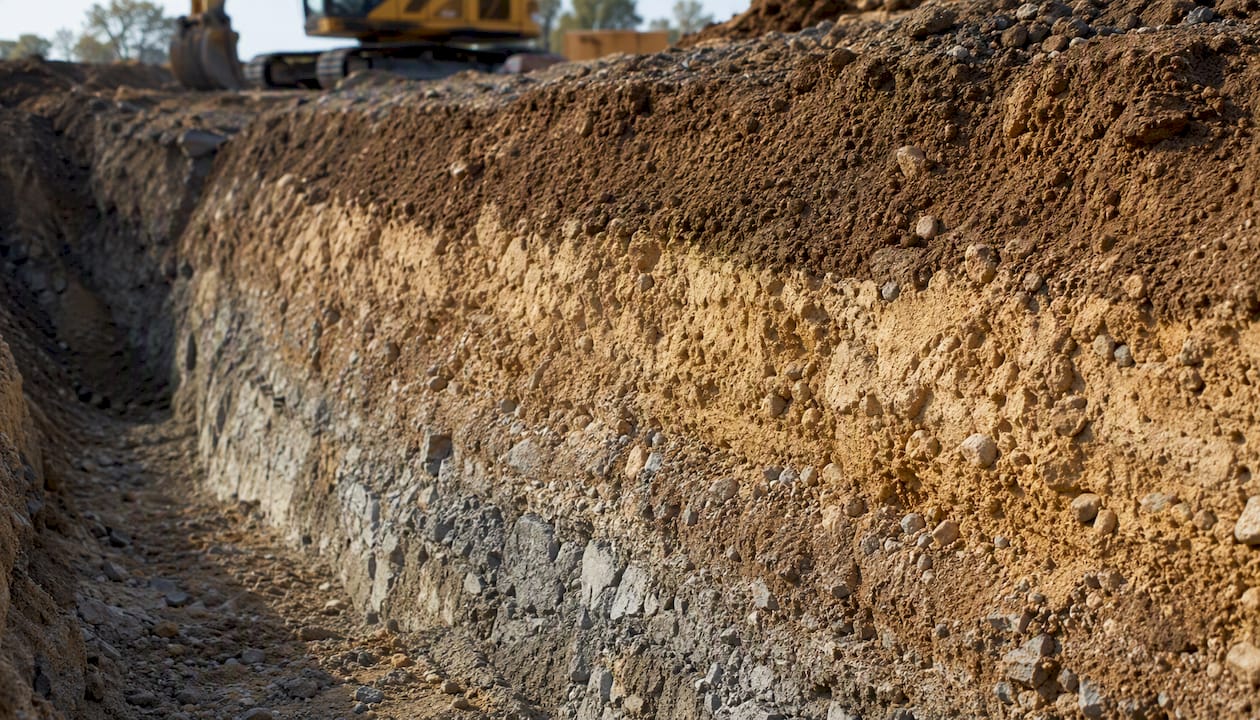
Table B-1 in OSHA 29 CFR 1926 Subpart P Appendix B sets the maximum allowable slope for any trench under 20 feet deep: vertical for stable rock, 3/4:1 for Type A soil, 1:1 for Type B, and 1 1/2:1 for Type C. A short-term exception lets you cut Type A soil to 1/2:1 on excavations 12 feet deep or less. Below those numbers, two depth triggers control everything else: at 5 feet, you need a protective system (sloping, benching, shoring, or shielding) unless you’re excavating in stable rock, and at 20 feet, that system must be designed by a registered professional engineer.
A few exceptions trip up even experienced crews. Benching is flatly prohibited in Type C soil, no matter the depth. Anyone working 4 feet down or deeper needs a compliant means of egress within 25 feet of lateral travel. Spoil piles and heavy equipment need to stay at least 2 feet back from the edge.
Quick-reference numbers a competent person should have memorized:
- Stable rock: vertical cut allowed
- Type A soil: 3/4:1 (53 degrees), or 1/2:1 short-term up to 12 feet
- Type B soil: 1:1 (45 degrees)
- Type C soil: 1 1/2:1 (34 degrees), benching never permitted
Key Takeaways
Trench slope requirements come down to matching soil classification to Table B-1’s H:V ratios and honoring the 5-foot and 20-foot depth thresholds without exception.
| Point | Details |
|---|---|
| Know your ratio | Type A allows 3/4:1, Type B needs 1:1, Type C requires 1 1/2:1; stable rock can stay vertical. |
| Watch the depth triggers | Protective systems are mandatory at 5 feet, and an engineer must design the system past 20 feet. |
| Never bench Type C | Benching is prohibited outright in Type C soil regardless of trench depth. |
| Reduce slope on distress signs | Cracks, bulging, or water at the face mean cutting back at least 1/2H:1V flatter than the table allows. |
| Document every inspection | A tool like CHERP centralizes daily soil checks, slope measurements, and timestamped photos for compliance records. |
Table of Contents
- What Are the Core OSHA Trenching Rules?
- How Does Soil Classification Determine Maximum Slope?
- How Do You Calculate the Correct Trench Slope?
- Benching Rules: How High Can Each Bench Be?
- When Should You Use Shoring or Shielding Instead of Sloping?
- What Should a Competent Person Check Every Day?
- What Are the Most Common Trenching Compliance Mistakes?
- Practical Perspective: Applying the Rules on Today’s Jobsites
- Keeping Trench Records Straight Without the Paperwork Chase
- Frequently Asked Questions
- Sources
What Are the Core OSHA Trenching Rules?
Every trench decision on a U.S. jobsite runs through the same handful of thresholds. Get these wrong and you’re either over-excavating for no reason or exposing a crew to a cave-in, which remains one of the deadliest hazards in construction.
- Depth triggers protection. At 5 feet or deeper, you need a protective system unless the trench sits entirely in stable rock. A competent person can still require protection below 5 feet if soil is wet, previously disturbed, or otherwise unstable, and OSHA treats that threshold as a floor, not a ceiling.
- Twenty feet means an engineer. Past 20 feet, tabulated data no longer cuts it. A registered professional engineer must design the protective system or approve site-specific data in writing.
- Egress can’t wait. Any excavation 4 feet deep or more needs a ladder, ramp, or steps positioned so no worker travels more than 25 feet laterally to reach one.
- Surcharge loads change the math. Spoil, parked equipment, adjacent structures, and even vibration from nearby traffic add load that can demand a flatter slope than the soil type alone would require.
- Spoil stays back. Keep excavated material and equipment at least 2 feet from the edge, further if the load is heavy or the soil is marginal.
- The competent person owns the call. Daily inspections, plus inspections after every rainstorm, vibration event, or visible change in soil condition, aren’t optional paperwork. They’re the mechanism that catches deterioration before it becomes a collapse.
Pro Tip: Write down your protective-system decision even when a trench is under 5 feet and you decide protection isn’t needed. That written judgment call, paired with a photo, is exactly what an OSHA compliance officer asks for after an incident.
How Does Soil Classification Determine Maximum Slope?
Soil type is the single variable that decides which row of Table B-1 applies to your trench, and misclassifying it is the most common way crews end up out of compliance without realizing it.
Stable rock is natural mineral matter you can excavate with vertical sides and it stays intact. Type A is cohesive soil like clay, silty clay, or hardpan with an unconfined compressive strength of 1.5 tons per square foot or greater, but it drops to Type B if it’s fissured, previously disturbed, subject to vibration, or has water seeping through it. Type B covers cohesive soil between 0.5 and 1.5 tons per square foot, or previously disturbed soil that doesn’t meet Type A or C criteria. Type C is the least stable: granular soil like sand or gravel, soil with water flowing through it, or anything below 0.5 tons per square foot.
| Soil or Rock Type | Maximum Allowable Slope (H:V) | Approximate Angle |
|---|---|---|
| Stable rock | Vertical | vertical |
| Type A | 3/4:1 | 53 degrees |
| Type A (short-term, 12 ft or less) | 1/2:1 | 53 degrees |
| Type B | 1:1 | 45 degrees |
| Type C | 1 1/2:1 | 34 degrees |
A layered profile gets classified by its weakest layer, always. If you’ve got Type A clay sitting on top of Type C sand, the whole cut is treated as Type C for slope purposes, per the OSHA Technical Manual.
Common misclassification traps worth checking before you cut:
- Assuming last month’s soil report still applies after a rain event
- Treating previously excavated and backfilled soil as undisturbed Type A
- Missing fissures or seepage that would downgrade Type A to Type B
- Ignoring vibration from nearby traffic, generators, or compaction equipment
Pro Tip: Run a simple thumb penetration test or pocket penetrometer check at multiple points along the trench, not just at one end. Soil conditions can shift dramatically over even 20 feet of run, especially near old utility cuts.
How Do You Calculate the Correct Trench Slope?
The H:V ratio tells you how many feet of horizontal cutback you need for every foot of vertical depth. A 1:1 slope in Type B soil means 1 foot of horizontal distance for every foot down. A 1 1/2:1 slope in Type C means 1.5 feet horizontal for every foot of depth.
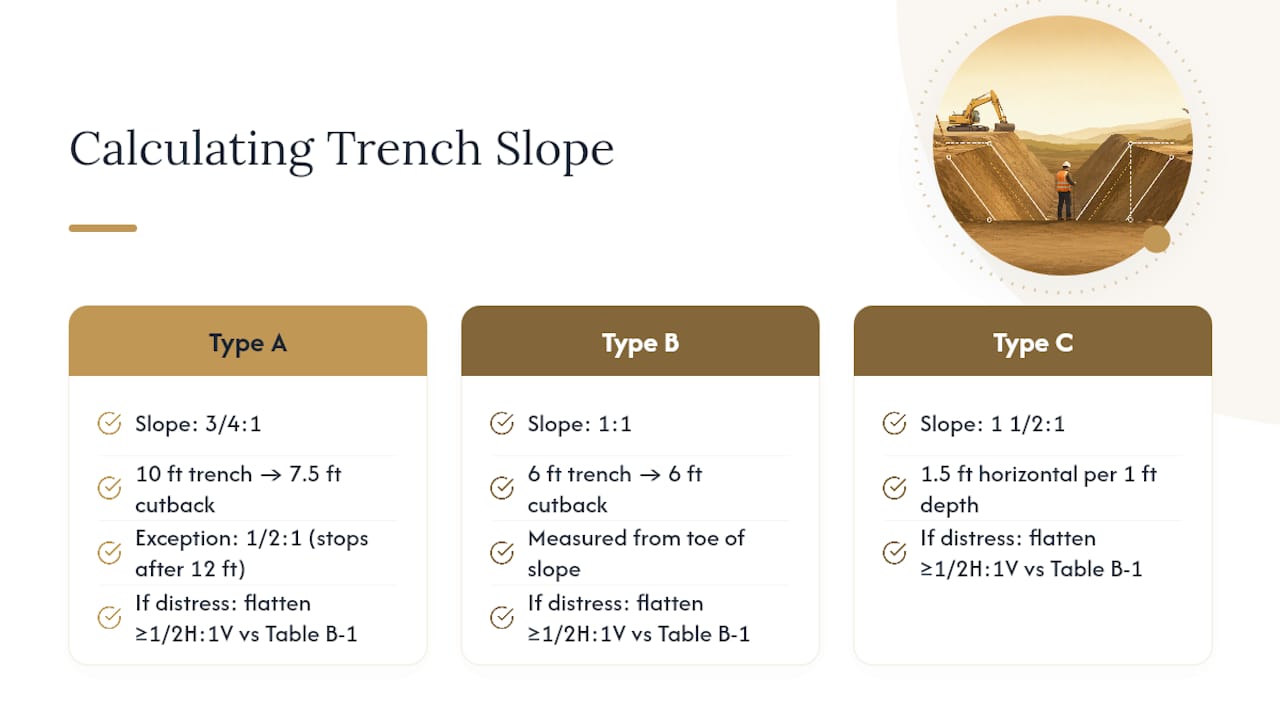
Two examples make this concrete. A 6-foot trench in Type B soil needs 6 feet of horizontal cutback on each side, measured from the toe of the slope, since the ratio is 1:1. A 10-foot trench in Type A soil under the standard 3/4:1 ratio needs 7.5 feet of cutback; the short-term 1/2:1 exception doesn’t help much here since it only tightens the ratio, and it stops applying past 12 feet anyway.
Signs of distress override the math. Tension cracks, bulging at the toe, slumping, or water seeping through the face all mean the slope needs to be cut back at least 1/2H:1V flatter than whatever Table B-1 allows for that soil type. Don’t wait for a second sign.
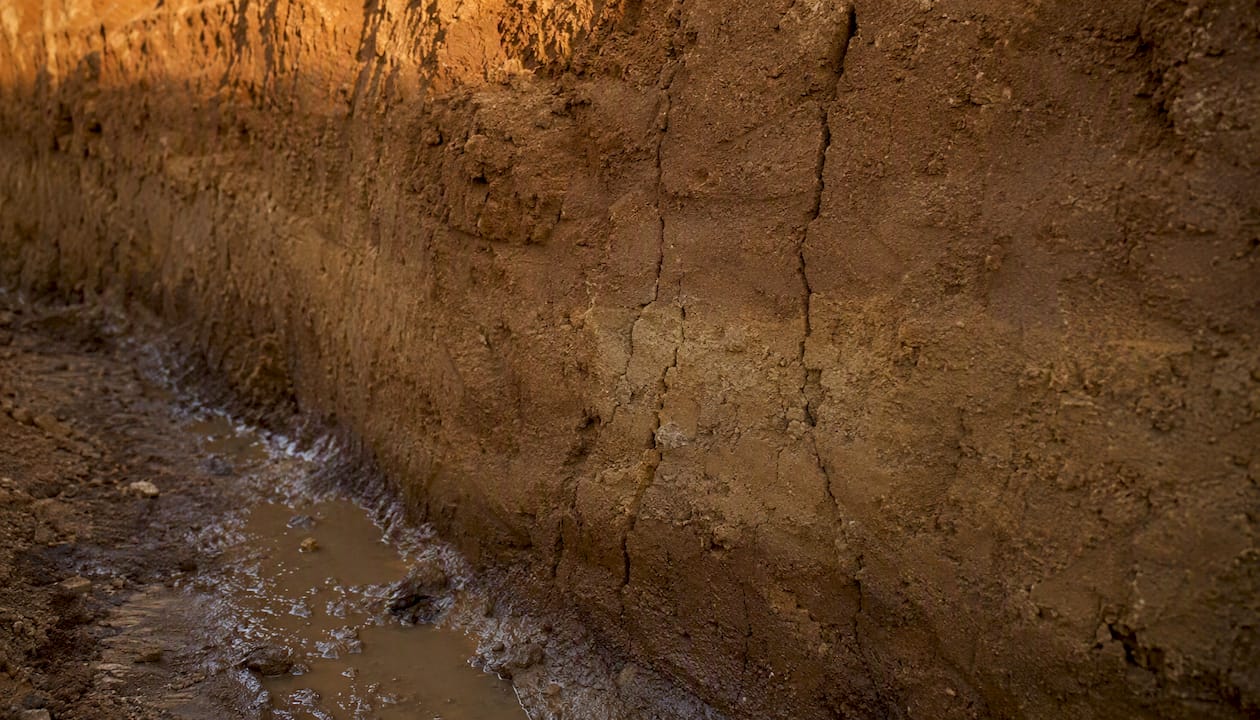
Surcharge loads near the edge, parked excavators, stacked pipe, a haul road running parallel to the cut, demand the same response: flatten the slope or move the load back. When multiple loads stack up (heavy equipment plus vibration plus water), that’s the point to loop in a registered professional engineer rather than eyeballing an adjustment.
Benching Rules: How High Can Each Bench Be?
Benching lets you step a trench wall back in stages instead of cutting one continuous slope, and it’s often the practical choice on tight urban sites where a full slope would eat too much surface area.
The numbers are fixed. The first bench, the one closest to the trench bottom, cannot exceed 4 feet in vertical height in any soil type where benching is permitted. Subsequent benches can go up to 5 feet in Type A soil or 4 feet in Type B soil, and the total benched depth can’t exceed 20 feet without engineering.
- Type A soil: first bench up to 4 ft, subsequent benches up to 5 ft each
- Type B soil: first bench up to 4 ft, subsequent benches up to 4 ft each
- Type C soil: benching prohibited outright, regardless of depth or configuration
That prohibition isn’t a technicality. Type C soil lacks the cohesion to hold a stepped face; the vertical portion of each bench acts like a mini vertical cut in material that wants to slough off, which is exactly the failure mode benching is supposed to avoid.
Single benching (one step) works fine for shallower cuts. Multiple benching stacks several steps and needs each one to sit within the overall slope envelope, not just meet its own individual height limit. When soil is marginal, mixed, or you’re not fully confident in the classification, sloping the full face is the more forgiving choice over benching. Shielding beats both when the trench is deep, narrow, or surrounded by utilities you can’t disturb.
When Should You Use Shoring or Shielding Instead of Sloping?
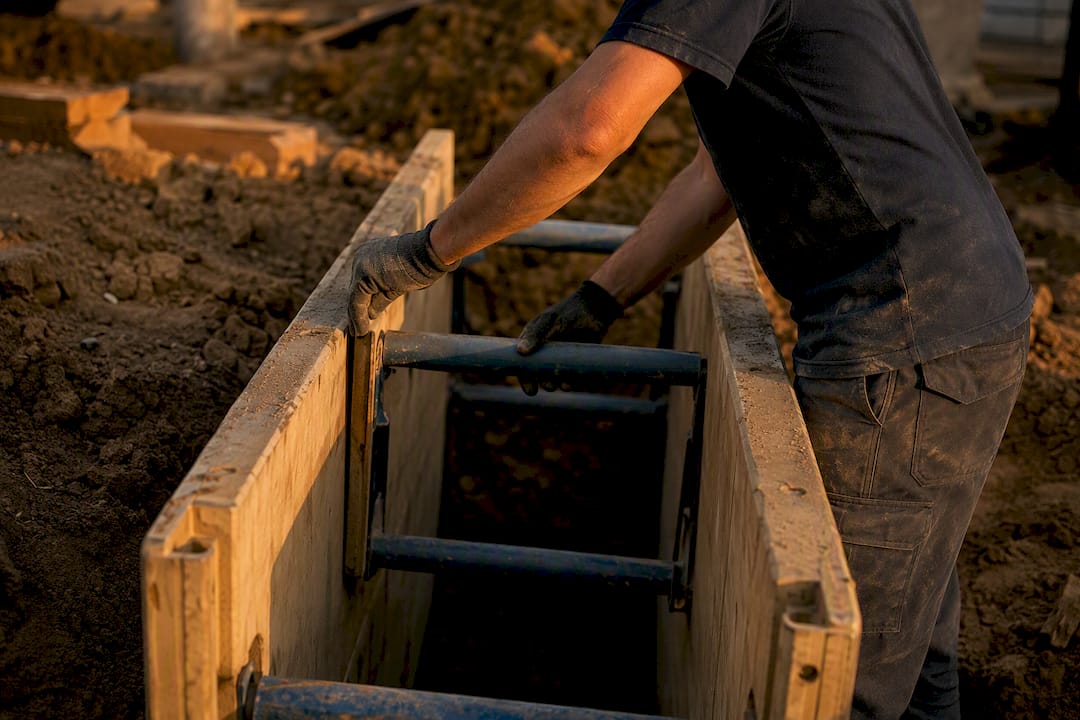
Shoring supports the trench wall structurally, hydraulic or timber systems installed before or during excavation. Shielding, most commonly a trench box, protects workers inside a rated cage without altering the soil face at all. Both let you excavate near-vertical walls where sloping back would consume too much room or isn’t structurally reasonable.
- Trench boxes work well for linear utility runs where you can advance the box as pipe goes in
- Shoring suits sites with limited footprint where a shield can’t fit or maneuver
- Combining a shield with a sloped upper section is common on deep excavations to limit total excavation volume
When you combine a trench box with a sloped upper wall, the box needs to extend at least 18 inches above the top of the vertical portion if the slope angles toward the excavation. Skip that clearance and you’ve created a roll-in hazard: material sliding down the slope has nowhere to go but into the trench.
Past 20 feet, none of these systems can rely on tabulated data alone. A registered professional engineer has to design the shoring, the shield capacity, or approve project-specific tabulated data in writing before anyone enters.
Sequencing matters as much as selection. Install shields before workers enter and remove them from the bottom up as backfill progresses, never leave a box in place while equipment works directly above the open trench edge.
What Should a Competent Person Check Every Day?
The competent person is the OSHA-designated individual authorized to identify hazards and empowered to stop work or order corrective action, and trench slope compliance lives or dies on how seriously that role gets taken.
Daily and post-condition-change inspection items:
- Soil classification, re-verified, not assumed from yesterday’s log
- Slope angle or bench dimensions measured against the applicable Table B-1 ratio
- Protective system integrity: shoring intact, shield undamaged, no gaps
- Egress access within the 25-foot lateral travel limit
- Spoil and equipment distance from the edge (2 feet minimum)
- Atmospheric testing where hazardous gases are plausible
- Water accumulation or seepage at the trench face
Order corrective action immediately if you spot tension cracks, bulging, water infiltration, nearby vibration sources, or any surcharge load that wasn’t there at the last inspection.
A usable field log records: date and time, inspector name, soil type and how it was verified, slope H:V ratio or bench dimensions, protective system in use, and any corrective action taken.
Pro Tip: Timestamp every inspection photo and note the exact station or landmark it corresponds to. A folder of undated trench photos is nearly worthless in an OSHA records request; a timestamped, location-tagged sequence is your best defense.
What Are the Most Common Trenching Compliance Mistakes?
Most citations trace back to a small set of repeated errors, not exotic edge cases.
- Classifying soil once at the start of the job and never rechecking after rain or excavation progress
- Benching in Type C soil because it “looked stable enough”
- Placing spoil or equipment inside the 2-foot buffer, especially on narrow sites
- Skipping daily inspections when the crew is “just finishing up” a trench opened days earlier
- Missing egress within 25 feet on a long linear trench
Enforcement almost always centers on documentation gaps: no evidence of a competent person’s daily inspection, no written record of the soil classification method used, or no RPE sign-off on a trench that clearly exceeded 20 feet. OSHA inspectors typically ask for the inspection log first and the physical trench second.
Practical Perspective: Applying the Rules on Today’s Jobsites
The numbers in Table B-1 are a floor for judgment, not a substitute for it. When soil conditions are ambiguous or the site has layered fill, deciding the safe path is what separates a competent person from someone who just read the regulation.
Bring in a registered professional engineer early, not after a problem surfaces, on anything near utilities, deeper than 15 feet, or squeezed into a tight urban lot.
Keeping Trench Records Straight Without the Paperwork Chase
Most competent persons don’t fail because they don’t know the numbers. They fail because the daily inspection got logged on a paper form that ended up crumpled in a truck cab, or the corrective-action photo never made it off someone’s personal phone.

CHERP, one of the field operations platforms built by Debecorp, gives crews a structured daily log built for exactly this kind of record: soil classification, slope H:V ratio, protective system in use, and a timestamped photo attached to the entry instead of floating loose in a camera roll. Log a Type B classification on a 6-foot trench, attach the photo of the sloped face, note the protective system, and it’s stored centrally where the whole crew and the safety manager can see it, not buried in a group chat. That kind of centralized record is also what helps a project manager catch a condition change before it becomes a bigger problem.
None of this replaces the competent person’s judgment on site or the engineering sign-off a trench past 20 feet requires. What it does is make sure the decision, once made, survives contact with an OSHA records request. Take a look at what CHERP and SiteComm cover for daily logs and safety compliance.
Frequently Asked Questions
What is the maximum slope allowed for a trench under OSHA? It depends on soil type: stable rock can be vertical, Type A allows 3/4:1, Type B requires 1:1, and Type C requires 1 1/2:1, per Table B-1 in Appendix B.
At what depth does OSHA require a protective system? Protective systems are required at 5 feet or deeper unless the excavation is entirely in stable rock. Below 5 feet, the competent person can still require one if conditions look unstable.
When does a trench need an engineer-designed system? Once a trench reaches 20 feet, tabulated data alone isn’t sufficient. A registered professional engineer must design the protective system or approve site-specific data in writing.
Can you bench a trench in Type C soil? No. Benching is not permitted in Type C soil under any circumstance because the soil lacks the cohesion to support a stepped vertical face.
How far must spoil and equipment stay from a trench edge? At least 2 feet, though a heavier load or marginal soil condition may call for greater distance to prevent surcharge-induced collapse.
Sources
- 1926 Subpart P App B - Sloping and Benching | Occupational Safety and Health Administration
- Excavations benching and sloping toolbox safety talk | Cornell EHS
- Trenching and Excavation Safety (OSHA fact sheet)
- OSHA Technical Manual (OTM) - Section V: Chapter 2