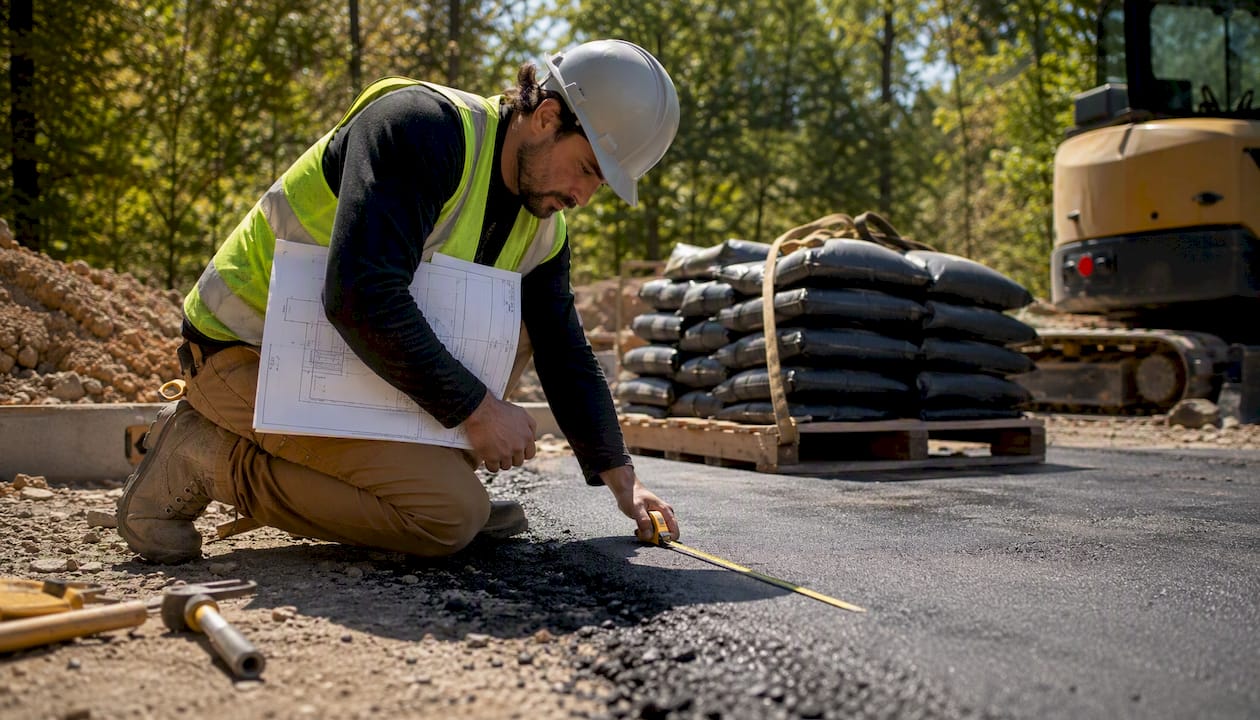
Tonnage = (area ft² × thickness in ÷ 12 × 145 lb/ft³) ÷ 2,000. For a 24 × 40 ft driveway at 3 inches compacted, calculate the tonnage by applying the formula (area × thickness in feet × 145) ÷ 2,000, which estimates the weight before waste. Add a 5–7% waste factor and you’re ordering roughly 19 tons for this driveway, rounded to the plant’s full-ton minimum increment. The three variables that move the final bid most are material cost per ton, labor per square foot, and project scope — and those three together are what separates a tight estimate from a change-order nightmare. Store your calculator template in CHERP or SiteComm so every estimator on your crew pulls from the same verified formula.
Table of Contents
- How does the asphalt driveway cost calculator formula work?
- Worked example: 24 × 40 ft driveway at 3 inches
- How do you convert tons into a full installed job price?
- Why do two same-size driveways get different quotes?
- How do you build a spreadsheet calculator template?
- How do CHERP and SiteComm store your calculator templates?
- What should you check on-site before ordering asphalt?
- Key Takeaways
- Why embedded calculators belong at the crew level
- Keep your asphalt calculator and plant tickets in one place
How does the asphalt driveway cost calculator formula work?
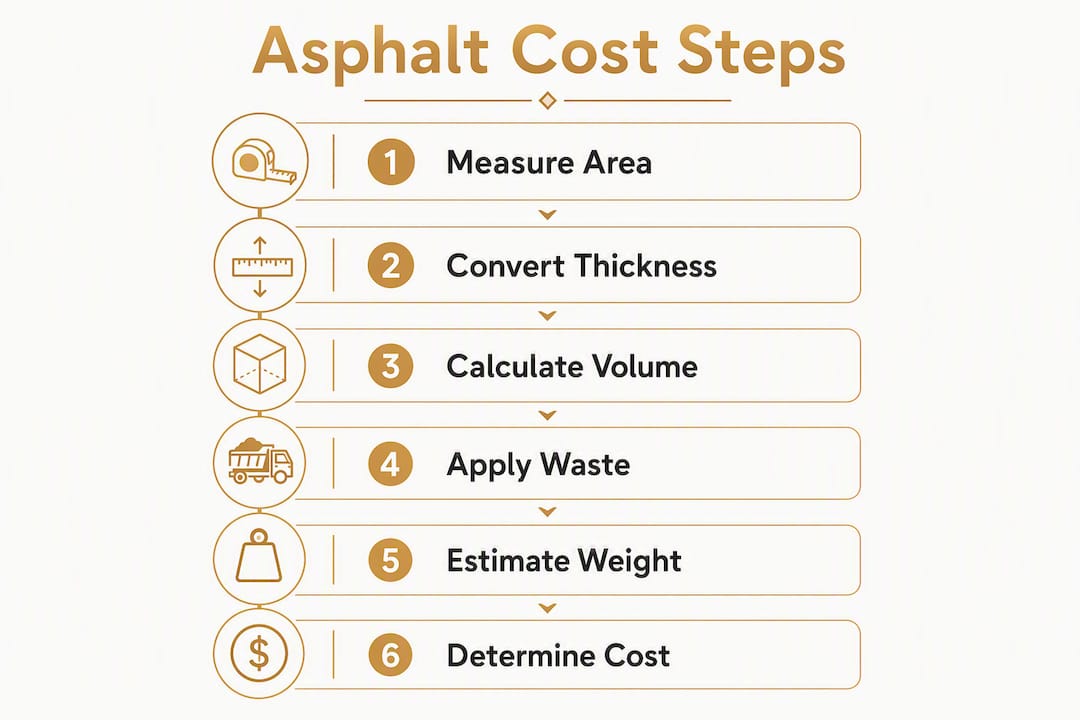
The math runs in five steps. Work through them once, build them into a spreadsheet, and you’ll never back-calculate tonnage from a plant ticket again.
- Measure area: Length (ft) × Width (ft) = Area (ft²)
- Convert thickness: Thickness (in) ÷ 12 = Thickness (ft)
- Calculate volume: Area (ft²) × Thickness (ft) = Volume (ft³)
- Convert to pounds: Volume (ft³) × 145 lb/ft³ = Weight (lb)
- Convert to tons: Weight (lb) ÷ 2,000 = Compacted tons
The 145 lb/ft³ density is the planning standard for dense-graded hot-mix asphalt (HMA). It’s a compacted-layer assumption — not a loose-load figure. Your plant ticket will show loose tons, which run slightly higher due to compaction yield. Always confirm the mix-specific yield with your supplier before placing the order.
Apply a 5–7% waste factor for straight rectangular driveways; bump it to 8–10% for curved edges, tight aprons, or heavy handwork areas. Round your final order up to the plant’s minimum load increment — many plants work in half-ton steps.
| Conversion | Formula |
|---|---|
| Inches to feet | in ÷ 12 |
| Cubic feet to cubic yards | ft³ ÷ 12 |
| Pounds to US tons | lb ÷ 2,000 |
| Compacted tons to loose tons | compacted tons ÷ compaction yield (typically 0.92–0.95) |
Pro Tip: Ask the plant for the mix’s compaction yield ratio when you pick up tickets. If the yield is 0.93, divide your compacted tons by 0.93 to get the correct loose-ton order quantity. Missing this step is the most common cause of short loads on residential jobs.
Worked example: 24 × 40 ft driveway at 3 inches
Here’s the full walk-through for a standard two-car driveway. Replicate this in your spreadsheet and you can validate any plant ticket in under a minute.

| Step | Calculation | Result |
|---|---|---|
| Area | 24 ft × 40 ft | — |
| Thickness (ft) | 3 in ÷ 12 | 0.25 ft |
| Compacted tons | — | 18.6 tons |
| With 7% waste | 18.6 × 1.07 | 19 tons (order quantity, rounded up) |
| Material cost at $120/ton calculated by multiplying the order quantity by the price per ton. | ||
| Material cost at $145/ton calculated by multiplying the order quantity by the price per ton. |
Round the order to 19 tons if the plant’s minimum increment is a full ton. Many plants set a short-load surcharge below 5 tons, so this job clears that threshold easily. The $120–$145/ton range reflects Midwest to Northeast planning bands — confirm current pricing with your local plant before bidding.
How do you convert tons into a full installed job price?
Material is only part of the number. Asphalt material typically runs 30–50% of total installed cost; labor, equipment, mobilization, and overhead cover the rest. Build your bid line by line.
- HMA material: tons × $/ton (your plant quote)
- Aggregate base: $1.50–$2.50/ft² for a standard 6-inch compacted base
- Demo and haul-off: $1.40–$2.20/ft² for asphalt tear-out; $2.40–$3.10/ft² for concrete
- Labor and equipment placement: $1.20–$1.80/ft²
- Tack coat: $0.10–$0.25/ft² — cheap to include, expensive to skip (delamination in 12–18 months without it)
- Edge work and hand work: $150–$500 flat depending on linear footage
- Mobilization: $350–$800 for local crews; $800–$1,400 for longer hauls
- Permits and disposal: varies by municipality — confirm before bidding
- Overhead and profit: 12–18% on private work; 15–25% on public prevailing-wage jobs
- Contingency: 5–10% buffer on top of subtotal
For planning purposes, new residential installation runs $7–$15/ft² installed; resurfacing runs $3–$7/ft²; sealcoat alone is $0.50–$1.30/ft². Regional $/ton bands for 2026:
| Region | $/ton (plant gate) |
|---|---|
| Northeast | $120–$145 |
Source: Asphapro regional cost data
Assumptions block: These planning bands assume standard subgrade, no major drainage work, and a haul distance under 20 miles. Major subgrade remediation, retaining walls, or utility conflicts are change-order items — not included here.
Present bids as itemized line items, not lump sums. A customer who sees one number will compare it to the lowest quote they got. A customer who sees six lines understands what they’re buying.
Why do two same-size driveways get different quotes?
Sub-base condition, haul distance, and local labor demand are the three biggest variables — and none of them show up in a simple $/ft² benchmark. A driveway on clay soil in a freeze-thaw climate needs 6–8 inches of compacted base. The same footprint on sandy soil in the Southeast might need 4 inches. That difference alone can shift the bid by $1.50–$2.00/ft².
Paving seasons are shorter in the Northeast (roughly April through November) versus year-round in the Southeast. Shorter seasons compress demand, raise mobilization costs, and push $/ton higher. A contractor bidding in Boston in May is competing for plant capacity in a way a Florida contractor never does.
Small jobs carry disproportionately high $/ft² because mobilization is a fixed cost. On a 300 ft² driveway, mobilization can represent 18–26% of the total. On a 2,500 ft² job, it drops to 3–5%. If you’re bidding a small residential job, ask whether you can coordinate with a nearby job the same week and share the mobilization cost.
Pro Tip: Before you finalize a bid, ask the customer two questions: Has this driveway had drainage problems? and Is there an existing base or was it gravel? Those two answers will tell you whether you’re looking at a standard job or a subgrade remediation situation.
How do you build a spreadsheet calculator template?
Set up these columns in Excel or Google Sheets. Lock the constant cells (density = 145, waste default = 7%) so estimators can’t accidentally overwrite them.
| Column | Formula / Input | Notes |
|---|---|---|
| Length (ft) | Input | — |
| Width (ft) | Input | — |
| Area (ft²) | =Length × Width | — |
| Thickness (in) | Input | Default: 3 |
| Thickness (ft) | =Thickness(in) ÷ 12 | — |
| Volume (ft³) | =Area × Thickness(ft) | — |
| Compacted tons | =Volume × 145 ÷ 2,000 | Lock density cell |
| Waste % | Input | Default: 7% |
| Order tons | =Compacted tons × (1 + Waste%) | Round up to plant increment |
| $/ton | Input | Pull from plant quote |
| Material total | =Order tons × $/ton | — |
| Labor ($/ft²) | Input | Regional default |
| Mobilization ($) | Input | Flat fee |
| Contingency % | Input | Default: 10% |
| Total bid | =Sum × (1 + Contingency%) | — |
Ordering checklist before you call the plant:
- Confirm mix design (surface course vs. binder course)
- Verify plant minimum tonnage and short-load fee threshold
- Confirm delivery window and lead time
- Ask for compaction yield ratio for the specific mix
- Confirm tack coat requirements for the base interface
- Check whether the plant accepts CSV or XLSX for ticket reconciliation
Export the template as CSV or XLSX for import into CHERP or SiteComm. Keep one master template per trade and duplicate it per job — never edit the master.
How do CHERP and SiteComm store your calculator templates?
The workflow is straightforward: save the master template in CHERP, duplicate it when a new job opens, attach the plant ticket and site photos to that job’s record, and update actual tons after the pour. Your estimator’s planned quantity and the foreman’s actual delivery are in the same place, timestamped.
Storing per-trade calculators in field software and capturing actual yield against planned quantities is the fastest way to build a local $/ton and waste-factor database that actually reflects your crews and your plants — not national averages.
CHERP’s per-trade field calculators support exactly this workflow. Role-based access means estimators can edit the template fields, while foremen see the locked version and attach delivery tickets. SiteComm handles the crew-side communication — if the plant changes the delivery window, the foreman gets it in the same platform where the job record lives.
Pro Tip: Track actual yield vs. planned yield on every job for six months. You’ll quickly see whether your local plant runs 0.92 or 0.95 compaction yield — and that difference, applied to a 20-ton order, is nearly half a ton of material cost you’re either over- or under-bidding.
What should you check on-site before ordering asphalt?
Run through this list before you call the plant. A short load costs more than the extra tons you would have ordered.
- Re-measure the area. Split any irregular shapes into rectangles and sum them.
- Confirm compacted thickness with the customer and your crew lead — in writing.
- Walk the edge work. Measure linear footage of hand-work edges separately.
- Check access. Can the dump truck reach the pour zone without a long push?
- Verify the plant’s minimum tonnage for the delivery window you need.
- Photograph the existing surface and any soft spots before demo begins.
- Confirm haul-off destination and whether disposal fees apply.
Garage aprons and curved edges get their own waste factor — use 8–10% for those sections rather than the standard 7%. Add them as a separate line in your spreadsheet so the overage is visible, not buried in the main calculation.
Pro Tip: Take a quick sketch of the driveway with dimensions noted and attach it to the job record in CHERP before you leave the site. When the plant calls to confirm tonnage, you have the sketch, the calculation, and the customer sign-off in one place.
Key Takeaways
Accurate asphalt tonnage starts with (area × thickness in feet × 145 lb/ft³) ÷ 2,000, plus a 5–7% waste factor; round up to the next full ton for ordering.
| Point | Details |
|---|---|
| Core formula | Tons = (ft² × thickness ft × 145) ÷ 2,000; add 5–7% waste before ordering. |
| Material is 30–50% of total | Labor, base, mobilization, and overhead make up the rest — always bid all line items. |
| Regional $/ton varies | Northeast runs $120–$145/ton; Southeast —/ton — confirm with your local plant. |
| Small jobs cost more per ft² | Mobilization is fixed; on a 300 ft² drive it can hit 18–26% of total installed cost. |
| Debecorp CHERP/SiteComm | Store calculator templates, attach plant tickets, and track actual vs. planned yield per job. |
Why embedded calculators belong at the crew level
Most estimating errors don’t happen because someone got the formula wrong. They happen because the formula lived in one person’s spreadsheet, on one laptop, and the foreman on-site was working from memory or a printed sheet that hadn’t been updated since the last job. The gap between the estimate and the pour is where short loads, change orders, and margin erosion actually originate.
The trades-led design philosophy behind CHERP and SiteComm came directly from that reality. Calculators that live in field software — accessible to the estimator, the foreman, and the project manager, with role-based editing and ticket attachment — close that gap structurally, not just procedurally. Tracking labor productivity and actual material yield in the same platform where the estimate lives means your next bid is better than your last one, automatically.
Keep your asphalt calculator and plant tickets in one place
Estimating the tonnage is the easy part. The hard part is making sure the number that left your desk is the number the foreman ordered and the number the plant delivered. CHERP and SiteComm solve that handoff problem directly: store your calculator template, attach the plant ticket, and sync actuals to the project cost line — all in one platform built for the trades.

The result is fewer short loads, tighter yield tracking, and a bid-to-field handoff that doesn’t depend on someone forwarding the right spreadsheet version. Every job you run through the platform adds to a real local database of $/ton and waste factors that makes your next estimate sharper than your last.
Ready to see how it works for your crew? Explore CHERP and SiteComm and request a demo for your organization.